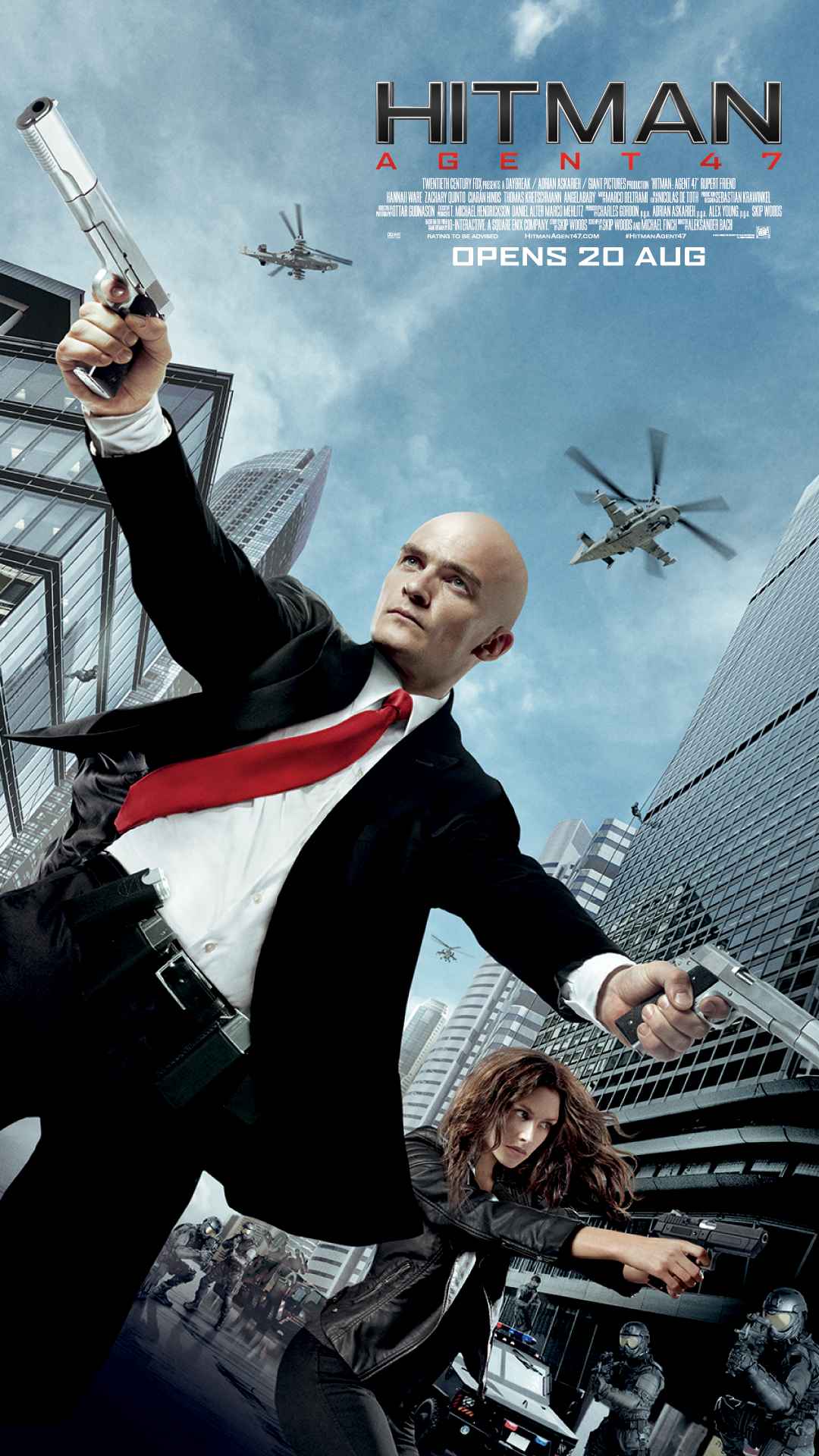
Hitman: Agent 47

Genre: Action

Director: Aleksander Bach

Screenplay: Skip Woods, Michael Finch

Cast: Rupert Friend, Hannah Ware, Zachary Quinto, Ciaran Hinds, Thomas Kretschmann, Angelababy

Running Length: 96 minutes

Synopsis: Hitman: Agent 47 centers on an elite assassin who was genetically engineered from conception to be the perfect killing machine, and is known only by the last two digits on the barcode tattooed on the back of his neck. He is the culmination of decades of research – and forty-six earlier Agent clones – endowing him with unprecedented strength, speed, stamina and intelligence. His latest target is a mega-corporation that plans to unlock the secret of Agent 47’s past to create an army of killers whose powers surpass even his own. Teaming up with a young woman who may hold the secret to overcoming their powerful and clandestine enemies, 47 confronts stunning revelations about his own origins and squares off in an epic battle with his deadliest foe.

Review: Video game to movie adaptations have generally not gone well, and for the Hitman videogame, there was even a poorly-received precedent set in 2007. Flash forward almost a decade later, and it’s time for yet another movie franchise to be rebooted. Agent 47 is likely to elicit a higher interest level locally, simply because parts of the movie were shot on location in Singapore, and let’s face it – there is always a little bit of a cheap thrill when you see familiar landmarks on the big screen, especially in an international blockbuster.

This is not a film that will please fans of the Hitman videogames, simply because it chooses to forgo the stealth element that was an essential component to the videogames. More often than not Agent 47 feels more like a younger, supercharged John McClane, coming out with guns blazing and blowing brains out along the way, and earning the film its NC-16 rating. As an action film, it is a rather generic one, though with a number of pretty decent action set-pieces that serve to move the film along nicely. The CG, unfortunately, is quite unimpressive, though Bach seems to try to mitigate this by employing a copious amount of quick cuts during most of the action scenes.

Apart from the lack of a coherent plot, one of the most glaring faults of Hitman: Agent 47 is how blatant the product placements are. It is clear that Audi must have spent a pretty penny for all the exposure in the film, but even the Singapore portions of the film resemble a promotional video rather than being vital to the film. Was there a need to show Hannah Ware swimming in the (an admittedly gorgeous) infinity pool of a five-star hotel, or to arrange a meeting at (again, admittedly gorgeous) Gardens by the Bay if it was intended to be a clandestine one? More disappointingly, for a film that must have been substantially bankrolled by Singapore, there seems to be only one discernable local actress involved in the film, and even then only as an extra in a very short sequence.

While Rupert Friend makes for a rather effective Agent 47 (this was a role that apparently was intended for Paul Walker before his death), the rest of the cast is bland and forgettable, and Zachary Quinto and Ciaran Hinds in particular feel criminally underused. Although the end credits sequence sets the stage for a potential sequel, it’s hard to imagine this film garnering enough interest or box office for the studios to consider a follow-up.

Rating: * * (out of four stars)

Standard

Pixels

Genre: Comedy

Director: Christopher Columbus

Screenplay: Tim Herlihy, Timothy Dowling

Cast: Adam Sandler, Kevin James, Michelle Monaghan, Peter Dinklage, Josh Gad, Brian Cox, Sean Bean

Running Length: 105 minutes

Synopsis: As kids in the 1980s, Sam Brenner (Adam Sandler), Will Cooper (Kevin James), Ludlow Lamonsoff (Josh Gad), and Eddie “The Fire Blaster” Plant (Peter Dinklage) saved the world thousands of times – at 25 cents a game in the video arcades. Now, they’re going to have to do it for real. In Pixels, when intergalactic aliens discover video feeds of classic arcade games and misinterpret them as a declaration of war, they attack the Earth, using the video games as the models for their assaults – and now-U.S. President Cooper must call on his old-school arcade friends to save the world from being destroyed by PAC-MAN, Donkey Kong, Galaga, Centipede, and Space Invaders. Joining them is Lt. Col. Violet Van Patten (Michelle Monaghan), a specialist supplying the arcaders with unique weapons to fight the aliens.

Review: The only reason that Pixels gets a passing grade from me is because of the nostalgia it taps into – after all, the 80s video games that the film so relentlessly references formed part of my childhood. Thus, in spite of the paper-thin, messy plot and the lack of any quality acting, I must admit that there were parts of Pixels that I enjoyed. However, the same probably can’t be said of the majority of the moviegoers that would attempt to watch this film.

The premise that aliens chose to attack Earth because of arcade game footage found in an interstellar time capsule is a thin one, and the seams constantly show in Pixels. Stretching out a two-minute short film (that the story is based on) into an almost two-hour movie is ill-advised in this case, and the absolute paucity of plot means the show wears out its welcome very quickly. There’s absolutely no effort to give any background to the attacking aliens, which makes much of the proceedings rather meaningless, carrying no dramatic weight at all. The aliens may be threatening the total annihilation of Earth, but it never feels like anything is at stake.

While Adam Sandler has honed his portrayal of the sullen man-child to perfection over a good number of films, the rest of the casting leaves much to be desired. Josh Gad is unendingly grating and annoying, while Peter Dinklage doesn’t make much of an impression apart from the weird accent he chose to adopt for his role. Michelle Monaghan is given the totally thankless role of playing Sandler’s love interest, and the absolute lack of chemistry between the duo makes the romantic sequences truly cringe-worthy to sit through.

Fortunately, the visual effects are decent enough, especially during the live-action videogame battles. For viewers that grew up in the 80s, it will be fun to look out for videogame icons like Donkey Kong, Mario, Q*Bert, Frogger, Paperboy and more. However, Wreck-It Ralph has already done a much better job back in 2012 integrating these into a movie, and boasts a far stronger plot, despite being an animated film. There’s really only that much nostalgic good-will that one can tap into, and even for myself I was scraping the bottom of the barrel barely halfway through the movie.

Rating: * * (out of four stars)

Standard

Hot Pursuit

Genre: Comedy

Director: Anne Fletcher

Screenplay: David Feeney, John Quaintance

Cast: Sofía Vergara, Reese Witherspoon, Jodi Lyn Brockton, Matthew Del Negro, Michael Mosley

Running Length: 87 minutes

Synopsis: An uptight and by-the-book cop (Reese Witherspoon) tries to protect the sexy and outgoing widow of a drug boss (Sofia Vergara) as they race through Texas pursued by crooked cops and murderous gunmen.

Review: I really wanted to like Hot Pursuit. After all, action comedies with female leads are few and far between, and Reese Witherspoon and Sofia Vergara are both likable actors. This also happens to be Vergara’s first proper lead role in a movie, which is kind of surprising given the success she has found off hit TV sitcom Modern Family. Although there are laughs to be had, Hot Pursuit is more lukewarm than hot, the result of minimal chemistry between the leads and a script that simply doesn’t do enough. Hot Pursuit runs a short 87 minutes but still feels laboured before the final reel, and even the gags feel like they have run their course an hour into the film.

It appears from the end-credit outtakes that Witherspoon and Vergara not only had a great time making the film, but that they seem to have developed what seems like a rather healthy camaraderie as well. Unfortunately, I doubt that viewers could tell that from the main feature itself – there are barely any sparks between the two despite sharing significant screen time. It also annoys me that – without going into too much detail for risk of spoilers – the screenplay tries its best to create a will-they-stay-or-will-they-go tension between the odd couple, creating scenarios that then limply resolve themselves in a matter of minutes without making any actual impact to the pairing.

It also seems like half the jokes seem to be about either Witherspoon’s height and boyish (??) looks or Vergara’s age and Latina heritage, and neither actress makes even a concerted effort to rise above the mediocre and rather lazy writing. They are content to play to their characters’ stereotypes, and this is really the essence of why Hot Pursuit doesn’t work that well despite low expectations: nothing comes across as being particularly genuine and as a result it just doesn’t engage enough. When the same joke gets recycled for the fifth time in an hour, even the funniest gag starts to feel like a lame duck.

The audience is never truly vested in what happens to either woman, and since this is a comedy everyone already knows what the eventual outcome would be. The journey is indeed more important than the destination, and in this case the journey just isn’t all that interesting. As a low budget contender for Summer, Hot Pursuit will definitely get its fair share of moviegoers, but given that both Witherspoon and Vergara have producer credits on this film, I really expected it to deliver more than it did.

Rating: * * (out of four stars)

Standard

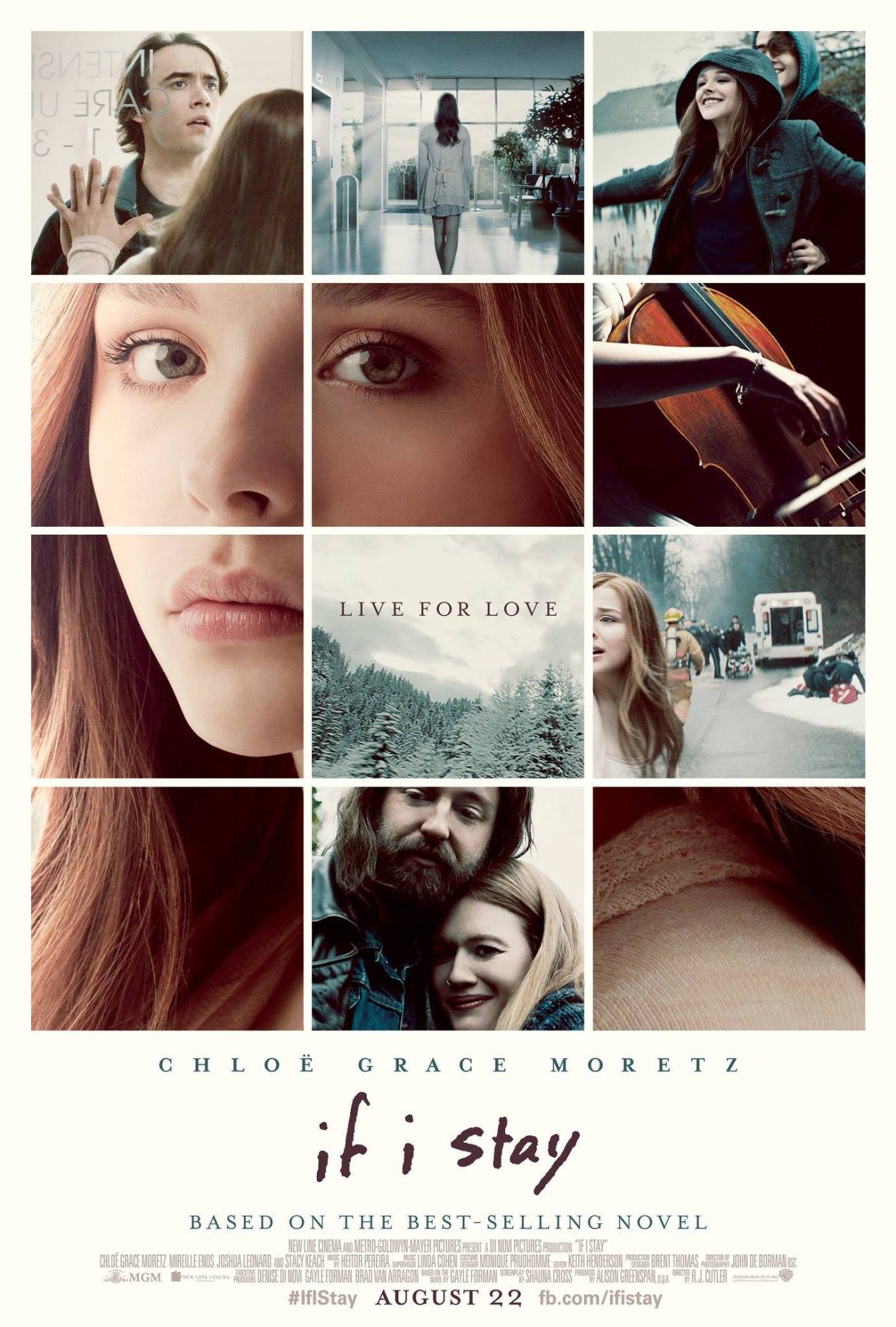
If I Stay

Genre: Drama

Director: R. J. Cutler

Writer: Shauna Cross, based on the novel by Gayle Forman

Cast: Chloe Grace Moretz, Mireille Enos, Jamie Blackley, Joshua Leonard, Liana Liberato, Aisha Hinds, Stacy Keach, Lauren Lee Smith, Gabrielle Rose, Jakob Davies, Gabrielle Cerys Haslett

Running Length: 107 minutes

Synopsis: Mia Hall (Chloe Grace Moretz) thought the hardest decision she would ever face would be whether to pursue her musical dreams at Juilliard or follow a different path to be with the love of her life, Adam (Jamie Blackley).  But what should have been a carefree family drive changes everything in an instant, and now her own life hangs in the balance.  Caught between life and death for one revealing day, Mia has only one decision left, which will not only decide her future but her ultimate fate.

Review: There’s a certain familiarity that comes with YA adaptations these days – it’s almost invariably set in the perspective of the teenage girl (that is the target demographic, after all), and regardless of the quality of the movie, the soundtrack will always be quite listenable, though bordering on the mournful, emo side. If I Stay does not vary from these conventions at all, but despite the best intentions of first-time feature film director Cutler (who had previously cut his teeth on documentaries) and the concerted thespian effort of Chloe Grace Moretz, the film comes across as being just a hair too manipulative and mawkish to earn a solid recommendation.

The narrative structure deviates from the norm – although it starts with a typical first person narrative, the catastrophic accident that lands Mia comatose in hospital also seems to cause an out of body experience for her, and the remainder of the film sees Mia moving about metaphysically (so to speak) in the hospital, unseen and unheard by those around her, coupled with multiple flashbacks to key moments in her life to date. This structure makes it different from most other YA adaptations, but fails to hide the fact that the story is really quite banal, with most of the flashbacks failing to resonate emotionally, despite the rather insistent efforts of the scribe. Therein lies the biggest problem of If I Stay, that it feels way too artificial, from the too-hip parents, the too-cute couple and the incessantly eloquent bon mots that seem to tumble out at will from all the characters’ mouths.

Chloe Grace Moretz is a relatively young actress (just 17 years old) but has been rather prolific of late, and her strong work in If I Stay is one of the key reasons why the film remains watchable. Setting aside the fact that Mia is way too precocious to be believable, Moretz manages to put together a nuanced performance that is far better than the source material would require. Moretz manages to outclass almost everyone in the cast, and the thespian shortcomings of Jamie Blackley in particular are unfortunately thrust into the spotlight quite regularly. If I Stay ends up being a decidedly mixed bag of offerings, a pedestrian YA adaptation that has limited appeal outside of fans of the source novel.

Rating: * * (out of four stars)

Standard

Tammy

Genre: Comedy

Director: Ben Falcone

Writers: Ben Falcone, Melissa McCarthy

Cast: Melissa McCarthy, Susan Sarandon, Alison Janney, Gary Cole, Mark Duplass, Dan Akroyd, Kathy Bates, Sandra Oh, Toni Collette, Nat Faxon

Running Length: 96 minutes

Synopsis: Tammy (Melissa McCarthy) is having a bad day. She’s totaled her clunker car, gotten fired from her thankless job at a greasy burger joint, and instead of finding comfort at home, finds her husband getting comfortable with the neighbor in her own house. It’s time to take her boom box and book it. The bad news is she’s broke and without wheels. The worse news is her grandma, Pearl (Susan Sarandon), is her only option – with a car, cash, and an itch to see Niagara Falls. Not exactly the escape Tammy had in mind. But on the road, with grandma riding shotgun, it may be just what Tammy needs.

Review: Somewhere beneath the jumbled mess of Tammy is a good movie – there are scenes where the film feels warm and fuzzy, and there are a few funny, even laugh-out-loud moments. But so much of the film comes off as directionless and lackadaisical that for a short movie that clocks in under 100 minutes, Tammy feels like a protracted, joyless affair. What’s truly surprising is that the film is co-written by McCarthy and her husband Ben Falcone, who also directed the movie, and yet this passion project (which took more than half a decade to come to fruition) seems so devoid of any real passion.

Tammy is essentially a road trip movie, and like all road trip movies the journey is usually more important than the destination. This is not the case, unfortunately, in Tammy – there’s very little actual travelling involved, and some of the stopovers make absolutely no sense. The most egregious example of this is the diversion to what seems like a lesbian compound, where a bunch of talented actresses (I’m looking at you, Kathy Bates and Sandra Oh) come together and basically collectively waste their talents doing nothing.

The biggest failing of Tammy, however, is that the McCarthy-Sarandon pairing does not work well – putting an insufficient age gap aside (Sarandon is just 67, 24 years apart from McCarthy’s 43), there is almost no chemistry between the two, and sparks just simply fail to fly even when the movie calls for it. That, and the lack of directorial skills from Falcone, who has absolutely no sense of timing or pacing – one wonders what the film could have been like in the hands of a more capable director.

It’s no surprise that Melissa McCarthy is not the problem here – she has excellent comic timing, and manages to flesh out a somewhat believable Tammy that’s not just a sad caricature of an overweight woman. However, even an excellent comedian like her has trouble with the material when it’s just not up to snuff, and in the end there are many more unsuccessful sequences in Tammy than successful ones. It’s not a stretch to say that the film is only watchable because of McCarthy’s considerable talents, and this is a film that passes the Bechdel Test with flying colours, but whether these alone can justify a trip to the cinema would depend largely on one’s affections towards McCarthy’s style of comedy and acting.

Rating: * * (out of four stars)

Standard

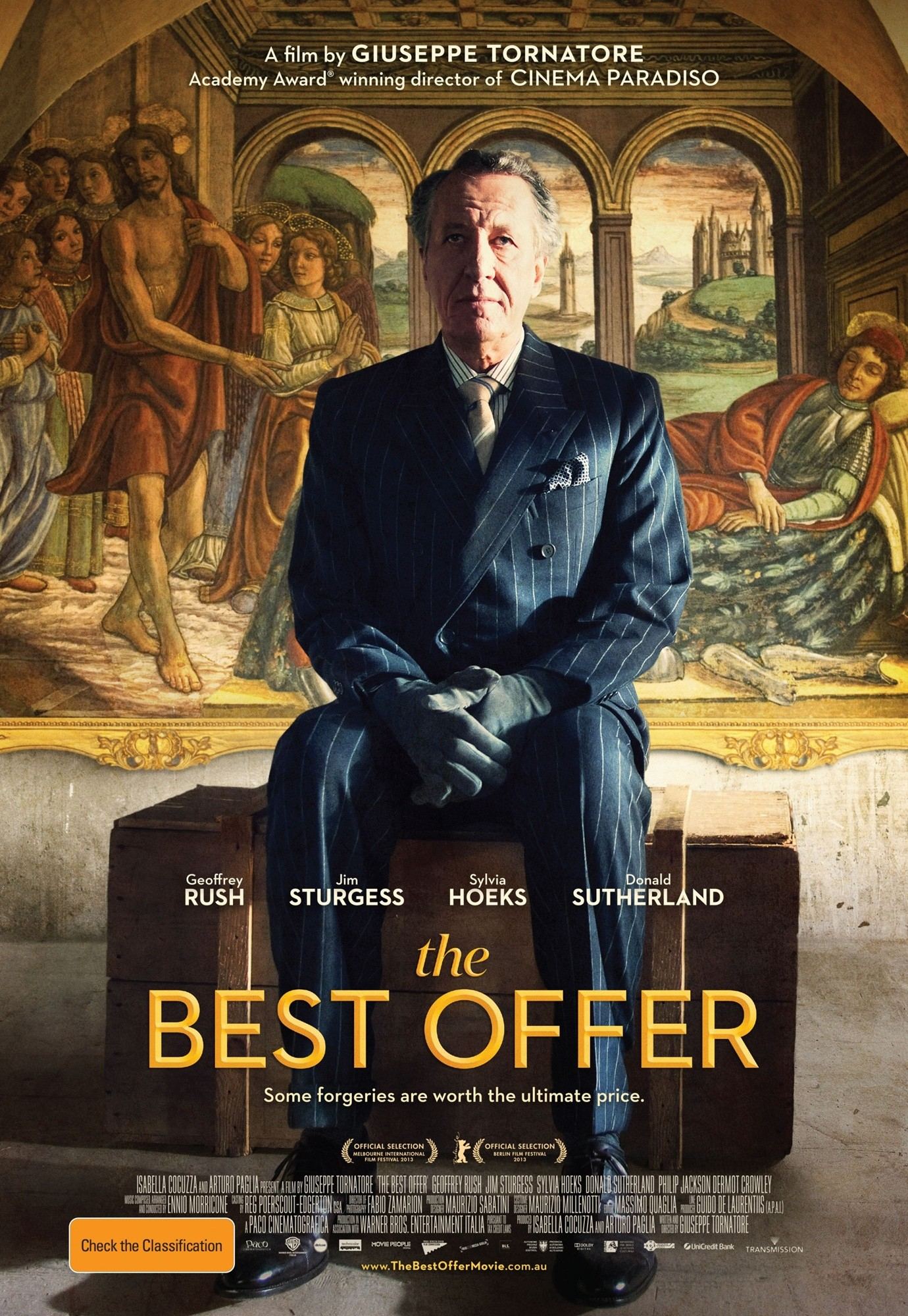
The Best Offer

Image

Genre: Drama

Director: Giuseppe Tornatore

Writer: Giuseppe Tornatore

Cast: Geoffrey Rush, Sylvia Hoeks, Donald Sutherland, Jim Sturges

Running Length: 131 minutes

Synopsis: The Best Offer is the tale of the solitary, cultured Virgil Oldman (Geoffrey Rush), no longer young, whose reluctance to engage with others is matched only by the dogged obsessiveness with which he practices his profession of art expert and auctioneer. Asked to handle the valuation and sale of a mysterious woman, Claire Ibbeston’s (Sylvia Hoeks) priceless heirlooms, Virgil finds himself enveloped by a passion that will transform his grey existence forever.

Review: The Best Offer is an uneven offering from Giuseppe Tornatore, whose body of work can be best described with the same word – uneven – since the early career success of Cinema Paradiso. Directed and written by Tornatore, The Best Offer is an excellent showcase of Geoffrey Rush’s thespian skills, and is accompanied by great visuals and a lush score (by Ennio Morricone). However, the rest of the cast don’t fare as well as Rush, and the plot is an extremely convoluted one that eventually does itself in with a flurry of hamstrung, too-obvious twists and turns.

Geoffrey Rush once again proves to be a brilliant actor, especially since he has to portray two aspects of Virgil – the cold, calculative social misfit before he meets Claire, and the more human and vulnerable old man that he becomes after falling for the largely unseen Claire. His performance does veer into the over-dramatic at times, almost a caricature of a crotchety old eccentric, but overall it’s still a very assured and charismatic performance. Sylvia Hoeks unfortunately disappoints as Claire, and worked better as a disembodied voice in the first half of the movie, than the petulant and quite unlikeable (though still beautiful) woman in the second half. One cannot imagine her being attractive even to a social hermit like Virgil, no matter how much the script tries to force this union.

Tornatore also seemed to be unable to practice self-editing, the most evident being a completely baffling subplot with a mechanical automaton that has zero need to be present in the film, except to function as a tool for exposition. The end result is a movie that runs over 2 hours and yet doesn’t justify the running time at all. Over-exposition is the order of the day, and since the finale is so glaringly obvious, the film feels as though it takes forever to reach a foregone conclusion. And yet, so many plot lines are left unexplained that it’s almost frustrating, and the film simply assumes that no one would question the logic (or lack thereof) of the whole venture.

The Best Offer is an offer that’s marginally good, at its best – although highly technically proficient, checking all the requisite boxes for what makes a handsome movie, the film falters and stumbles along, despite an intriguing start. It is rescued solely by Rush’s presence, but the most of the goodwill runs out along the way, and the entire film virtually falls apart in its final, rather disappointing reel.

Rating: * *(out of four stars)

Standard

The Twilight Saga: Breaking Dawn Part One * *

Genre: Drama

Director: Bill Condon

Writer: Melissa Rosenberg, based on the novel Breaking Dawn by Stephenie Meyer

Cast: Robert Pattinson, Kristen Stewart, Taylor Lautner

Running Length: 117 minutes

Synopsis: In Breaking Dawn Part One, the vampire Edward (Robert Pattinson) and human Bella (Kristen Stewart) are finally getting married, but an unexpected turn of events during their honeymoon threatens to unsettle their life together. Meanwhile, werewolf Jacob Black (Taylor Lautner) is torn between loyalty to his wolfpack and his devotion to Bella. 

Review: The Twilight series is practically critic-proof – there’s a whole bunch of rabid Stephenie Meyer fans who want nothing more than to see the books come to life on the big screen, and then there’s the “Twi-mom” phenomenon where normally rational women go absolutely gaga over Robert Pattinson. Who cares about storyline, thespian skills and quality when box office triumph is assured? Well, certainly not Summit Entertainment, who has deemed it fit to split the final installment of the Twilight series into two movies in an obvious money grab, even if the material does not justify such a move. The film is not a total wash – the last reel is actually pretty well done – but so much of the movie feels so perfunctory that it’s hard to look past the movie’s many shortcomings.
 
If compared to the previous Twilight films, Breaking Dawn really is marginally better – because there’s actually something else going on other than endless teenage angst that plagued the previous installments. However, the much vaunted bedroom-destroying sex scene is so tame it’s almost laughable, the showdown between Jacob and the wolf pack is actually laughable, and only the climactic delivery of Bella’s half-vampire baby actually manages to (pun intended) deliver.

There’s really no acting talent to be found here, even if the actors themselves have shown thespian quality in other films (except Taylor Lautner who’s really not much of an actor in any movie so far). And although the film’s budget is not small, the CGI is somewhat questionable, especially the wolves which just doesn’t seem at all realistic. Given the blah screenplay by Melissa Rosenberg, even a lauded director like Bill Condon can’t do much to elevate the movie to anything beyond mediocre.

It’s probably not very fair to judge Breaking Dawn Part 1, since well, it is not a complete movie. However, extrapolating what has already played out on screen, it’s hard to imagine Part 2 being much improved over Part 1. That probably won’t matter, since this far down the road in the Twilight franchise, only die hard fans should even consider watching this movie, and would probably find the experience a worthwhile one.

Rating: ** (out of four stars)

Standard

Transformers: Dark of the Moon * *

Genre: Action

Director: Michael Bay

Writer: Ehren Krueger

Cast: Shia LaBeouf, Rosie Huntington-Whiteley, Josh Duhamel, John Tuturro, Patrick Dempsey, Frances McDormand, John Malkovich

Voice Cast: Peter Cullen, Leonard Nimoy, Hugo Weaving

Running Length: 157 minutes

Synopsis: Picking up from where the last Transformers movie left off, the Autobots are now working with humans to fend off the Decepticons and also help to battle (believe it or not) terrorists in the name of world peace. However, when Optimus Prime (Peter Cullen) discovers a secret that the US Government has been hiding from them on the moon, this sets off a chain of events that begins with the revival of the powerful Autobot Sentinel Prime (Leonard Nimoy) and eventually to a secret from Cybertron’s past that causes the future of Earth to hang in the balance.

In the mean time, Sam Witwicky (Shia LaBeouf) is finding difficulty adjusting to a normal lifestyle after graduating from college, and is not even able to find a proper job, despite being in a relationship with yet another hot girlfriend, Carly (Rosie Huntington-Whiteley). He uncovers a Decepticon plot but has difficulty getting anyone to listen to him, much less believe in what he says. In desperation, Sam tries to put his motley crew back together, including the now-wealthy conspiracy theorist Simmons (John Turturro), but they have to get past the no-nonsense FBI Security Director Mearing (Frances McDormand) first.

Review: It’s perhaps redundant to review Transformers: Dark of the Moon as essentially nothing has changed since the movie franchise started, and the exact same flaws that plagued the previous two films are back in the third. However, since Transformers: Revenge of the Fallen was such a terrible film, there was really no way to go but up. So yes, Dark of the Moon is a better film than Revenge of the Fallen, but is that saying much?

Michael Bay himself had expressed disappointment in the screenplay of Revenge of the Fallen, but in all honesty Dark of the Moon doesn’t fare much better. Running at a very bloated 157 minutes, Bay and screenwriter Krueger spend almost an hour on largely pointless exposition, punctuated only briefly by much-needed action sequences. Is there really a need to see Sam getting relationship advice from his parents? Or stilted, emotionless scenes in which Shia LaBeouf and Rosie Huntington-Whiteley try to convince the audience (unsuccessfully) of their deep love for each other? The entire film shudders to a halt repeatedly due to these superfluous sequences, and any hope of Dark of the Moon being able to tell a compelling story dissipates in this first hour.

The human actors are all deeply unimpressive, and this includes (much as it pains me to say) Frances McDormand and John Malkovich, who are obviously slumming it for the money. In fact, the human performances are so weak that all of them could have been wiped out without me feeling much for their plight. This is particularly true of Rosie Huntington-Whiteley, whose complete lack of acting skills makes Megan Fox’s vapid performances in the first two Transformers seem like thespian masterpieces in comparison. It’s quite telltale that the most emotionally affecting scenes in the film are those that deal with the Transformers. In fact, the bro-mance between Sam and Bumblebee comes across as being more believable that the romance between Sam and Carly, and it’s due to Bumblebee’s emoting, not LaBeouf’s.

Michael Bay isn’t known, of course, for his storytelling ability, but one thing he manages to do well is in action sequences. The action in Dark of the Moon is thankfully less confusing than before, with Bay actually managing to slow down most action sequences that they become discernible, something that was sorely lacking in Revenge of the Fallen. And the special effects and CGI are really top notch, with the most memorable being the scene where the main characters are trapped in a crumbling building –almost reminiscent of 9/11, and is easily the most visceral of the many, many action set-pieces in the movie.

Bay had recanted on his initial decision to eschew 3D midway through production, and it shows in the finished product. This is possibly the least 3D film I have ever seen, and it’s easy to forget that one is watching a 3D film in long stretches, not because the environment is immersive, but because there’s no sense of the third dimension at all. My advice is to save the money and the eye fatigue and go with normal 2D instead.

In the end, Dark of the Moon would probably have worked better if Michael Bay had elected to keep it short and sweet instead of trying to aim for an “epic”. Though the action sequences work well, viewer fatigue quickly sets in when so much of it is crammed into the movie. Add to that the unnecessarily lengthy exposition, and Dark of the Moon becomes a numbing cinematic experience that goes on far longer than it should have been. If there’s a fourth movie in the franchise, let’s hope that Bay would finally be able to exercise some self-restraint and not turn it into another overburdened behemoth.

Rating:
* * (out of four stars)

Standard

The Green Hornet * *

Genre: Action Comedy

Director: Michel Gondry

Writers: Seth Rogen & Evan Goldberg, based on the radio series by George W. Trendle

Cast: Seth Rogen, Jay Chou, Cameron Diaz, Tom Wilkinson, Christoph Waltz

Running Length: 119 minutes

Synopsis: Britt Reid (Seth Rogen) is the son of a wealthy and recently deceased media mogul who seems to be the epitome of badly behaving moneyed offspring. However, Britt and his sidekick Kato (Jay Chou) transform into masked superheroes at night, posing as criminals and pitting themselves against corrupt District Attorney Scanlon (David Harbour) and crime lord Chudnofsky (Christoph Waltz). However, because they are pretending to be criminals, the police are also hot on the masked duo’s trail. Apart from Kato, Reid’s only other ally is his personal assistant Lenore Case (Cameron Diaz). Eventually, the conflict between Reid and Chudnofsky come to a head, and a battle of wits and brute force (more of the latter, though) ensues.  

Review: Other than a number of sequels, the past couple of years have been pretty quiet for the superhero movie genre. This is set to change in 2011 with a deluge of superhero movies, and the first salvo is that of Michel Gondry’s re-imagining of The Green Hornet. Given the unconventional release date of January, it’s quite obvious that this particular superhero movie doesn’t pack big guns. And while that is true, The Green Hornet still offers up some decent entertainment, but suffers from an overlong running time and a lack of focus.  

Unsurprisingly, The Green Hornet will be viewed very differently in Hollywood compared to here in Asia – after all, Jay Chou can be considered one of the most well-known celebrities in this part of the world, and The Green Hornet will very much be seen as a star vehicle for him. This actually bodes well for the film because Jay Chou is the best thing in the movie. Seth Rogen’s Green Hornet is simply put, Seth Rogen wearing a mask, and as a central protagonist he is so annoying at times that I occasionally found myself rooting for the villains. This allows Jay Chou’s Kato to stand out as the more sympathetic character, and simply put, Jay Chou just does more with his role and characterization, poor English enunciation notwithstanding.

The biggest issue with The Green Hornet is that it’s just too unfocused throughout its too-long 2 hour running time. The screenplay cannot decide if it wants to be a superhero movie or a spoof of a superhero movie. While it’s not necessarily a negative to have a little bit of everything, this is only true when the proceedings are interesting. This could be one of the most boring superhero origins stories of all time (basically it’s two people deciding to put on costumes while performing vigilante work), and to spend almost half of the movie on this aspect doesn’t work.

It’s also a pity that the usually visually inventive Michel Gondry limited himself to just a couple of sequences – there is an absolutely brilliant telephone montage that employed split screens like I’ve never seen before.  However, the usage of 3D in the film (apart from the end credits) is very minimal, and Gondry, who is an expert in employing visual tricks, does not make use of the third dimension at all.  There is a good possibility that if given freer rein and a tighter script, The Green Hornet could have been a good, if not great, superhero movie, but now it’s merely passable entertainment, especially so for fans of Jay Chou. 

Rating: * * (out of four stars)

Standard

TRON: Legacy * *

Genre: Sci-Fi

Director: Joseph Kosinski

Writers: Edward Kitsis, Adam Horowitz

Cast: Jeff Bridges, Garrett Hedlund, Olivia Wilde, Bruce Boxleitner, Michael Sheen

Running Length:  127 minutes

Synopsis: Set in the present, Kevin Flynn (Jeff Bridges) – the original hero of TRON – has been missing for over two decades, disappearing shortly after announcing that he has discovered a breakthrough in his research of cyberspace. His son Sam (Garrett Hedlund) becomes primary shareholder of ENCON, but has no interest in running the family business. His pseudo-presence in the company is not welcomed by anyone except for Alan Bradley (Bruce Boxleitner), an old family friend who is still looking out for the Flynn family’s interests. When Alan receives what seems to be a message from Flynn, Sam goes to Flynn’s Arcade to investigate, but is accidentally transported into cyberspace, where he discovers the world is now ruled by Flynn’s alter-ego, Clu (also Jeff Bridges). Sam finds that Flynn is now a recluse, aided only by the enigmatic Quorra (Olivia Wilde). Joining forces with his father and Quorra, Sam needs to find a way to escape cyberspace, and also to stop Clu from crossing over to the real world. 

Review: While a fair number of viewers will look upon the original TRON fondly, it really isn’t a masterpiece by any measure – apart from the (then) amazing visuals, the film’s storyline and pacing were not great, and seen years down the road, TRON doesn’t stand up to the test of time. However, TRON has evolved into a cult classic, and understandably expectations were high for this sequel 28 years later. While TRON: Legacy would have probably been perfectly fine as a typical sci-fi action movie, it is weighed down by an overly self-important script that seems to want to elevate the film into greatness, but the attempt fails spectacularly. TRON: Legacy is watchable for its visuals, an excellent soundtrack and a handful of good action sequences, but with the confusing plot, middling performances and plodding pace, the resulting film is a very average one indeed. 

Although spiritually a sequel to TRON, the look of the grid has evolved a fair bit due to the advancements of CGI, but it’s a change for the better. The environments are mostly enshrouded in darkness, punctuated only by bright neon strips of light in white, blue and orange, but it’s a very clean look that works very well in context. However, the simplicity of the environment also means the 3D is neither immersive nor very impressive – in fact, the 3D effect is so subtle in many scenes that it seems almost non-existent. As a film that was specifically shot in 3D (like Avatar), it’s a little disappointing that so little was done with it. Technology was also employed to render the young(er) faces Tron and Clu, and while it’s quite impressive, it hasn’t crossed the uncanny valley yet. 

It’s arguably true that a movie of this nature doesn’t require much of a plot or thespian skills, but TRON: Legacy is sorely lacking in both. The film tries to be epic but falls far short – the plot is an incomprehensible mess, far more complex than it should be and explaining way too little, perhaps in an attempt to seem profound. While Jeff Bridges is perfectly serviceable as Flynn, Garrett Hedlund is unfortunately quite wooden in his portrayal as Sam and Olivia Wilde’s character is so one-dimensional she is reduced to being merely a pretty face and a pseudo love interest.  

What TRON: Legacy manages to do reasonably well is in its action sequences, especially those found in the first half of the movie. In the second half, sadly, the action tapers off and is replaced by interminable chunks of dialogue and pointless exposition that just kills the pacing of movie entirely. Another highlight is the excellent soundtrack by French electronica duo, Daft Punk. Surprisingly, most of the score is still a classical one, but with electronic flourishes. It’s perhaps the only component of the film that successfully feels epic, but the rest of the film simply doesn’t match up. 

Rating: * * (out of four stars)
Standard