The Imitation Game

Genre: Drama

Director: Morten Tyldum

Screenplay: Graham Moore, based on the book “Alan Turing: The Enigma” by Andrew Hodges

Cast: Benedict Cumberbatch, Keira Knightley, Matthew Goode, Allen Leech, Matthew Beard, Charles Dance, Mark Strong

Running Length: 114 minutes

Synopsis: Famously leading a motley group of scholars, linguists, chess champions and intelligence officers, Alan Turing (Benedict Cumberbatch) was credited with cracking the so-called unbreakable codes of Germany’s World War II Enigma machine. An intense and haunting portrayal of a brilliant, complicated man, The Imitation Game follows a genius who under nail-biting pressure helped to shorten the war and, in turn, save thousands of lives.

Review: Although The Imitation Game is thematically similar to The Theory of Everything, it ranks as the better biopic. The Imitation Game is more willing to show the darker side of things, occasionally dips its toes into thriller category, and boasts equally strong lead performances, which makes it a better cinematic experience overall. While Eddie Redmayne astonishes with his physical transformation, Benedict Cumberbatch impresses with superior thespian skills.

Intertwining three periods in Turing’s life, The Imitation Game begins in 1952, with Alan Turing being investigated and arrested for “gross indecency” – as homosexuality was still illegal back in the 50s – and using the police interrogation as the launching point of a recounting of his exploits in World War II at Bletchley Park. Turing was instrumental in cracking the German Enigma machine, which helped decode German radio messages and led to an earlier conclusion of the War, but he sadly committed suicide at the young age of 41, one year after he was found guilty and chose chemical castration over prison time. There are also earlier flashbacks to the 1920s, when Turing was a schoolboy who is just discovering his sexuality and experiencing his first crush.

The decision to focus on just three periods in Turing’s life is an astute one. By going deep instead of going wide, Tyldum and Moore have managed to create a multidimensional portrait of Turing, aided of course by the superlative performance of Benedict Cumberbatch. Cumberbatch manages to capture the essence of Turing, from his complete social awkwardness to his laser-like focus on solving Enigma, from his brilliance to his isolation. It is a pitch-perfect performance, and firmly establishes Cumberbatch as one of the top talents in the industry.

Special mention must also go to Alex Lawther playing the younger Alan Turing, who also manages to capture the nuances required to realistically portray a conflicted teenager coming to terms with his love for a fellow schoolboy. Keira Knightley once again shows that she is best in unconventional roles and not as a wide-eyed ingénue, though she isn’t given that much to do in the film.

Opting to eschew the more technical aspects of how Enigma was solved, certain scenes in The Imitation Game do stretch plausibility somewhat, though they do add more excitement to what’s essentially a very academic activity. Solving Enigma takes place around the midpoint of the film, but it’s really what unfolds after that makes the film an engrossing one. In the end, Turing’s brilliance and his contributions to ending the war is undermined by a society that condemned his sexuality, resulting in a life that ended way before it should have. The Imitation Game does not shy away from the ugly truth, making it an engrossing if dark movie to watch.

Rating: * * * ½ (out of four stars)
Standard

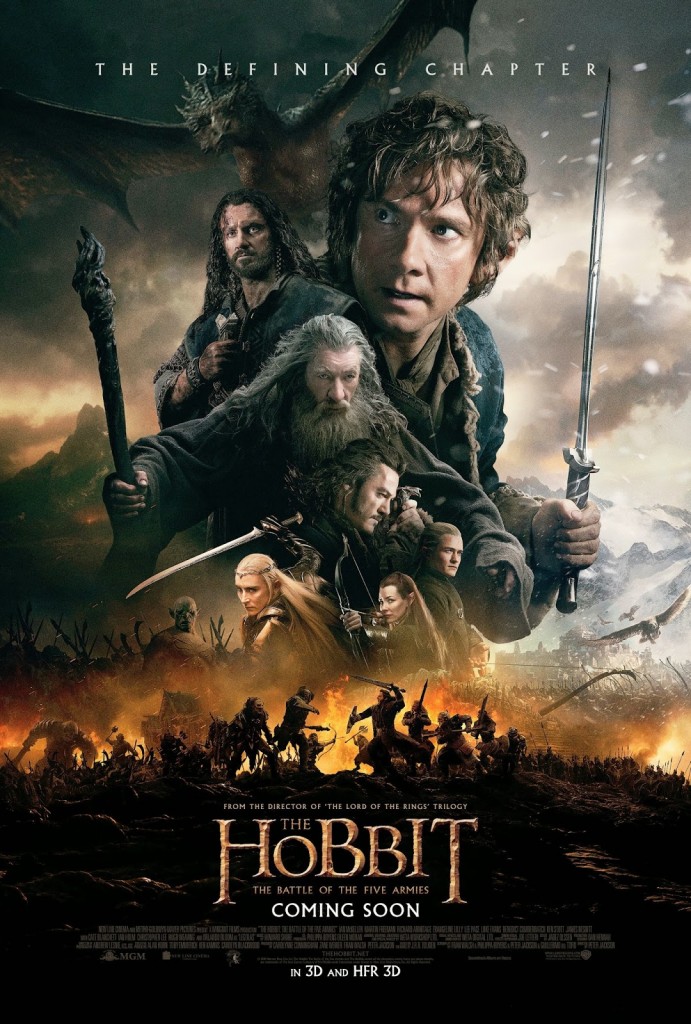
The Hobbit: The Battle of the Five Armies

Genre: Fantasy

Director: Peter Jackson

Writers: Fran Walsh, Philippa Boyens, Peter Jackson & Guillermo del Toro, based on the novel “The Hobbit” by J. R. R. Tolkien

Cast: Martin Freeman, Ian McKellan, Richard Armitage, Luke Evans, Orlando Bloom, Evangeline Lilly, Lee Pace, Stephen Fry, Cate Blanchett, Hugo Weaving, Christopher Lee, Benedict Cumberbatch (voice)

Running Length: 144 minutes

Synopsis: The Hobbit: The Battle of the Five Armies brings to an epic conclusion the adventures of Bilbo Baggins (Martin Freeman), Thorin Oakenshield (Richard Armitage) and the Company of Dwarves. The Dwarves of Erebor have reclaimed the vast wealth of their homeland, but now must face the consequences of having unleashed the terrifying Dragon, Smaug, upon the defenseless men, women and children of Lake-town.

As he succumbs to dragon-sickness, the King Under the Mountain, Thorin Oakenshield, sacrifices friendship and honor in his search for the legendary Arkenstone. Unable to help Thorin see reason, Bilbo is driven to make a desperate and dangerous choice, not knowing that even greater perils lie ahead. An ancient enemy has returned to Middle-earth. Sauron, the Dark Lord, has sent forth legions of Orcs in a stealth attack upon the Lonely Mountain. As darkness converges on their escalating conflict, the races of Dwarves, Elves and Men must decide—unite or be destroyed. Bilbo finds himself fighting for his life and the lives of his friends as five great armies go to war.

Review: By this third installment, it’s safe to say that The Hobbit trilogy is kind of a misnomer, since the titular character doesn’t really factor all that much into the proceedings, made most abundantly clear in this episode, The Battle of the Five Armies. This is a natural outcome of trying to stretch out what is essentially a children’s storybook into a fantasy epic, in an attempt to make The Hobbit trilogy’s breadth and scope similar to the Lord of the Rings trilogy. So much material in the three Hobbit movies aren’t even in the novel that it is moot to discuss the faithfulness of the movie to the source, and not all additions work in the movies’ favour.

That said, The Battle of the Five Armies is easily the best film in the trilogy, far trumping the soporific An Unexpected Journey and an improvement upon the sporadically interesting The Desolation of Smaug. The film opens with Smaug raining fiery destruction on Lake-town, and the CG effects, especially Smaug himself, remain a sight to behold. The action never really lets up from there, culminating in an epic battle sequence lasting more than an hour, with the expansive battle coming close to the best scenes in the Lord of the Rings trilogy. Bookended by these two setpieces, The Battle of the Five Armies feels closest to being a complete entity of its own, unlike the two films that came before it, both of which ended very abruptly. There can be a case made for too much CGI as the trilogy progresses, but it’s hard to argue that the end results are very impressive and rightfully lends an epic feel to the sequences. (A side note: HFR 3D remains a little too sharp for my own preferences, but at least the 3D is not entirely redundant in the film, unlike almost every other title that decides to open in 3D.)

It’s no secret that there are plenty of embellishments in The Hobbit trilogy to pad out the thin storyline, even creating characters that were not part of the canon – most notably the female Wood Elf Tauriel. Sure, the interspecies romance between Tauriel and Kili will probably make the film more appealing to a greater number of moviegoers, but it just flat out does not work well as a plot device because it feels so ill-fitted in the Tolkien universe. The decision to include Legolas as more than just a cameo probably stems from the same desire to appeal to a specific fan base, but the action sequences involving Legolas have devolved into near-farce, especially one in which he seems to be in a different movie – Crouching Tiger, Hidden Dragon perhaps – altogether.

The same can be said of many returning faces, and everyone (save for Gollum) makes an appearance, making it feel almost like some Middle-Earth reunion movie of sorts. However, such extraneous filler also manages to diminish the central plot and character, and much of The Battle of the Five Armies sees Bilbo Baggins being sidelined as a spectator of the proceedings. It’s a shame, because Martin Freeman is excellent in his role, but the audience simply does not get to see enough of him despite it being an almost two-and-a-half-hour movie (for those keeping count, this means the combined running length of The Hobbit trilogy is a whopping 474 minutes).

And so, thirteen years after embarking on a journey to Middle-Earth, Peter Jackson finally concludes his six-film saga with a big (enough) bang. Jackson has stated that there will be no third set of films based on The Silmarillon from him, but one can never be too sure about such things – after all it does seem that rights issues is what’s stopping potential production. When looked upon as a complete body of work or as a part of the entire Middle Earth saga, The Hobbit doesn’t do all that badly (though I still maintain that it should never had become three movies – even the originally planned two-parter was a dubious decision), and is already a qualified box office success even before The Battle of the Five Armies opened. This last movie singlehandedly raises the trilogy to above mediocrity, and whilst The Hobbit never comes close to its predecessor on any level, The Battle of the Five Armies rounds out one of the better film trilogies in recent years, paling only to Christopher Nolan’s superlative Dark Knight trilogy. That’s not to say that the films are without their flaws, but at the very least the journey there and back again has a decent payoff.

Rating: * * * ½ (out of four stars)

Overall Rating for The Hobbit trilogy: * * * (out of four stars)

Standard

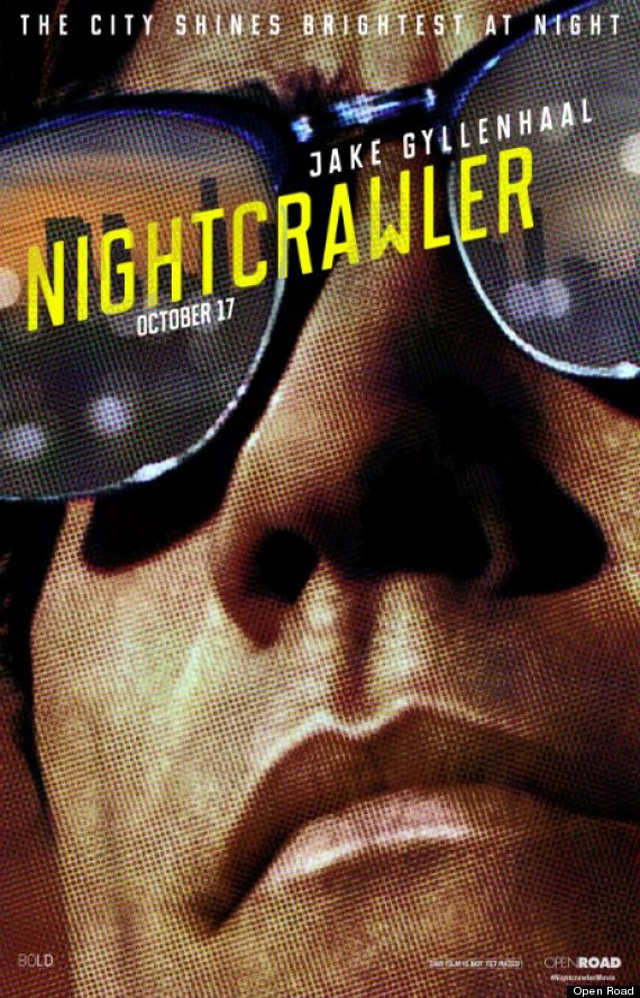
Nightcrawler

Genre: Drama

Director: Dan Gilroy

Writer: Dan Gilroy

Cast: Jake Gyllenhaal, Rene Russo, Riz Ahmed, Bill Paxton

Running Length: 117 minutes

Synopsis: Nightcrawler is a thriller set in the nocturnal underbelly of contemporary Los Angeles. Jake Gyllenhaal stars as Lou Bloom, a driven young man desperate for work who discovers the high-speed world of L.A. crime journalism. Finding a group of freelance camera crews who film crashes, fires, murder and other mayhem, Lou muscles into the cut-throat, dangerous realm of nightcrawling – where each police siren wail equals a possible windfall and victims are converted into dollars and cents. Aided by Rene Russo as Nina, a veteran of the blood-sport that is local TV news, Lou blurs the line between observer and participant to become the star of his own story.

Review: Jake Gyllenhaal has had an excellent body of work so far, with wide-ranging roles that manage to impress time and again (Enemy, Brokeback Mountain, Jarhead, Prisoners, and many more). However, his performance in Nightcrawler is undoubtedly his best yet, and that says a lot about how good it is – highly deserving of a great run at the awards season next year, and on its own is reason enough to give Nightcrawler a go. While Nightcrawler is not without some flaws, it has a mesmerising central performance around a smart, always engaging film, making it impossible to look away for the entire 2-hour running time. This is the poster child for movies that don’t accord audiences any good moments for a pee break.

The most immediate comparison that one can make to Gyllenhaal’s performance is that of Robert De Niro’s in Taxi Driver – Lou Bloom is as much of an anti-hero as Travis Bickle was, although Bloom definitely has less of a moral compass than Bickle. And it’s an equally transformative, unforgettable performance – Gyllenhaal totally disappears into the role, fully embodifying Bloom not just in his physicality (he lost over 20 pounds of weight for the role) but in every aspect. It’s clear that in Nightcrawler, Bloom is the antagonist, and his soulless eyes, forced smile and ruthless, sociopathic focus on the end game is unyieldingly creepy yet fascinating to observe. This is easily one of the best performances of the year, on par with the mind searing turn by Rosamund Pike in Gone Girl.

While Gyllenhaal carries the film on his performance alone, the supporting cast is also quite capable – Rene Russo (Dan Gilroy’s wife, by the way) is the only female presence in the film and leaves a strong impression as the network executive that’s almost willing to do anything for ratings. Bill Paxton plays a small but important role in the film, and despite limited screen time gives a memorable performance as well. Riz Ahmed’s Rick acts as the human foil for Lou, but at times does feel more like a convenient plot device rather than a convincingly written character.

Dan Gilroy pulls double duty as director (his debut) and screenwriter, and manages to excel at both. With such solid performers on board, he wisely chooses a straightforward, unflashy directorial style, but is aided by Robert Elswit hitting it out of the park with excellent cinematography – nighttime Los Angeles has not looked so spectacular since the equally lush take in 2011’s Drive. The scripting is impeccable, and although I question the veracity of how network news footage is acquired (and the sensationalism of news is a very tired, old trope), Gilroy is masterful in ramping up the suspense all the way to the explosive, macabre, yet strangely satisfying denouement.

Rating: * * * ½ (out of four stars)

Standard

Interstellar

Genre: Sci-Fi, Drama

Director: Christopher Nolan

Writers: Jonathan Nolan, Chris Nolan

Cast: Matthew McConnaughey, Anne Hathaway, Jessica Chastain, Ellen Burstyn, John Lithgow, Michael Caine, Casey Affleck, Wes Bentley, Bill Irwin, Mackenzie Foy, Topher Grace, David Gyasi, Timothee Chalamet, David Oyelowo, Will Devane, Matt Damon

Running Length: 169 minutes

Synopsis: A group of explorers make use of a newly discovered wormhole to surpass the limitations on human space travel and conquer the vast distances involved in an interstellar voyage.

Review: If I were to pick just one word to describe Christopher Nolan’s latest film, it would have to be “ambitious” – Interstellar is an epic undertaking that doesn’t always succeed, but you have to give Nolan brownie points just for trying. Although this sounds like faint praise, Interstellar is actually an excellent cinematic experience – the sheer scope and spectacle of the film is more than enough reason to give this movie a once-over on the big screen (and I am serious about “big screen” – this movie deserves to be seen on IMAX – more on this later), and even if the final reels come a little unhinged, it does not undo what happens in the two hours prior.

Although the film runs almost three hours long, it never feels belaboured, and plotlines are so engaging and well developed that the 169 minute running time passes by very quickly. Nolan smartly intertwines plot heavy scenes with action setpieces which are nothing short of stunning, taking place on a variety of very different landscapes. If you thought the action setpieces in Nolan’s Inception and Batman trilogy were impressive, you ain’t seen nothing yet.

While Interstellar is essentially a sci-fi film, Nolan manages to inject a lot of emotionality into the proceedings. It treads the fine line between emotional resonance and cheesiness, but most of the time the drama does hit the right notes, none more so than a mid-movie segment in which the time warping capabilities of a black hole is brought into stark relief. Matthew McConnaughey is extremely impressive in this sequence, and without spoiling the proceedings, the range and depth of emotions that he displays in those five minutes could rival the entire cast of some other sci-fi films, and brings to mind Sandra Bullock’s similarly excellent turn in Gravity. The supporting cast is strong, but undeniably McConnaughey is the one that holds the entire film together. It would not be a surprise to see him nominated second year running for Best Actor.

That the film throws so many scientific principles and terms at the audience, and yet still remains rather accessible, is a feat in itself. Most of it seems legit too, especially since famed CalTech astrophysicist Kip Thorne consults on the film and is credited as an Executive Producer. It does get a bit too farfetched and clunky near the end, and the denouement feels a little rushed, as though Nolan is aware that dwelling too long on the postscript would bring the plot holes into focus. Interstellar is not as mind-bending as some of Nolan’s other work (it was pretty clear to me how the plot would pan out eventually, midway through), but audience members will nevertheless need to prepare for a mental workout when watching the film – this is not your usual Hollywood sci-fi action blockbuster.

In terms of technical accomplishment, Interstellar is about as flawless as it gets. Every technical aspect is remarkably executed – art direction, production design, sound, visual effects, CG work, cinematography, editing, musical score and more – one simply cannot ask for more in a movie. This is a big budget Hollywood movie done right, and I will be surprised if there would not be a flurry of nominations and awards in technical categories come awards season next year. Having been shot entirely on celluloid, bucking the digital trend, the film’s scale and beauty is best appreciated in IMAX, and is a necessity in my opinion.

Interstellar is such a massive undertaking that the fact that Nolan manages to pull it off is impressive enough, and for the film to actually be this accomplished means it automatically takes a spot in my best-of list for 2014. Despite some blemishes, it is the cinematic experience to beat in 2014, and much as it sounds like a cliché: if you watch one movie this year, make it Interstellar.

Rating: * * * ½ (out of four stars)
Standard

Marvel’s Guardians of the Galaxy

Genre: Action, Comedy

Director: James Gunn

Writers: James Gunn, Nicole Perlman, based on the Marvel comic book by Dan Abnett and Andy Lanning

Cast: Chris Pratt, Zoe Saldana, Dave Bautista, Vin Diesel, Bradley Cooper, Lee Pace, Michael Rooker, Karen Gillan, Djimon Hounsou, John C. Reilly, Glenn Close, Benicio Del Toro, Laura Haddock

Running Length: 120 minutes

Synopsis: An action-packed, epic space adventure, Marvel’s Guardians of the Galaxy expands the Marvel Cinematic Universe into the cosmos, where brash adventurer Peter Quill (Chris Pratt) finds himself the object of an unrelenting bounty hunt after stealing a mysterious orb coveted by Ronan (Lee Pace), a powerful villain with ambitions that threaten the entire universe. To evade the ever-persistent Ronan, Quill is forced into an uneasy truce with a quartet of disparate misfits-Rocket (Bradley Cooper), a gun-toting raccoon, Groot (Vin Diesel), a tree-like humanoid, the deadly and enigmatic Gamora (Zoe Saldana) and the revenge-driven Drax the Destroyer (Dave Bautista). But when Quill discovers the true power of the orb and the menace it poses to the cosmos, he must do his best to rally his ragtag rivals for a last, desperate stand-with the galaxy’s fate in the balance.

Review: This is going to sound like hyperbole, but Guardians of the Galaxy is probably one of the best comedies I’ve seen in years, the most entertaining Marvel Cinematic Universe movie yet, and definitely the most fun movie I’ve managed to watch this Summer. Is it perfect? Nope, but it is almost impossible to harbour any ill will against an action blockbuster that’s this entertaining and so full of heart. That it comes with an amazing 1970s soundtrack is just the cherry on top – as we all already know from X-Men: Days of Future Past, 70s songs tend to make superhero films better.

Perhaps it’s because Guardians of the Galaxy is such an obscure part of the Marvel canon, that director James Gunn and co-writer Nicole Perlman have a freedom that not many other directors and scribes involved in the Marvel Cinematic Universe are allowed. That sense of irreverence is what makes Guardians of the Galaxy such a pleasure to watch – this is what the MCU is like after-hours, kicking back on the recliner with a Bud Light in hand. I am willing to bet that even the most seasoned moviegoers will find themselves surprised by some of the plot turns in the film, because the film is not afraid to confound expectations unlike the usual “serious” superhero movies.

Yet, what makes Guardians of the Galaxy extra special is that despite the humour and the zaniness, this is a movie with a lot of heart. Even in the confines of an action movie, the main characters are fully developed – yes, even Groot, who is about two levels above being monosyllabic – and very relatable to the audience. These are not inaccessible superheroes, billionaires or gods, but a bunch of adventurers who have less than noble motives, and are all damaged in their own ways. This organic emotional vulnerability (versus say, Superman’s weakness to kryptonite) is refreshing and adds a dimensionality to the movie that is rarely seen in other movies in the same genre.

I must admit I had doubts when Chris Pratt was cast in the lead role of Guardians of the Galaxy – he’s been a dependable costar both in films and on TV, but is he able to shoulder the lead role of a multimillion dollar action blockbuster? My doubts are totally unfounded, as Chris Pratt is a perfect fit for the role. Not only did he buff up for the role (Pratt can justifiably be called hot now), his perfect comic timing is actually critical for the movie’s success. In fact, his performance here reminds me of Harrison Ford’s two iconic roles as Han Solo and Indiana Jones. While Zoe Saldana and Dave Bautista are both serviceable complements, what’s truly impressive is that the two animated characters of Rocket and Groot are not only voiced perfectly by Bradley Cooper and Vin Diesel, they actually carry as much thespian weight as the other live action characters. All five lead characters share great onscreen chemistry, and any combination of the five works well, which is truly a rarity. It’s also a testament to the advance of CG imagery that they manage to integrate so well into the proceedings. The villains don’t fare as well, however, and everyone from Lee Pace to Karen Gillan to Josh Brolin are unmemorable and merely serve to advance the plot along.

The film is also very capable in its other technical aspects. Production design and art direction is excellent, with brand new worlds that are vibrant and meticulously built, with great attention to detail. For once, watching the movie in 3D also seems to be a worthy investment and not an unnecessary expense. It also lives up to its name as an action blockbuster, with a number of well-choreographed, well-animated space dog fights as well as close quarter battles that get the adrenalin flowing.

Personally, despite a Summer season with a good number of quality superhero movies, Guardians of the Galaxy ranks as number one for me. Although the MCU output so far has had relatively few clunkers, Guardians of the Galaxy still stands out as being such a unique and special entity that gets so many things right, that I’m inclined to also say that this is the best MCU movie to date. There does seem to be a surfeit of unresolved plotlines, but given that the sequel is already greenlit, it’s not too major a concern. It’s going to be a long, long wait to July 2017 when we will finally be able to rejoin the Guardians on their next, hopefully equally zany and entertaining, adventure.

P.S If you thought that nothing could be more inane than The Avengers’ shawarma end credits coda, well, stay around for the coda to this one. One only hopes that the character reference in the coda does not suggest a remake to what I feel was a TERRIBLE movie the first time round.

Rating: * * * ½ (out of four stars)
Standard

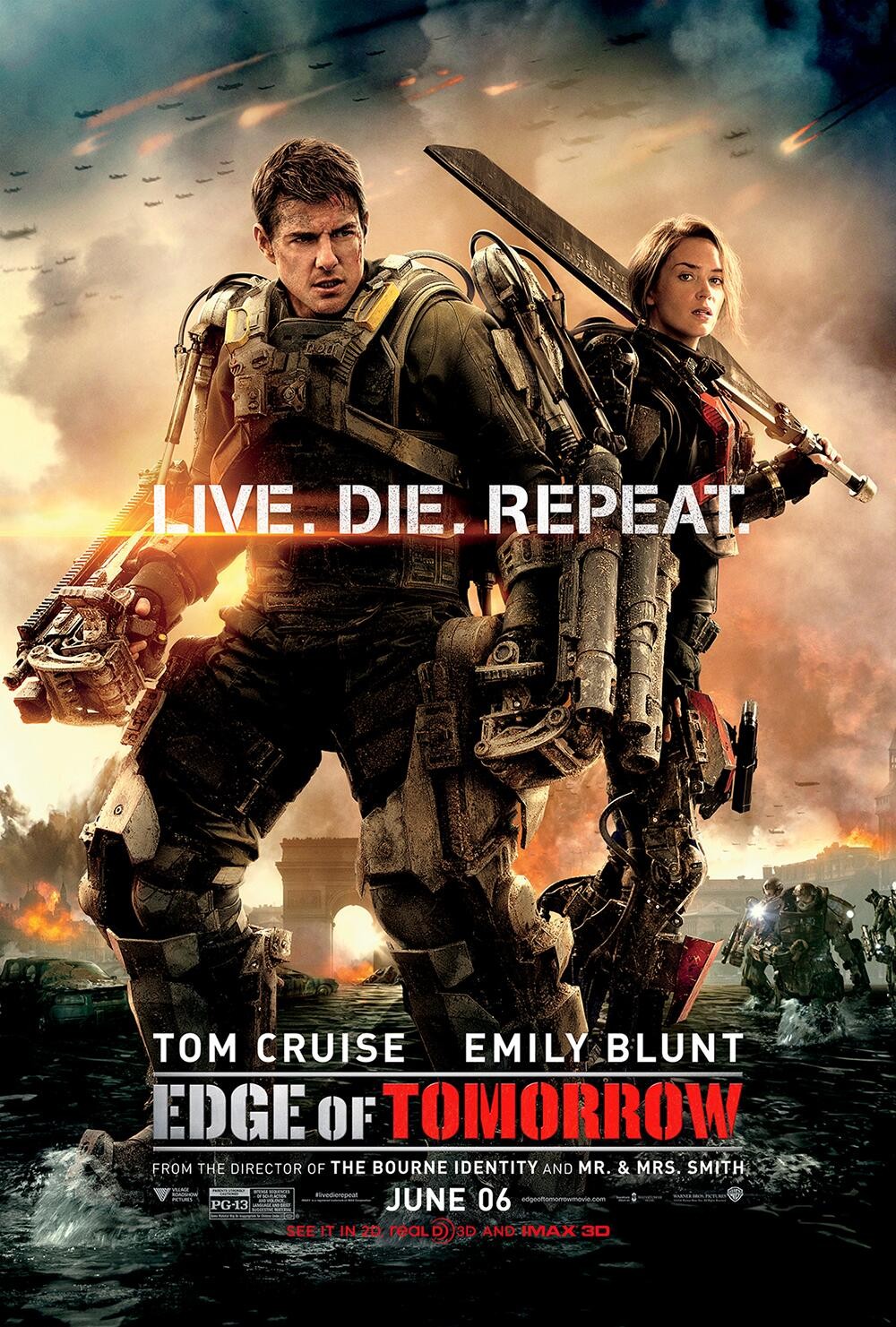
Edge of Tomorrow

edge_of_tomorrow_ver5_xlg

Genre: Sci-Fi, Action

Director: Doug Liman

Writers: Christopher McQuarrie, Jez Butterworth, John-Henry Butterworth, based on the novel “All You Need is Kill” by Hiroshi Sakurazaka

Cast: Tom Cruise, Emily Blunt, Bill Paxton, Brandon Gleeson, Noah Taylor

Running Length: 113 minutes

Synopsis: Edge of Tomorrow unfolds in a near future in which an alien race has hit Earth in an unrelenting assault, unbeatable by any military unit in the world. Major William Cage (Tom Cruise) is an officer who has never seen a day of combat when he is unceremoniously dropped into what amounts to a suicide mission. Killed within minutes, Cage now finds himself inexplicably thrown into a time loop forcing him to live out the same brutal combat over and over, fighting and dying again… and again. But with each battle, Cage becomes able to engage the adversaries with increasing skill, alongside Special Forces warrior Rita Vrataski (Emily Blunt). As Cage and Rita take the fight to the aliens, each repeated encounter gets them one step closer to defeating the enemy.

Review: Groundhog Day has withstood the test of time and almost two decades later, still remains one of my favourite movies. In my books, it’s no mean feat to be compared favourably to Groundhog Day, but that’s exactly what Edge of Tomorrow manages to achieve – it is essentially a sci-fi version of Groundhog Day, and although it’s a big budget action movie, the film is much better thought-out than the usual mindless summer action flick, and it’s the smaller moments that manages to impress more so than the effects-laden action setpieces.

While Edge of Tomorrow falters a little at the start, complete with the used-to-death news montage to set up the story, once the time loop starts kicking in the film becomes far more interesting. Doug Liman has obviously worked hard with the screenwriters to try and figure out exactly how much repetition audiences can take, and much like Groundhog Day, chooses to show only parts of each cycle to prevent audience fatigue. It generally works well, but there are moments where the plot does get lost. What really helps the movie is that it is not shy to inject humour into the proceedings, and indeed that are a handful of sequences that are laugh-out-loud funny, which makes Edge of Tomorrow a better-rounded movie than a typical sci-fi action film.

Tom Cruise is excellent as William Cage, mainly because he manages to dial his usual all-in-all-the-time intensity down for the role, and it certainly is refreshing to see him play a coward that dies and gets beaten down literally hundreds of times in the movie. Of course he does eventually blossom into the usual hero character he plays, but present here is at least a progression that is hardly seen in other movies headlined by Cruise. He is ably partnered by Emily Blunt, who is impossibly athletic and graceful in the film, and puts in a mesmerizing and believable performance. The only misstep is the attempt to develop a romantic liaison between the two actors, as while they share a good onscreen chemistry, the romance subplot feels undercooked and unconvincing.

And then there’s the film’s denouement, which is surely going to split audiences down the middle. Edge of Tomorrow ends with the usual CGI-laden, guns blazing finale, which really carries very little emotional heft as both the aliens and the cannon fodder are one-dimensional, and audience members are unlikely to feel vested. To avoid being spoilerly, all I can say is that the final scene is sure to throw audiences for a loop, which isn’t necessarily a good thing. Fortunately, the movie has built up enough goodwill along the way that even the head-scratching conclusion is unlikely to derail the positive sentiments. Will Edge of Tomorrow stand up to repeat viewings like Groundhog Day? I don’t think so, but at least the first time round will be fun and rather entertaining.

Rating: * * * ½ (out of four stars)

Standard

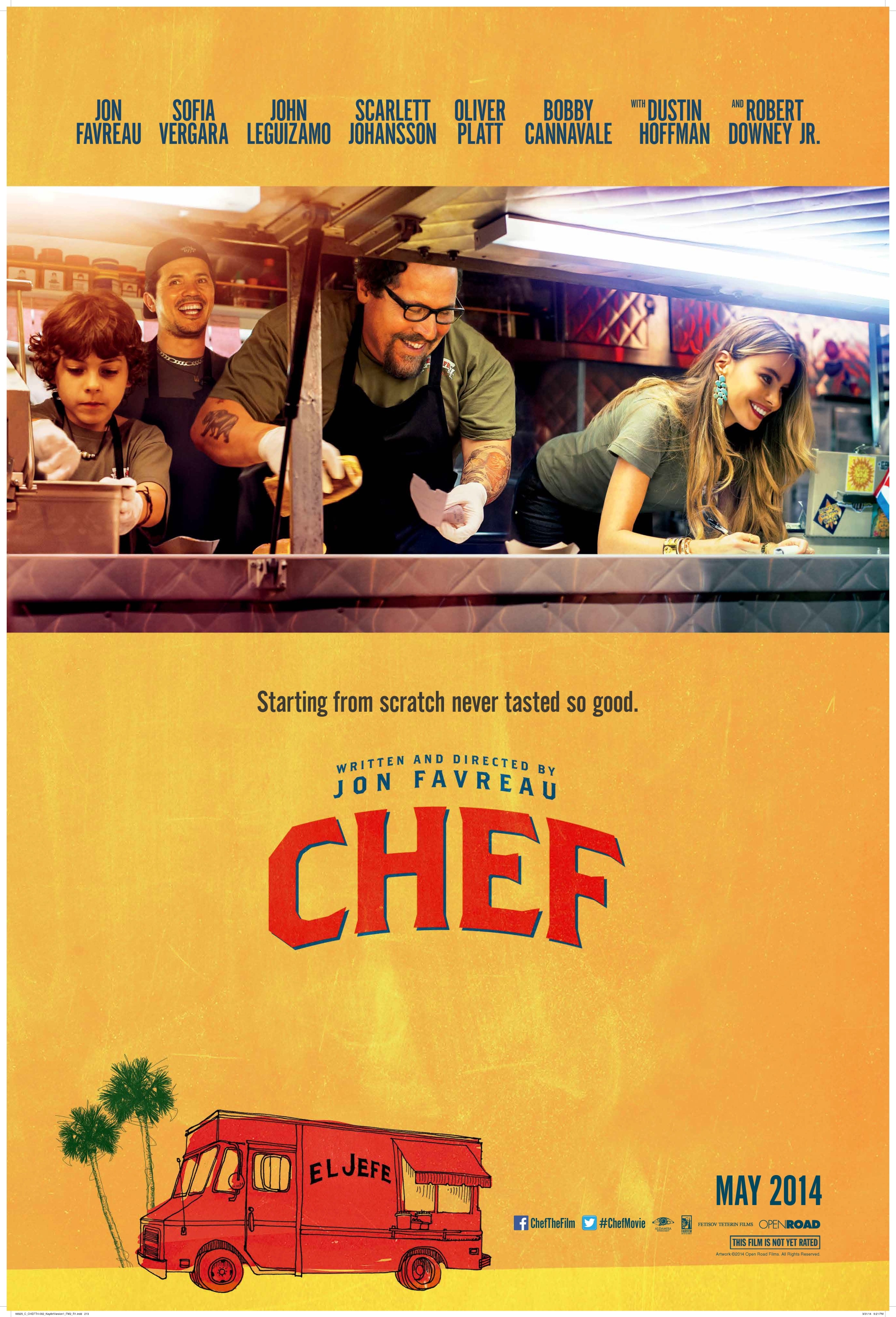
Chef

chef-poster

Genre: Drama

Director: Jon Favreau

Writer: Jon Favreau

Cast: Jon Favreau, Sofia Vergara, John Leguizamo, Scarlett Johansson, Dustin Hoffman, Oliver Platt, Bobby Cannavale, Amy Sedaris, Emjay Anthony, Robert Downey Jr.

Running Length: 115 minutes

Synopsis: A chef who loses his restaurant job starts up a food truck in an effort to reclaim his creative promise, while piecing back together his estranged family.

Review: Most current moviegoers will know Jon Favreau for the three action blockbusters he directed in the last decade – two successful Iron Man episodes (the first and second) and the not-so-great Cowboys and Aliens. Chef represents a return to his indie movie roots, and despite the big names in the cast, is a refreshing, small-budget movie with good intent and an excellent soundtrack. It also features a good amount of “food porn”, so viewers beware – any attempts to watch this movie on an empty stomach will be rather detrimental to health.

The premise of the film is a simple one, and the denouement is a given, but Favreau is happy to take his time getting there – like a true road trip, the enjoyment of this movie lies in the journey and not the destination. Favreau himself is excellent in the lead role of Chef Casper, but it’s the great chemistry that he shares with two other cast members – John Leguizamo’s Martin and the young Emjay Anthony as his son Percy, that truly makes the film special. There’s an easy, seemingly genuine camaraderie between the trio, and this makes their road trip across America a very enjoyable one.

Not only does Chef feature a fair amount of hunger-inducing food and cooking sequences (the grilled cheese sandwich scene is destined to become the de facto instructional video for making grilled cheese sandwiches), but there are also great scenes that showcase the sights and sounds of the various cities that the food truck passes by, augmented by an eclectic and energetic soundtrack. There’s interestingly a whole occasionally amusing subplot devoted to the usage of social media, but it unfortunately come across more like a paid advertisement for Twitter because it feels a little too staged.

Sure, there are elements that don’t work too well – the family drama in particular pretty much fails to take off.  It requires viewers to be vested in characters that just aren’t all too fleshed out (Sofia Vergara in particular seems to have simply transplanted her role in Modern Family), and Favreau goes off the deep end a fair bit with the schmaltz. And whilst it’s clear that Favreau has great access to big-name stars, the cramming of a good number of celebrity cameos doesn’t really do much for the film either. While Chef may not work as a degustation menu, it certainly satisfies as an amuse-bouche, and while it’s clearly a vanity project for Favreau (perhaps more accurately termed an anti-vanity project in this case), it does far better than the usual crop of films in this niche genre.

Rating: * * * ½ (out of four stars)

Standard

The Hunger Games: Catching Fire

Image

Genre: Sci-Fi / Adventure

Director: Francis Lawrence

Writers: Simon Beaufoy and Michael Arndt, based on the novel by Suzanne Collins

Cast: Jennifer Lawrence, Josh Hutcherson, Sam Claflin, Woody Harrelson, Donald Sutherland, Liam Hemsworth, Jena Malone, Philip Seymour Hoffman, Jeffrey Wright, Elizabeth Banks

Running Length: 146 minutes

Synopsis: Katniss Everdeen (Jennifer Lawrence) and Peeta Mellark (Josh Hutcherson) become targets of the Capitol after their victory in the 74th Hunger Games sparks a rebellion in the Districts of Panem.

Review: Being the middle installment of any book or movie franchise poses a unique problem – there’s no start and end to the story, and many audience members will leave the cinema feeling dissatisfied at the lack of a denouement. This is the case for Catching Fire, the follow up to last year’s box office blockbuster The Hunger Games (although now that they are splitting up Mockingjay into two films, Catching Fire doesn’t exactly sit right in the middle any more), but it’s very interesting to see where the film has brought the franchise to. It’s a much darker, broodier movie, and sets the tone for the even bleaker events unfolding in Mockingjay.

Armed with a much larger budget ($130 million versus the first film’s $78 million) and a new director who cut his teeth on music videos before moving to film, it’s almost a given that Catching Fire will be the handsomer movie. Coupled with impressive performances all round, particularly that of Jennifer Lawrence’s, and the compelling screenplay, it’s readily apparent that as the title suggests, the box office for the film would be quite fiery indeed. Catching Fire belongs to a rare breed of page-to-screen movies which would please both fans and non-fans alike.

A caveat – it is essential to have prior knowledge of The Hunger Games (whether in novel form or from the first movie) because Catching Fire jumps right into the narrative without any preamble. Anyone not initiated in any way before watching the movie would certainly find it hard to navigate around the multi-layered plot (masterfully put together by lauded scribes Simon Beaufoy and Michael Arndt) and figure out exactly what is going on. This is not a film that will be coherent on its own.

However, anyone who is already familiar with the Hunger Games backstory would find that Catching Fire has managed to elevate the franchise to way beyond a mere film catered for young adults (yes, Twilight, I’m looking at you). Yes, there’s a pseudo love triangle, and yes there are the occasional moments that lapse into pouty teen movie territory, but thankfully these are few and far between. Catching Fire is a somber movie dealing with rather adult themes, and even the Hunger Games itself is a more joyless event this time round – it’s clear that no matter who survives the Games, the victory will be a pyrrhic one. The film also concludes on a grim note, almost identical to how the Catching Fire novel ended.

Jennifer Lawrence reprises her role as Katniss Everdeen, and once again proves that she is definitely one of the best young actresses of our time. Katniss has been emotionally damaged after the conclusion of the first Hunger Games, and Jennifer Lawrence manages to flesh the character out further along this line. She manages to craft a tangible, strongly identifiable character out of Katniss, and commands the full attention of the audience whenever she appears.

The rest of the ensemble cast are very capable as well, particularly Woody Harrelson and Donald Sutherland, who both shine in the small number of scenes they have. The male heartthrobs Josh Hutcherson and Liam Hemsworth are the weakest links in the movie, but that may have been a construct of the script rather than due to a lack of thespian skills.

Costume design and art direction is superlative in Catching Fire – the costumes in particular are stunning, well worthy of many nominations (and potentially, wins) in the upcoming awards season. The increased budget also shows in the set design and effects, especially during the Quarter Quell itself.

Catching Fire is a complete package, even though the storyline isn’t – it boasts everything that the original Hunger Games has, and ups the ante in almost every way possible. The film has set the tone for the franchise, and it is now with great anticipation that I await the next two films in 2014 and 2015 to conclude the franchise.

Rating: * * * ½ (out of four stars)

Standard

Thor: The Dark World

Genre: Action

Director: Alan Taylor

Writers: Screenplay by Christopher L. Yost, Christopher Markus and Stephen McFeely, story by Don Payne and Robert Rodat, based on the comic book series by Stan Lee, Larry Lieber and Jack Kirby

Cast: Chris Hemsworth, Natalie Portman, Tom Hiddleston, Christopher Eccleston, Anthony Hopkins, Stellan Skarsgard

Running Length: 120 minutes

Synopsis: Thor: The Dark World continues the big-screen adventures of Thor, the Mighty Avenger (Chris Hemsworth), as he battles to save Earth and all the Nine Realms from a shadowy enemy that predates the universe itself.  In the aftermath of Thor and Marvel’s The Avengers, Thor fights to restore order across the cosmos…but an ancient race led by the vengeful Malekith (Christopher Eccleston) returns to plunge the universe back into darkness.  Faced with an enemy that even Odin and Asgard cannot withstand, Thor must embark on his most perilous and personal journey yet, one that will reunite him with Jane Foster (Natalie Portman) and force him to sacrifice everything to save us all.

Review: It now seems par for the course for superhero movie sequels to outdo their predecessors, but this is particularly surprising for Thor: The Dark World, because the first Thor had already set the bar pretty high. Throw in the fact that the villain (Malekith the Dark Elf) is so bland and spectacularly unmemorable in this outing, it almost seems like an impossible task. However, director Alan Taylor (probably best known for his work on Game of Thrones) manages to deftly balance action, drama and humour, and coupled with a brilliant performance by Tom Hiddleston, manages to one-up the original Thor. While Marvel fans are still going to be getting the most out of the movie, Thor: The Dark World is a definite crowd-pleaser and is destined to do well at the box office.

Although Chris Hemsworth has loads of charisma and the physicality to pull off playing Thor (for those interested, there is a gratuitous “money shot” of Hemsworth’s muscled torso, much like every other movie he’s been in), he is outclassed by Tom Hiddleston’s Loki, who not only gets the best lines in the movie but gets the delivery spot-on. Hemsworth and Hiddleston share a great onscreen chemistry, and the best scenes in Thor: The Dark World are when Loki and Thor team up against their common enemy. The only downside is that the pairing only takes place about an hour into the film, when more Thor-Loki interaction would probably have further improved the movie.

One of the few nits to pick with Thor: The Dark World would be that of the romantic angle. While it’s almost necessary to include a love interest to tone down the testosterone (and perhaps the bro-mance), Natalie Portman sadly proves once again to be the weakest link in the movie, as despite an expanded role, her performance is rather vapid and at odds with her earlier body of work. There exists very little chemistry between Jane Foster and Thor, and though the movie wisely chooses not to focus too much on the romantic subplot, what’s been left in still does not convince.

Although Thor: The Dark World has a somewhat iffy storyline, it is near flawless on a technical level. The CGI looks stunning throughout, and the set design and art direction (especially for Asgard) are incredible. Perhaps the Dark Knight trilogy has led some viewers to expect a dark, gritty look for superhero movies, but Thor happily takes it to the other end of the spectrum, featuring bright, beautiful, ornate sets and costumes for much of the movie (3D is not necessary to enjoy this movie – it did not add much to the proceedings at all). Action sequences are off-the-wall in their choreography, and although the amount of junk science is nothing short of spectacular, Thor: The Dark World is so frenetically paced that one would barely have the chance to think about the way they trashed physics and logic in this film (the denouement is particularly guilty of this).

With an unending number of Marvel superhero movies coming and having gone our way (2014 alone will bring to the table Captain America: The Winter Soldier, The Amazing Spiderman 2, X-Men: Days of Future Past, and Guardians of the Galaxy), it’s getting increasingly difficult to feel enthused about each movie. Thor: The Dark World manages to impress, more so than Iron Man 3, though one does feel some form of superhero fatigue setting in. Remember to stay for the end credits codas, the first one alluding to an upcoming Marvel Studios movie in 2014, and the second one, at the very end of the credits crawl, is at least good for a laugh but largely inconsequential.

Rating: * * * ½ (out of four stars)

Standard

Gravity

Genre: Sci-Fi, Drama

Director: Alfonso Cuaron

Writers: Alfonso Cuaron and Jonas Cuaron

Cast: Sandra Bullock, George Clooney

Running Length: 91 minutes

Synopsis: Dr. Ryan Stone (Bullock) is a brilliant medical engineer on her first shuttle mission, with veteran astronaut Matt Kowalski (Clooney) in command. But on a seemingly routine mission, disaster strikes. The shuttle is destroyed, leaving Stone and Kowalski completely alone—tethered to nothing but each other and spiralling out into the blackness. The deafening silence tells them they have lost any link to Earth…and any chance for rescue. As fear turns to panic, every gulp of air eats away at what little oxygen is left. But the only way home may be to go further out into the terrifying expanse of space.

Review: Gravity is a master-class in how 3D can be used to a film’s advantage and to deepen the audience’s immersion. Despite running a mere 91 minutes, this is an intense and visually stunning movie that works best in IMAX 3D (completely worth the price of admission), with a stellar performance from Sandra Bullock that guarantees an Oscar nomination, if not a win. Although it’s not entirely without flaws, Gravity is easily one of the best movies released this year so far, and should be seen on the big screen as home video is unlikely to be able to successfully replicate the transcendent viewing experience.

The film opens with a single 20-minute take, and almost all of the exposition and scene-setting occurs in this sequence. It is a great technical achievement, and the scene is one that sets the tone of the whole movie. A caveat to those prone to motion sickness:  the latter minutes of this sequence could be taxing on your sensibilities, since it’s set in the first-person POV of Ryan Stone.

What ensues after the stage is set is an extremely intense hour of cinema – although the structure is very straightforward, the fact that Ryan Stone is essentially on her own (George Clooney’s character functions more like a cameo appearance despite him getting equal top billing to Sandra Bullock) in the vast confines of space means the challenge of performing even the simplest acts seems near insurmountable. Combined with what seems like an unrelenting wave of bad luck, it’s almost physically exhausting, in a good way, to witness Stone’s struggles to survive.

This is definitely Sandra Bullock’s strongest performance in her career, far outshining her somewhat overrated (Oscar-winning) performance in The Blind Side. Bullock has to carry nearly the entire movie on her own, and has no other characters to play off of for the majority of the movie (even Tom Hanks at least had Mr Wilson in Cast Away). It does veer a little towards schmaltz in the final minutes of the film, but she is definitely the one to beat in 2014’s Oscar race.

Because of the setting in space, viewing Gravity in 3D in the largest format possible will definitely aid in the sense of immersion one gets from the film. Alfonso Cuaron has succeeded in harnessing technology to deepen the viewing experience – it’s rare that one reacts instinctively to “duck” from a flying piece of debris without feeling a sense of cheesiness, but that’s exactly what I did on multiple occasions in Gravity. The 3D amplifies the vastness of space, yet paradoxically it also makes the viewer feel even more intimately linked to and focused on Bullock’s performance. It’s hard to tell how much of the experience will be lost on smaller screens at home, but to not at least view this once in a darkened theatre would be missing out on one of the movie events of the year.    

 * * * ½ (out of four stars)

Standard