Star Trek Beyond

Genre: Sci-Fi, Action

Director: Justin Lin

Screenplay: Simon Pegg, Doug Jung

Cast: Chris Pine, Zachary Quinto, Karl Urban, Zoe Saldana, Simon Pegg, Anton Yelchin, John Cho, Idris Elba, Sofia Boutella

Running Length: 122 minutes

Synopsis: In Star Trek Beyond, the Enterprise crew explores the furthest reaches of uncharted space, where they encounter a mysterious new enemy who puts them and everything the Federation stands for to the test.

Review: The first post-reboot Star Trek movie not helmed by J. J. Abrams himself (directorial reins have been passed to Fast & Furious’ Justin Lin, while Abrams is preoccupied with Star Wars), Star Trek Beyond continues the winning streak that the new Star Trek franchise has been enjoying. It brings back everything that made the previous two films a success – a space adventure, comedy, excellent action set pieces and a great ensemble cast. However, the 13th movie in the Star Trek universe does seem to be spinning its wheels a bit, and instead of boldly taking audiences where they’ve never gone before, Star Trek Beyond ends up feeling more like an extended, big-budget episode of the various Star Trek TV series.

While Star Trek Beyond is ostensibly about the captain and the crew of the USS Enterprise, the bulk of the film actually takes place outside the starship. While it’s commendable that screenwriter-actors Pegg and Jung (who shows up as Sulu’s husband, another first for the franchise) for making this creative decision, it does detract somewhat from the “Star Trek experience” where you see all the core crew members of the USS Enterprise interact with each other. That is mitigated somewhat by deeper interactions within small pairings of the crew – Kirk with Chekhov (one of Anton Yelchin’s last roles before his untimely demise), Bones with Spock, Sulu with Uhura, Scotty and newcomer Jaylah (a very effective Sofia Boutella) and so on.

It is this aspect of Star Trek Beyond that truly seems to harken to the series’ TV roots, and despite the big budget and big effects, the film feels small in terms of plot and payoff, and the denouement doesn’t really move the needle either in terms of character or franchise development. The various Star Trek TV series had the luxury of time to build characters and storylines week by week, which is not the case in a summer blockbuster film with a running time of just over two hours, and Star Trek Beyond’s narrative suffers a little due to this.

Justin Lin is an old hand at action sequences, and while it does take some time to get started, the action set pieces are indeed quite well done. Be it an extended unarmed combat sequence, or massive dogfights in space, the action is consistently engaging and thrilling, though it can come across as being slightly confusing at times. 3D looks like it’s another post-production conversion and there was very little in terms of dimensionality that would make shelling out extra for a 3D screening. The soundtrack by Michael Giacchino does its job a little too well at times, and can come across as being just slightly overbearing in key moments of the film. The song choices for the film are quite inspired, however, and feature an excellent, highly memorable use of the Beastie Boys’ “Sabotage”.

Star Trek Beyond is certainly an entertaining Summer blockbuster, and should be able to appeal to general audiences and Trekkies alike. It may not mark a high point in the post-reboot canon, but it has at least maintained the momentum the franchise has gained since 2009. With the new TV series coming in 2017, and the likelihood of at least a fourth film with the current cast, it certainly looks like Star Trek has quite a bright future ahead.

Rating: * * * (out of four stars)

Standard

The Conjuring 2

Genre: Horror

Director: James Wan

Screenplay: Chad Hayes, Carey W. Hayes, James Wan, David Leslie Johnson

Cast: Patrick Wilson, Vera Farmiga, Frances O’Connor, Madison Wolfe, Simon McBurney, Franka Potente, Lauren Esposito, David Thewlis, Bonnie Aarons

Running Length: 133 minutes

Synopsis: Reprising their roles, Vera Farmiga and Patrick Wilson star as Lorraine and Ed Warren, who, in one of their most terrifying paranormal investigations, travel to north London to help a single mother raising four children alone in a house plagued by malicious spirits.

Review: The Conjuring was a breath of fresh air back when it was released in 2013 – an old-school horror film that managed to deliver genuine scares and a very engrossing storyline. While The Conjuring 2 was a sequel born out of financial necessity (The Conjuring made close to $400 million on a $20 million budget), it is still a very, very well-made horror film, even if it doesn’t feel as fresh the second time round.

James Wan is a true master at horror films, and his wizardry is clearly on show in The Conjuring 2. Virtually every scene in the film boasts excellent camerawork, and even the most mundane sequences pulses with menace and dread. Coupled with a terrific (and at times terrifying) soundtrack, even the most jaded moviegoer will be guaranteed a couple of scares. This is despite the truly old-school subject matter in The Conjuring 2 – haunted house, poltergeist activity, an old man apparition, demonic possession – nothing even a casual horror movie fan would be unfamiliar with. I can confidently say that Wan is currently at the top of the horror game with his multiple movie franchises, with no competitor coming even close.

Both Patrick Wilson and Vera Farmiga are back in The Conjuring 2, and a good part of why the film works is due to the strong performances by both actors. Not only are they able to keep the audience vested in their investigations, the couple dynamics are also quite convincing and really help to sell the Warrens’ cause as benevolent paranormal investigators.

While the film does run a little too long, with too much wheel spinning (almost an hour) before truly delving into the actual plot, the film does remain rather engrossing, resembling almost like a whodunit more than a horror film. This could dismay horror film purists, but for general audiences this may actually be seen as a plus point, since there’s more meat on the bones versus the “typical” horror film. While there seems to be a potential for a third film in the franchise, I doubt there is enough material left in the haunted house/demonology barrel for even Wan to not scrape the bottom.

Rating: * * * (out of four stars)

Standard

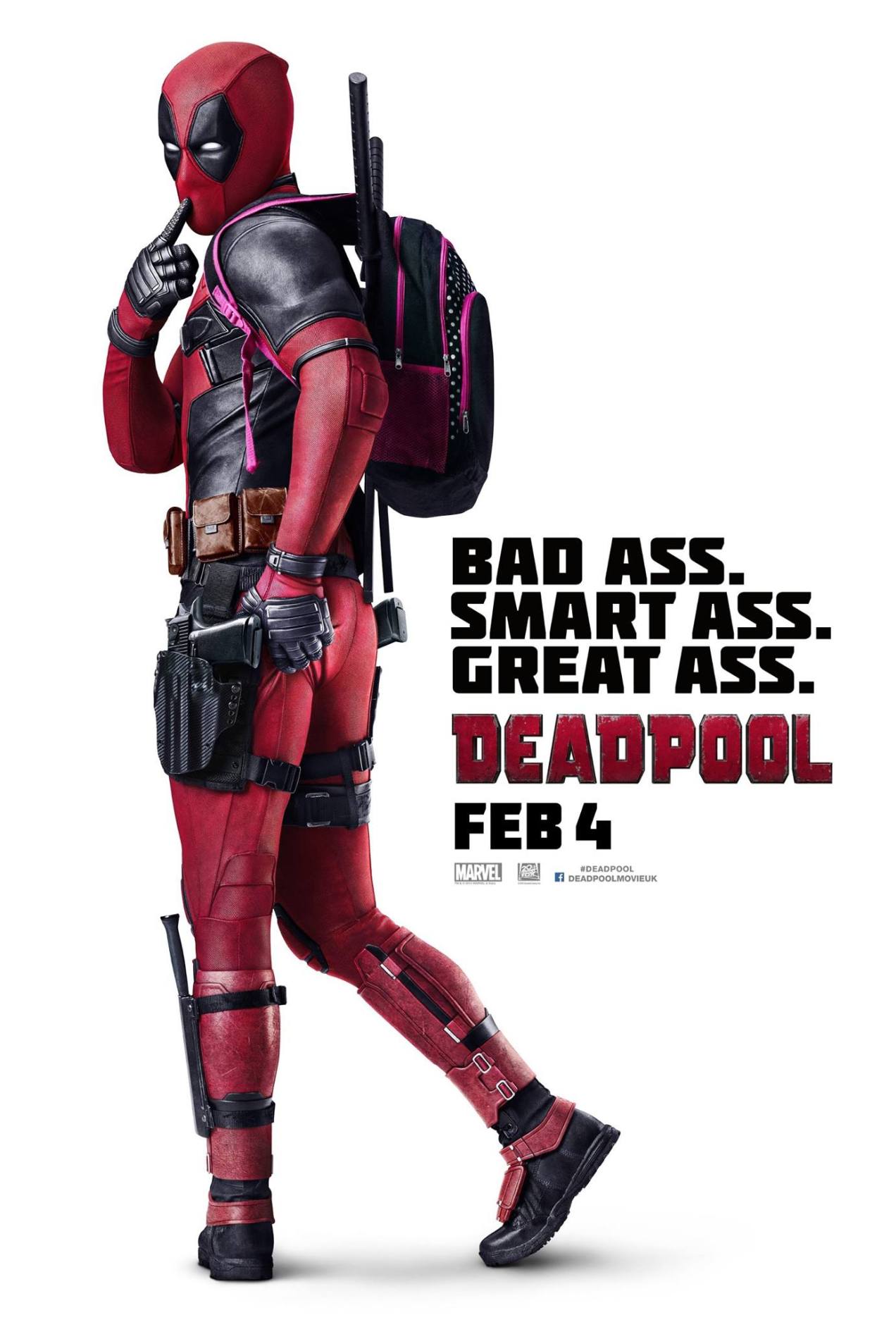
Deadpool

Genre: Action, Comedy

Director: Tim Miller

Screenplay: Rhett Reese, Paul Wernick

Cast: Ryan Reynolds, Morena Baccarin, Ed Skrein, T.J. Miller, Gina Carano, Leslie Uggams, Brianna Hildebrand, Karan Soni, Jed Rees, Stefan Kapicic, Randal Reeder, Isaac C. Singleton Jr.

Running Length:  107 minutes

Synopsis: Based upon Marvel Comics’ most unconventional anti-hero, Deadpool tells the origin story of former Special Forces operative turned mercenary Wade Wilson (Ryan Reynolds), who after being subjected to a rogue experiment that leaves him with accelerated healing powers, adopts the alter ego Deadpool. Armed with his new abilities and a dark, twisted sense of humor, Deadpool hunts down the man who nearly destroyed his life.

Review:  There’s no denying that the superhero movie genre is now one of the most popular, and in 2016 alone there are a whopping 7 superhero movies being released from both the Marvel and DC camps, with many more planned in the few years ahead. There’s also no denying that everyone is suffering from a little bit of superhero fatigue, which helps explain why Deadpool is such an appealing movie for many cinemagoers. After all, Deadpool is pretty much an anti-superhero, and together with one of the best movie marketing campaigns in recent years, have left many (including myself) anticipating the film with bated breath. Of course, it also helps that the film is being released in February instead of during the summer blockbuster season, with a much sparser release schedule.

Inspired marketing campaign aside, the actual Deadpool movie is indeed quite a refreshing change of pace, even though beneath that irreverent façade lies a pretty standard superhero origins movie. I’ve never witnessed any superhero (or movie, including spoofs) take so many potshots at the superhero movie genre, and in this aspect Deadpool is a tremendous success. Ryan Reynolds is totally in his element as the wisecracking, manic Deadpool, and his comic timing and delivery is close to flawless. Nothing is spared, and everything is fearlessly skewered – Ryan’s own failure in Green Lantern, the X-Men, even 20th Century Fox, and much, much more.

Deadpool also breaks the fourth wall repeatedly, turning to the audience and addressing them directly multiple times, and in one scene, even managing to break the fourth wall a second time while breaking the fourth wall (it truly needs to be seen to be believed). It’s smart to the point of being smart-alecky, and while a lot of it works, there are times where the self-aware, ironic shtick becomes a little tiresome.

The film is also not suited for everyone, as it is far raunchier and violent than usual superhero films, more than deserving of its R (locally, M18) rating.  However, if you have a stomach for the violence and are a fan of off-kilter humour, Deadpool will be a very rewarding cinematic experience that is refreshingly different from any other superhero movie before it.

Rating: *** (out of four stars)

Standard

Star Wars: Episode VII – The Force Awakens

Genre: Sci-Fi, Drama

Director: J.J. Abrams

Screenplay: Lawrence Kasdan & J.J. Abrams and Michael Arndt, based on characters created by George Lucas

Cast: Harrison Ford, Mark Hamill, Carrie Fisher, Daisy Ridley, Oscar Isaac, John Boyega, Adam Driver, Peter Mayhew, Domhnall Gleeson, Anthony Daniels, Andy Serkis, Lupita Nyong’o             

Running Length: 136 minutes

Synopsis: Thirty years after defeating the Galactic Empire, Han Solo (Harrison Ford) and his allies face a new threat from the evil Kylo Ren (Adam Driver) and his army of Stormtroopers.

Review: The wait is finally over – a ten-year hiatus has followed Episode III: Revenge of the Sith, but Star Wars makes a somewhat triumphant return to the big screen, this time under the stewardship of its new owner (Disney) and directed not by George Lucas, but by J. J. Abrams. While it is a solid, very entertaining space opera, and a good start to the new Star Wars trilogy (and its spin off movies), The Force Awakens feels somewhat encumbered by the baggage of being the “true” sequel of essentially the most revered movie franchise of all time, and the exceptionally high expectations that follow such a status. Abrams has done a very good job giving fans what they expect, but nothing much more than that.

Abrams has chosen to develop four new characters to succeed the thrones of Han Solo, Luke Skywalker and Darth Vader, and the casting choices are quite astute. Daisy Ridley and John Boyega are great as the heroes-to-be for the new trilogy, and Ridley is in particular a revelation. This relatively unknown British actress brings a graceful intensity and quiet strength to her role as Rey, and her performance reminds one of a younger Kiera Knightley. Boyega isn’t as commanding as Finn, but works well as a companion to Rey (somehow I am reminded of Jennifer Lawrence and Joss Hutcherson’s pairing in the Hunger Games franchise). Oscar Isaac is given significantly less to do in the show, but shows promise as the swashbuckling pilot Poe. Adam Driver is also quite memorable as the Kylo Ren, menacing and petulant at the same time, though as the main villain of The Force Awakens he comes up a little short.

It is somewhat surprising, however, that the new droid BB-8 has managed to upstage everyone else in the film. Abrams pays a lot of attention to this new spherical orange and white droid, and although he has no real dialogue, BB-8 manages to express a surprising variation of feelings and emotions, even when he is in the periphery of a scene. That he is also responsible for some of the biggest laughs in the film is also just the cherry on top. BB-8’s “performance” comes close to (or even possibly surpasses) what was achieved by WALL-E’s Eve and WALL-E, which is the gold standard.

Apart from drama, a good space opera should also serve up a fair share of action sequences. In this aspect The Force Awakens is a mixed bag – the first aerial dogfight (involving the Millenium Falcon) is a treat, but the remaining action sequences (yes, even the lightsaber battles) come across as being somewhat perfunctory. There’s an old-school feel to many of these scenes, which does not necessarily work in the film’s favour.

While it’s not a necessity to watch the preceding six films in the franchise, The Force Awakens assumes (not unreasonably, given how ingrained Star Wars is in our pop culture) knowledge of the Star Wars universe, and doles out heaps of fan service to its fans. For a Star Wars fan like myself, it’s impossible not to feel a stir of emotions when the Millennium Falcon makes its first appearance, or when anyone from the original trilogy shows up – Han Solo! Chewbacca! Princess Leia! Artoo! Admiral Ackbar! – but I could almost sense that Abrams and team had an omnipresent checklist and was striving to check off every item by the time the end credits rolled. This slavishness to the original trilogy sometimes makes The Force Awakens feel like a reboot of the franchise instead of a sequel.

This is the most critical flaw of The Force Awakens, and despite its top-secret plot and requests to keep reviews and commentary spoiler-free, there really are very few surprises to be had along the way. This lack of originality and freshness is something that many fans (including myself) would be willing to overlook, just to have the satisfaction of watching a new Star Wars movie on the big screen, but The Force Awakens is not a film that holds up very well to repeat viewings without the rose-tinted glasses of fandom and nostalgia. However, as the necessary fan-servicing is now mostly out of the way, I hope that Episodes VIII and IX will be given the freedom to explore new stories instead of retreading the old and familiar.

Rating: * * * (out of four stars)

Standard

The Good Dinosaur

Genre: Animation

Director: Peter Sohn

Screenplay: Meg LeFauve

Voice Cast: Jeffrey Wright, Frances McDormand, Maleah Padilla, Ryan Teeple, Jack McGraw, Marcus Scribner, Raymond Ochoa, Jack Bright, Peter Sohn, Steve Zahn, Mandy Freund, Steven Clay Hunter, A.J. Buckley, Anna Paquin, Sam Elliott, Dave Boat, Carrie Paff, Calum Mackenzie Grant, John Ratzenberger

Running Length: 101 minutes

Synopsis: The Good Dinosaur asks the question: What if the asteroid that forever changed life on Earth missed the planet completely and giant dinosaurs never became extinct? Pixar Animation Studios takes you on an epic journey into the world of dinosaurs where an Apatosaurus named Arlo (voice of Raymond Ochoa) makes an unlikely human friend called Spot. While traveling through a harsh and mysterious landscape, Arlo learns the power of confronting his fears and discovers what he is truly capable of.

Review: The Good Dinosaur revolves around one central “what if?” – what if the asteroid that wiped out the dinosaurs never hit Earth, and dinosaurs managed to survive for millions of years more? Although an interesting proposition, the story on show in The Good Dinosaur is extremely simplistic, and even in the hands of Pixar, the film very nearly feels like it’s a little too sparse in the plot department. Fortunately, it is Pixar after all, and the studio still manages to turn the film into a somewhat absorbing hour and a half, filled with cute critters, interesting vignettes and some of the best environmental animation I have ever seen in an animated film.

Although the setting is a bit off-kilter, the story of The Good Dinosaur develops in a very classic Disney style. After a rather predictable tragedy befalls Arlo’s family, Arlo gets (again, predictably) separated from his family and has to fend for himself – until he meets Spot. Yes, the reptile has a human pet, and this is just the beginning of a plethora of rather odd situations that film thrusts its viewers into. An extended sequence sees Arlo interacting with a family of T-Rex “cowboys”, and in one of the strangest sequences ever in a Pixar film, Arlo and Spot consume some hallucinogenic fruit and end up getting high on them. There’s a very good reason why the Good Dinosaur is rated PG, and parents of very young viewers may find this film to be somewhat unsuitable for their consumption.

Look past this general weirdness, and there are some gems to be found in the film. It’s filled with cute critters (and a number of rather disturbing ones) and there are sequences which are very fun to watch while not adding much to the main plotline. And to Pixar’s credit, they managed to include one extremely well executed sentimental scene where Arlo and Spot communicate their family history to each other with minimal dialogue. And whilst Arlo isn’t the most memorable central character in a Pixar film, the environmental animation certainly is. It’s incredible what Pixar managed to achieve here, with photorealistic environments that seem so lifelike I had to question if what I was seeing onscreen was culled from a nature documentary, and not digitally rendered 1s and 0s.

Despite all the visual splendor and a generally enjoyable viewing experience, it is undeniable that The Good Dinosaur firmly seats itself in the second-tier section of Pixar’s studio output. To have to follow an excellent film like Inside Out isn’t an easy thing to begin with, and the unyielding quirkiness of the storyline does the film no favours either.

Rating: * * * (out of four stars)

Standard

Spectre

Genre: Action, Thriller

Director: Sam Mendes

Screenplay: John Logan, Neal Purvis, Robert Wade, Jez Butterworth

Cast: Daniel Craig, Christoph Waltz, Lea Seydoux, Ralph Fiennes, Monica Bellucci, Ben Whishaw, Naomie Harris, Dave Bautista, Andrew Scott, Rory Kinnear, Jesper Christensen, Alessandro Cremona, Stephanie Sigman

Running Length: 148 minutes

Synopsis: A cryptic message from Bond’s (Daniel Craig) past sends him on a trail to uncover a sinister organisation. While M (Ralph Fiennes) battles political forces to keep the secret service alive, Bond peels back the layers of deceit to reveal the terrible truth behind Spectre.

Review: Given the very high bar that Skyfall had set, it was perhaps an unreasonable expectation that Spectre would outdo its predecessor, even if the production remains largely in the same hands. And while it is true that Spectre is a number of notches below Skyfall, it’s still a very decent Bond movie, and is actually more of a Bond movie than Skyfall is. It’s almost as though Sam Mendes, having broken the mould with Skyfall, had decided that his sophomore Bond effort would instead be something that comes much closer to the roots of the franchise.

Spectre opens with a (literal) bang, and minus the rather lackluster Sam Smith title song, ranks as one of the top Bond opening sequences in the franchise’s entire 53-year history. Set in Mexico on the Day of the Dead, the first five minutes is an ingeniously choreographed one-take tracking shot (mad props to Hoyte van Hoytema, who replaces Roger Deakin as DP), followed by an extended, equally stunningly orchestrated action sequence that culminates in a helicopter doing loop the loops over Zocalo Square. This is just the first of a number of great action set pieces in Spectre, and on their own makes the price of entry worthwhile.

This is Daniel Craig’s fourth appearance as James Bond, and he has firmly established himself as the best modern day Bond, handily beating out Timothy Dalton and Pierce Brosnan by a mile in every aspect (Sean Connery is still the iconic Bond for an old Bond fan like me). However, the rest of the cast simply fail to measure up, with both Bond girls Monica Belluci and Lea Seydoux lacking chemistry with Craig, and Christoph Waltz being particularly flat and uninspired as uber-villain Franz Oberhauser. Surprisingly, it’s the minor cast members that make more of an impression, none more so than Ben Whishaw’s expanded appearance as Q, and Andrew Scott’s detestable turn as government bigwig Max Denbigh.

Unlike Skyfall, there’s never a sense that anything is really at stake in Spectre, and it’s hard to be vested in any facet of the film, especially since the conclusion of any Bond film is a foregone one. It is somewhat surprising that Spectre isn’t pared down to a more manageable length, since the near two and a half hour running time does no favours to the film, and I found my interest flagging a little at times. There is definitely enough going on to not make the film feel like a bore, but it almost feels as though Mendes and crew got a bit lost along the way in an attempt to pull out all the stops for the film.

This is rumoured to be Daniel Craig’s last outing as Bond, and in a way that may not matter, since Spectre manages to wrap up the four-movie story arc quite nicely. It would not be surprising if this film becomes the end of yet another era, and a seventh actor will step up to take the mantle in the 25th Bond film. Although this isn’t the best Bond film in the Daniel Craig era, it will still be a decent swansong for the actor, and a tough act for the next James Bond to follow.

Rating: * * * (out of four stars)

Standard

The Walk

Genre: Drama

Director: Robert Zemeckis

Screenplay: Robert Zemeckis and Christopher Browne, based on the book “To Reach the Clouds” by Philippe Petit

Cast: Joseph Gordon-Levitt, Ben Kingsley, Charlotte Le Bon, James Badge Dale, Clement Sibony, Cesar Domboy, Benedict Samuel, Ben Schwartz, Steve Valentine, Mark Camacho

Running Length: 124 minutes

Synopsis: Twelve people have walked on the moon, but only one man – Philippe Petit (Joseph Gordon-Levitt) – has ever, or will ever, walk in the immense void between the World Trade Center towers. Guided by his real-life mentor, Papa Rudy (Ben Kingsley), and aided by an unlikely band of international recruits, Petit and his gang overcome long odds, betrayals, dissension and countless close calls to conceive and execute their mad plan.

Review: Movies worth watching in 3D come extremely few and far between, and I’ve always advocated sticking to 2D for the large majority of films that offer both options. However, The Walk is a movie that truly deserves to be seen on the big screen and in 3D (fortunately, it’s available in IMAX 3D locally, the largest possible format), and it’s my recommendation to go that route in order to maximize the viewing experience that The Walk will provide. In fact, if one does not watch The Walk in IMAX 3D, there’s very little compelling reason to watch the film in any other format.

The Walk takes its own sweet time to get started, with the first hour being largely unnecessary exposition filled with characters that populate the film but possess little to no depth (unfortunately that includes Joseph Gordon-Levitt’s portrayal of Petit, though he still imbues the character with a boatload of charm). However, once we move on to the actual attempt to walk the wire across the two World Trade Center towers, things become a lot more interesting. The setup of the walk feels like a heist movie, and is quite an entertaining segment of the film. The logistical challenge of sneaking the equipment into the towers and the actual setup of the line is nothing to sniff at, and while truncated, Zemeckis does manage to wring a lot of entertainment value out of this third of the film.

And then there’s the last reel of the movie, which covers the walk itself. This is the big payoff for the film, and manages to counterbalance all the faults that the film contained prior to this glorious sequence. When viewed in IMAX 3D, the walk is nothing short of a spectacle – you could almost believe that the towers are real, and the dizzying sense of vertigo is enhanced with the huge screen and 3D. In fact, anyone with a fear of heights might find themselves feeling a bit of anxiety over how realistic some parts of the sequence are. The technical wizardry employed to bring this segment to life is truly impressive and I am pretty sure that The Walk is a shoo-in for at least a handful of technical award nominations next Oscar season.

This is not the first big-screen treatment of Petit’s historic walk across the twin towers, as it was also the subject matter of the eminently watchable documentary Man on Wire in 2008. Truth be told, the documentary tells the tale better, but in terms of visuals The Walk wins out by a large margin. This will not be a movie that would work well on the small screen, so make plans to head down to a cineplex near you if a visceral cinematic experience is what you’re after.

Rating: * * * (out of four stars)
Standard

The Man from U.N.C.L.E.

Genre: Action

Director: Guy Ritchie

Screenplay: Guy Ritchie, Lionel Wigram

Cast: Henry Cavill, Armie Hammer, Alicia Vikander, Elizabeth Debicki, Luca Calvani, Hugh Grant

Running Length: 116 minutes

Synopsis: Set against the backdrop of the early 1960s, at the height of the Cold War, The Man from U.N.C.L.E. centers on CIA agent Napoleon Solo (Henry Cavill) and KGB agent Ilyas Kuryakin (Armie Hammer). Forced to put aside hostilities, the two team up on a joint mission to stop a mysterious international criminal organization bent on destabilizing the fragile balance of power through the proliferation of nuclear weapons and technology. The duo’s only lead is the daughter of a vanished German scientist, who is the key to infiltrating the criminal organization, and they must race against time to find him and prevent a worldwide catastrophe.

Review: Say what you will about this remake (yes, another 60’s TV franchise has made the transition), but The Man from U.N.C.L.E. is undeniably a feast for the eyes, and dripping with style to boot. Those looking for a traditional action blockbuster need look no further than the recent Mission: Impossible film, but The Man from U.N.C.L.E. resembles its leads – a charming (if shallow) diversion, and really fun to watch despite its flaws.

The Man from U.N.C.L.E. boasts a fantastic look – the attention to period detail is meticulous, and the illusion is sometimes so complete that it almost feels like a film that was actually made in the 60s, and not shot in 2015. It is also accompanied by an excellent soundtrack, employed to great effect by Guy, and even sneaks in snippets of the original TV theme song. The leads are also very easy on the eye, but both leading men are quite flat, particularly Henry Cavill. The women fare much better, and Armie Hammer’s performance is somewhat mitigated by his strong sexual chemistry with Alicia Vikander’s Gaby, who more than holds her own when paired against both men. The most memorable and delightful performance, however, goes to Elizabeth Debicki’s Victoria Vinciguerra, who slinks around the screen, almost purring with evil and menace.

Although positioned as an action blockbuster, Guy Ritchie does not display a good handle on the larger action setpieces. In fact, the climactic chase sequence feels kind of watered down and is about as unmemorable as it can get. Where Guy excels, however, are the more casual scenes, and most audiences will walk away with a deeper impression of Napoleon Solo snacking in a truck or the two men bickering over what fashions work best for undercover spies. There’s a lot of humour to be found in the movie, and this definitely makes the slightly over-long film a much more entertaining affair.

While this is ostensibly an origins story of The Man from U.N.C.L.E., it’s safe to say that not many viewers will even be familiar with the original TV series, so the film can pretty much stand on its own merits. Although the film does set up the backstory of the protagonists and leaves the door open for a sequel, the fact that Guy Ritchie has chosen to “date” this first film with a 1960s aesthetic means that a franchise is somewhat unlikely (though not impossible – see Austin Powers). I, for one, would welcome the possibility of a sequel, if only to see if Iilyas and Gaby would finally get down and dirty.

Rating: * * * (out of four stars)

Standard

Mission: Impossible – Rogue Nation

Genre: Action

Director: Christopher McQuarrie

Screenplay: Christopher McQuarrie

Cast: Tom Cruise, Jeremy Renner, Simon Pegg, Rebecca Ferguson, Ving Rhames, Sean Harris, Simon McBurney, Zhang Jingchu, Tom Hollander, Jens Hulten, Alec Baldwin

Running Length: 131 minutes

Synopsis: Ethan Hunt (Tom Cruise) and the rest of the IMF team take on their most impossible mission yet, eradicating the Syndicate – an International rogue organization as highly skilled as they are, committed to destroying the IMF.

Review: With the box office success of Mission: Impossible – Ghost Protocol, it was inevitable that there would be a fifth movie in the M:I series, but it is still somewhat surprising to see Tom Cruise tackle the role with such energy and conviction after a 19-year run. Now 53 years of age, Cruise seems to have taken after the Jackie Chan model of filmmaking, eschewing green screen and digital trickery with actual balls-to-the-wall stuntwork apparently performed mostly by himself. Regardless of what has gone on in his personal life (and the recent HBO documentary on Scientology will do no favours for his already tarnished image), Cruise continues to impress in his performance as Ethan Hunt, and is largely the reason why Rogue Nation works, even though the film does not supplant Ghost Protocol as the best film thus far in the franchise. 

The earlier M:I films had valued style over substance, and the plot threads were exceedingly confusing to follow for audiences. This had improved dramatically in Ghost Protocol, and in Rogue Nation the trend continues, with the relatively straightforward plot pretty much checking off everything a stock spy thriller should contain – a menacing supervillain, a femme fatale with dubious loyalties, multiple locations across the globe, thrilling car chases and visceral action sequences. While James Bond still holds the crown for the spy movie genre (particularly the current Daniel Craig era films), Ethan Hunt and the IMF is a close second. 

There is no doubt that Mission: Impossible is a star vehicle for Tom Cruise, and he still manages to hold the fort here with impressive ease. Apart from his physicality, Cruise remains a charismatic actor, and plays his roguish charms here to the hilt. Rebecca Ferguson is a capable foil as the aptly-named Ilsa Faust, and kudos to McQuarrie for creating a strong female character that very rarely reverts to damsel-in-distress mode, who surprisingly is not positioned as a “Bond Girl” love interest for Hunt. Simon Pegg’s role was largely played for laughs in Ghost Protocol, but in Rogue Nation he has become a key character, though most of the comedic work in the film still falls squarely on Pegg’s shoulders. The other returning characters – Alec Baldwin, Jeremy Renner and Ving Rhames – are unfortunately sidelined and barely given enough to do to justify their presence here. Although there seems to be strong Chinese financial backing for the film, the only Chinese actress present, Zhang Jingchu, has such a minimal blink-and-miss-it role that her inclusion seems to be purely an afterthought.  

Disappointingly, despite screening in IMAX theatres, none of the footage in Rogue Nation seems to have been shot on IMAX cameras (compared to the near half-hour of IMAX footage found in Ghost Protocol). The film still dazzles on the largest screen format, but does not boast the immersiveness that Ghost Protocol had. Given that the action set-pieces in Rogue Nation are as impressive as Ghost Protocol, this truly feels like a wasted opportunity. However, Rogue Nation remains a strong entry in the M:I franchise, and it would not be surprising that a sixth installment is greenlit based on the box office performance of this one. 

Rating: * * * (out of four stars)

Standard

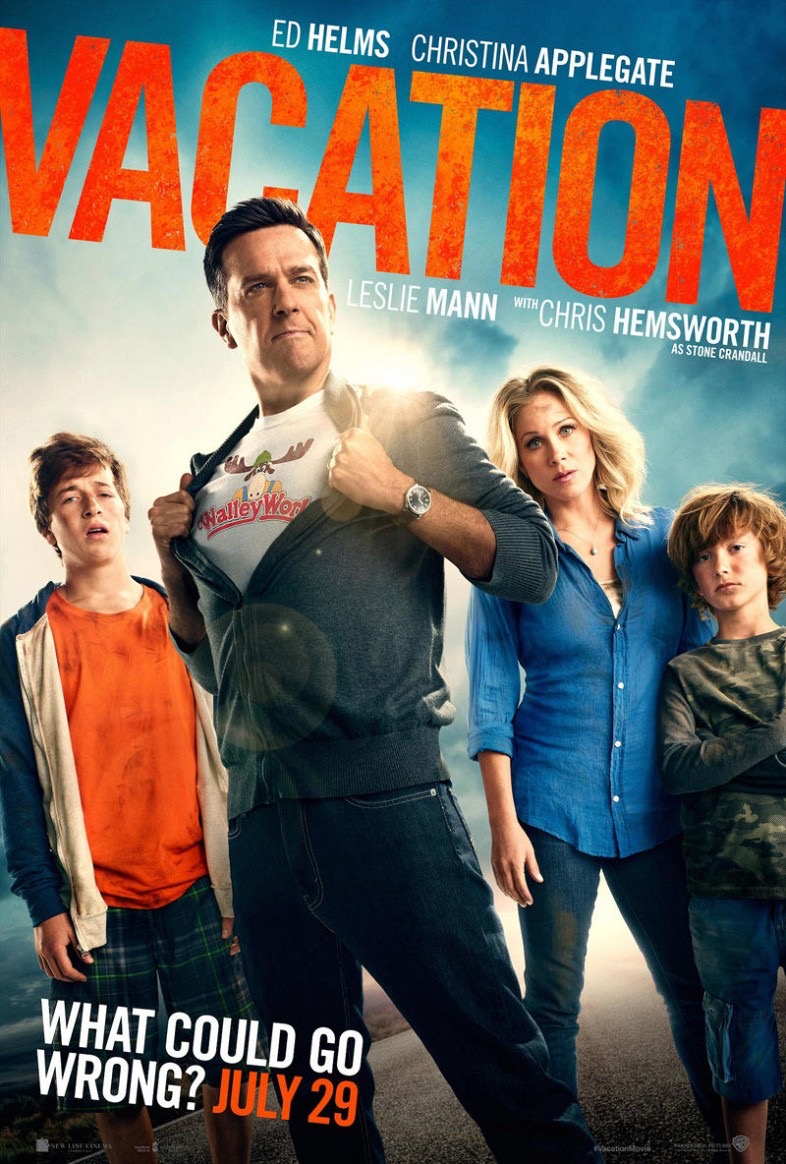
Vacation

Genre: Comedy

Directors: Jonathan Goldstein, John Francis Daley

Screenplay: Jonathan Goldstein, John Francis Daley

Cast: Ed Helms, Christina Applegate, Skyler Gisondo, Steele Stebbins, Chris Hemsworth, Leslie Mann, Chevy Chase, Beverly D’Angelo, Charlie Day, Catherine Missal, Ron Livingston, Norman Reedus, Keegan-Michael Key, Regina Hall, E’Myri Crutchfield, Alkoya Brunson, Hannah Davis

Running Length: 98 minutes

Synopsis: The next generation of Griswolds is at it again – and on the road for another ill-fated adventure. Following in his father’s footsteps and hoping for some much-needed family
bonding, a grown-up Rusty Griswold (Ed Helms) surprises his wife Debbie (Christina Applegate), and their two sons with a cross-country trip back to America’s “favourite family fun park”, Walley World.

Review: It has been 32 years since the first Vacation movie opened, and while it is surprising (in this age of remakes and reboots) that a sequel to the franchise hasn’t come along in quite some time (the last official installment being National Lampoon’s Christmas Vacation 2 back in 2003), this new Vacation actually manages to do very well for itself. Of course, this is also because the expectations for such a movie is quite simple – it just needs to be entertaining and funny, and in these aspects the movie more than delivers.

Shifting focus from Clark Griswold to his son Rusty, now played by Ed Helms, the premise remains largely the same – Rusty is on a quest to bring his family on a road trip to Walley World, and hilarity ensues. Sure, it’s a wildly inconsistent film that perhaps gave away a little too much in its trailers, but when it hits a comedic sweet spot, Vacation can be a truly hilarious experience. Like most comedies of our era, this new episode of Vacation does delve a bit deeper into gross-out and scatological humour that its predecessors, but at least they are well-executed gags (Christina Applegate’s unfortunate visit to her alma mater is a particularly noteworthy one).

It’s to Goldstein and Daley’s credit that they have managed to find some new material for such a well-treaded subgenre – having the younger sibling be the bully is an inspired choice, for example, and breathes new life into the family dynamics of the Griswolds. There are also a good number of cameo appearances, and almost all these don’t disappoint either. Without going into spoilers, the Michael Day sequence as a white water rafting guide is both filmed innovatively and manages to bring on the belly laughs. Of course, it would be a crime not to mention Chris Hemsworth’s cameo as the extremely well-endowed Stone Crandall, and for some this extended sequence with Stone and Rusty’s sister Audrey (Leslie Mann) alone would be worth the price of admission.

Although Vacation starts to flag and lose the energy in its final reel, there’s enough goodwill in the lead up to not make the film feel like a total bust. There’s a nice, affable chemistry amongst the members of the Griswold family, and together with the high hit to miss ratio for the comedic elements, makes Vacation a worthy successor to the Vacation series and a fun cinematic experience for the grown-ups (its M18 rating is a well-deserved one), even if it doesn’t really come close to the iconic status and cultural relevance of the first film.

Rating: * * * (out of four stars)

Standard