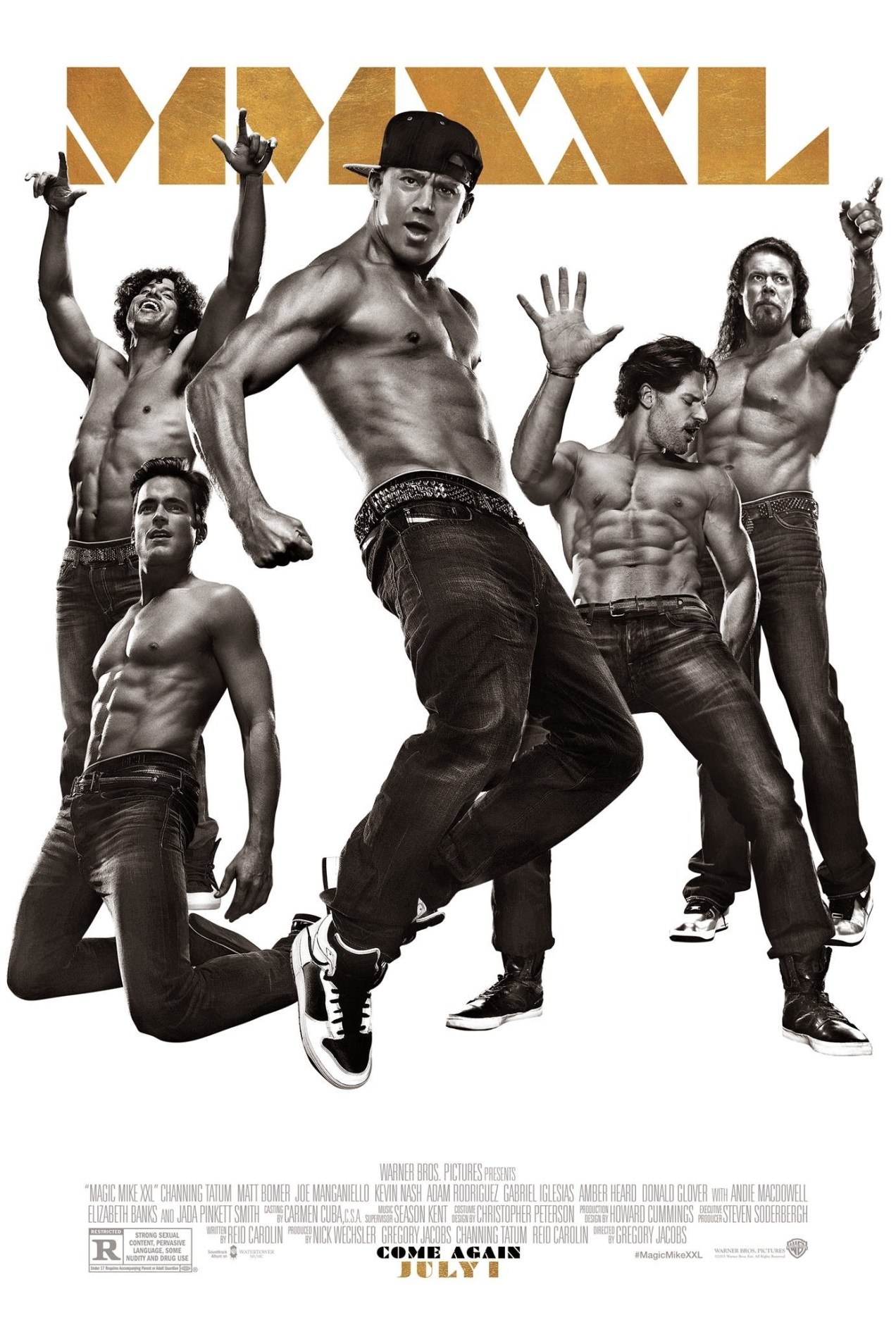
Magic Mike XXL

Genre: Drama

Director: Gregory Jacobs

Screenplay: Channing Tatum, Reid Carolyn

Cast: Channing Tatum, Matt Bomer, Joe Manganiello, Kevin Nash, Adam Rodriguez, Gabriel Iglesias, Amber Heard, Jada Pinkett Smith

Running Length:  115 minutes

Synopsis: Picking up the story three years after Mike (Channing Tatum) bowed out of the stripper life at the top of his game, Magic Mike XXL finds the remaining Kings of Tampa likewise ready to throw in the towel. But they want to do it their way: burning down the house in one last blow-out performance in Myrtle Beach, and with legendary headliner Magic Mike sharing the spotlight with them. On the road to their final show, with whistle stops in Jacksonville and Savannah to renew old acquaintances and make new friends, Mike and the guys learn some new moves and shake off the past in surprising ways.

Review: While Magic Mike was one of the bigger surprises in 2012 – although it’s about male strippers, in the end it was the power of storytelling that held the movie together, and not the strip acts – Magic Mike XXL is much less of a surprise. It’s essentially a road trip movie involving a bunch of old friends, except that they are “male entertainers” who get their kits off quite a number of times along the way. One thing that’s for sure – if you enjoyed the acts in the first Magic Mike, this aspect has been truly upsized (the movie title is not a lie) and more than earns the film its M18 rating, which probably isn’t a bad thing for the intended audiences.

There’s no real reason for this sequel to exist, and it clearly shows in the paper-thin plot that the film hangs onto. No matter, since the majority of audiences would have other things on their mind anyway. Yet, there’s a certain charm to the laid-back, almost impromptu style of storytelling that Magic Mike XXL has chosen to employ, which is in contrast to how Soderbergh chose to present the original Magic Mike. The film is also genuinely funny – there are little moments along the way that ensures a belly laugh or two, none more so than the hilarious gas station sequence where Richie (Joe Manganiello) tries to make the attendant smile.

What’s more interesting is that Magic Mike XXL is obtusely a girl-power movie: although the main cast is dripping with testosterone, the positions of power in the film are almost exclusively female – Jada Pinkett Smith as the steely yet sultry strip club owner cum (ahem) emcee, Andie McDowell’s cameo as an aging but rich Southern belle, Elizabeth Banks as the owner of the male stripper “convention”, and even all the women that are busy throwing money at the strippers. This is a movie made for the ladies (sorry guys – both straight and gay, although more the former than the latter), make no mistake about that.

And of course there’s the strip acts – lensed and edited impeccably by Soderbergh himself (under his Peter Andrews pseudonym) and choreographed flawlessly, the scenes in Domina and the finale really showcase what would imaginably be the top tier of male strip acts in the real world. Rarely has a movie been able to convey the steaminess of such acts without coming across as being sleazy, and while there are times where the movie toes the line, it will successfully leave many audiences feeling hot and bothered. And how can anyone actively hate on a film that can evoke such a visceral response?

Rating: * * * (out of four stars)

Standard

Jurassic World

Genre: Action/Sci-Fi

Director: Colin Trevorrow

Screenplay: Rick Jaffa, Amanda Silver, Derek Connolly, Colin Trevorrow, based on the novels by Michael Crichton

Cast: Chris Pratt, Bryce Dallas Howard, Vincent D’Onofrio, Nick Robinson, Ty Simpkins, B.D. Wong, Irrfan Khan, Omar Sy

Running Length: 123 minutes

Synopsis: Located off the coast of Costa Rica, the Jurassic World luxury resort provides a habitat for an array of genetically engineered dinosaurs, including the vicious and intelligent Indominus Rex. When the massive creature escapes, it sets off a chain reaction that causes the other dinosaurs to run amok. Now, it’s up to a former military man and animal expert (Chris Pratt) to use his special skills to save two young boys and the rest of the guests from an all-out, prehistoric assault.

Review: It has been a long time since the Jurassic Park franchise has seen the big screen, with the last (rather dismal) movie, Jurassic Park III released in 2001. Stuck in development hell for over a decade, Jurassic World represents a somewhat triumphant return for the franchise, though it would be hard to imagine there being enough interest for a fifth installment. Jurassic World boasts excellent visuals, and strong performances from leads Chris Pratt and Bryce Dallas Howard, but is a little let down near the end when the CG takes over the movie, like so many films these days are wont to do.

The 22-year old Jurassic Park was one of the first movies to make use of the then cutting-edge computer generated imagery, and the awe and wonder of seeing dinosaurs come to “life” can never be replicated in present times. The CGI in Jurassic World is miles ahead of the original film, but that’s honestly a given these days when technology has advanced so far. But, probably akin to the jaded amusement park attendees that populate Jurassic World, it doesn’t stir the soul like that Brachiosaurus reveal in the first film. Perhaps that’s the power of nostalgia speaking, but Jurassic World also falls to the uniquely present-day trap of letting the CGI do the acting – without going into spoilers, the finale sequence feels entirely (and probably is) artificial, and hence it was difficult to vest myself in the outcome in any way.

Although it works as a standalone film, Jurassic World assumes prior knowledge of the Jurassic Park films, never really delving into the backstory of the theme park. There are also a multitude of references to the first movie, which will particularly resonate with fans of Jurassic Park (aren’t we all, though). Michael Giacchino, who takes over the scoring of the movie from John Williams, does not shy away from the well-known musical cues from Jurassic Park either, although his score can feel a bit too bombastic at times. While it would be good to see Jurassic Park on as large a screen as possible to take in the majesty of the imagery, 3D is once again absolutely pointless and should be avoided.

Chris Pratt has really stepped up his Hollywood leading man game, and in Jurassic Park he channels his performance in Guardians of the Galaxy – funny and macho at the same time, he’s instantly likeable as Owen. Bryce Dallas Howard has the slightly more uphill task, since she needs to play both the “modern” action heroine and the “traditional” damsel in distress, and the duality does not work very well at times. She does share great onscreen chemistry with Pratt, which makes much of their interaction pleasant to watch. However, the Jurassic Park franchise has never been about the human actors, and relies more on its dinosaur counterparts. In this aspect the movie is not as successful. Although the Indominus Rex is positioned as a bad-ass dinosaur that’s even more dangerous than a T-Rex, she doesn’t really feel all that menacing onscreen. The velociraptors also make a return, but once again they come across as rather tame and certainly not as intelligent as the old raptors seemed to be.

No movie in the franchise will ever compare to the original, but it’s easy to place Jurassic World as the second-best film thus far. I am firmly of the opinion, however, that this should mark the end of the franchise – there’s no room in the franchise for any additional plot development, and any sequel after this one will be flogging a dead horse. I won’t put it past the studio executives to greenlight more films, especially if Jurassic World does well, but if this is indeed the swan song, it will conclude the franchise on a relatively high note.

Rating: * * * (out of four stars)
Standard

Good Kill

Genre: Drama

Director: Andrew Niccol

Screenplay: Andrew Niccol

Cast: Ethan Hawke, Bruce Greenwood, Zoe Kravitz, January Jones

Running Length: 102 minutes

Synopsis: In the shadowy world of drone warfare, combat unfolds like a video game – only with real lives at stake. After six tours of duty, Air Force pilot Tom Egan (Ethan Hawke) yearns to get back into the cockpit of a real plane, but he now fights the Taliban from an air-conditioned box in the Las Vegas desert. When he and his crew start taking orders directly from the CIA, and the stakes are raised, Egan’s nerves – and his relationship with his wife (January Jones) – begin to unravel. Revealing the psychological toll drone pilots endure as they are forced to witness the aftermath of their fight against insurgents, Andrew Niccol directs this riveting insider’s view of 21st-century warfare, in which operatives target enemies from half a world away.

Review: What happens when war can be conducted remotely, when obliterating human lives is reduced to an operator using a joystick thousands of miles away, and reviewing the carnage on a monitor? Does this reduce the emotional toll of war for the aggressor, and does it result in a more clinical, detached view of the casualties and collateral damage of waging a war? This is the grim scenario and tough questions that Good Kill puts forth, and is indeed one of the most relevant war movies that has been released in years. However, Andrew Niccol has directed and written the movie with a rather heavy hand, which actually lessens the impact that the movie has on audiences.

Ethan Hawke puts forth a solid, credible performance as Thomas Egan, and manages to convey a complex gamut of emotions without that many lines of dialogue. Unfortunately, the same cannot be said of his supporting cast – almost everyone is used either as a plot device or an expositional tool, and remains essentially dimensionless as characters.

Given the nature of the interactions in Good Kill, there is very little action to be had, but Niccol manages to ramp up the tension even given these confines. Although the action is viewed vicariously through a TV monitor and usually without any sound, it remains riveting and visceral, with such a high level of perceived realism that I found myself holding my breath each time the trigger is pulled. This is by far the most successful aspect of the film, and one that would likely stay with the viewer long after the credits roll.

Although it’s undeniable that Niccol has picked a very timely and relevant topic in Good Kill, his incessant soapboxing and moralizing comes across as a bit too much. It also doesn’t help that the various subplots (particularly the unnecessary romantic tension between Egan and new airman Suarez (Zoe Kravitz)).  Even the disembodied voice from Langley barking out executive commands via conference call falls prey to this, having to explain the administration’s rationale for issuing morally ambiguous kill orders at every turn. It’s a particularly clunky way of putting one’s point across, important as it may be.

Rating: * * * (out of four stars)

Standard

Marvel’s The Avengers: Age of Ultron

Genre: Action

Director: Joss Whedon

Screenplay: Joss Whedon

Cast: Robert Downey Jr., Chris Hemsworth, Mark Ruffalo, Chris Evans, Scarlett Johansson, Jeremy Renner, Don Cheadle, Aaron Taylor-Johnson, Elizabeth Olsen, Paul Bettany, James Spader

Running Length: 141 minutes

Synopsis: When Tony Stark tries to jumpstart a dormant peacekeeping program, things go awry and Earth’s Mightiest Heroes, including Iron Man, Captain America, Thor, The Incredible Hulk, Black Widow and Hawkeye, are put to the ultimate test as the fate of the planet hangs in the balance. As the villainous Ultron emerges, it is up to The Avengers to stop him from enacting his terrible plans, and soon uneasy alliances and unexpected action pave the way for an epic and unique global adventure.

Review: It cannot be denied that despite being an utterly successful commercial venture (and having other film studios scrambling to create similar franchises), the Marvel Cinematic Universe is starting to feel a little tired. Although this is “just” the second proper Avengers movie, it is also the 11th film in the Cinematic Universe, with just one more film to go (Ant-Man, coming in July) before Phase 2 ends and Phase 3 begins with TEN more movies on the slate, stretching all the way to 2019. To say that there’s a surfeit of superhero movies is an understatement, and one does wonder how long the gravy train can keep on chugging. 

Thankfully, there’s a dichotomy in Avengers: Age of Ultron that is rarely seen in the Cinematic Universe – the film delivers on the big action sequences that people have come to expect from these movies, and yet focuses the plot largely on the smaller characters that don’t have a dedicated movie (or movies) to their name. This approach adopted by Joss Whedon is really only possible in a franchise as developed as the Marvel one, since there is the luxury of time to tell the tale over multiple movies, and Age of Ultron is better for it.

Ultron, the titular mega-villain, stands head and shoulders above many of the other bland villains that have populated much of the MCU movies. He poses a credible threat and is a worthy opponent to the Avengers, and because he is literally heartless, there is actually a sense of peril pervading parts of the movie. Joss Whedon also tries to humanize a number of the Avengers, most notably Bruce Banner, Black Widow and Haweye, as well as newcomers Quicksilver and Scarlet Witch, giving them romantic subplots and human backstories that fill in the gaps between the action set-pieces.

Although this may sound like nit-picking, it’s actually the action set-pieces that bring Age of Ultron down a notch. Like the first Avengers movie, action sequences come across as being slightly over-edited, with so many cuts that the action actually becomes a little muddled. This is most apparent in the showdown between the Hulk and Iron Man (in a pretty cool Hulkbuster suit), which is edited with such a quickfire pace that it almost feels like a scene out of the Transformers franchise – which is not a good thing. Watching the film in 3D also exacerbates the issue while adding virtually nothing in the third dimension, and an IMAX non-3D screening would probably be the most optimal viewing experience.

It’s become apparent, especially in Phase 2 of the MCU, that the movies can no longer be entirely judged on their individual merit. As a standalone film, Age of Ultron has its flaws in terms of pacing and editing, but when viewed as a key film in Phase 2 of the MCU, it fares better – not only does it wrap up some loose ends from the preceding movies, it also begins the narrative arc of Phase 3, introducing a number of new superheroes that should come into their own when the next Phase begins.  There is a compelling story to be found in Age of Ultron, and despite it being what is essentially the middle film in the Avengers trilogy (now a quadrilogy, to be exact), doesn’t suffer too much from the middle-child syndrome.

Rating: * * * (out of four stars)
Standard

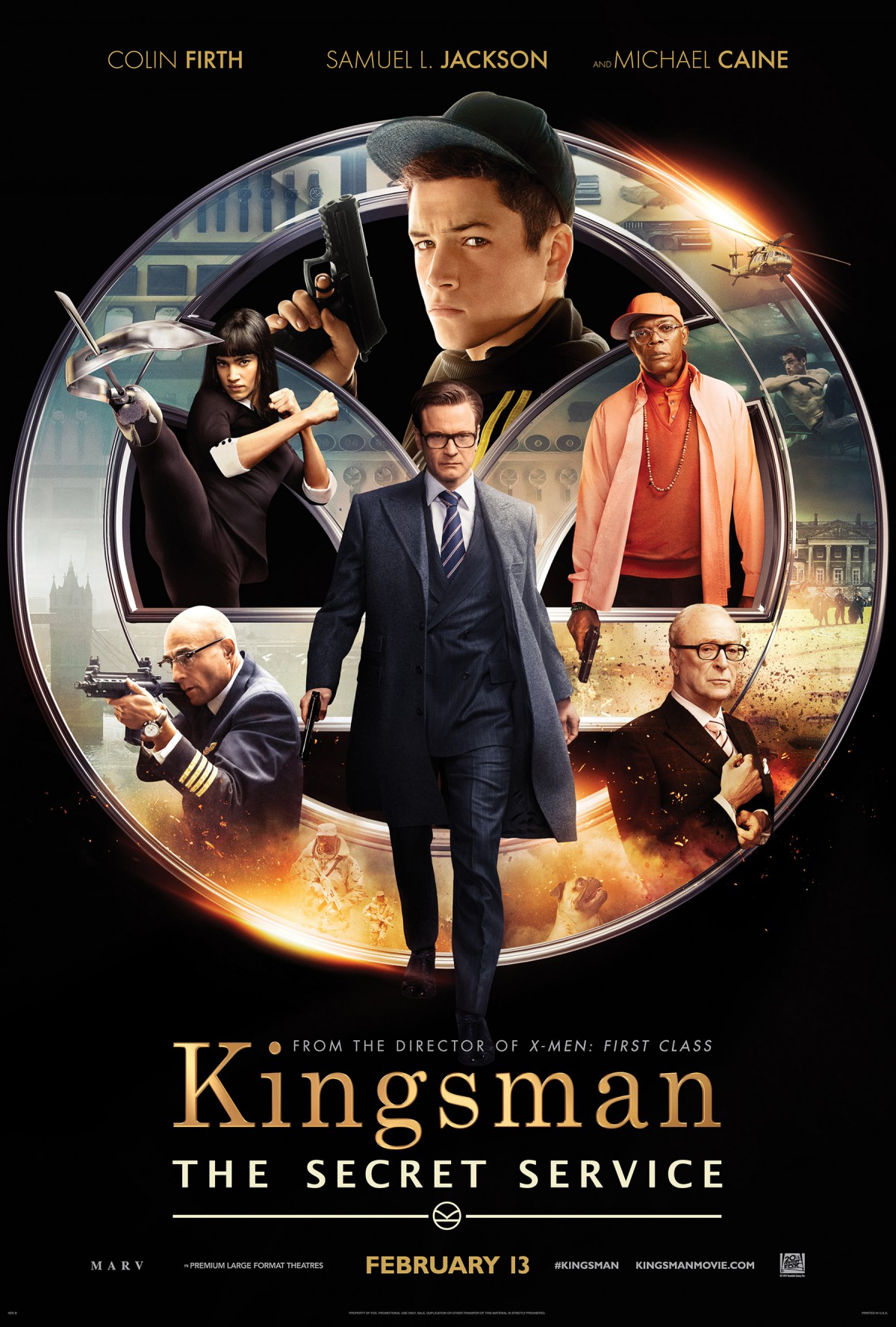
Kingsman: The Secret Service

Genre: Action

Director: Matthew Vaughn

Screenplay: Jane Goldman, Matthew Vaughn, based on the comic book “The Secret Service” by Mark Milar, Dave Gibbons

Cast: Colin Firth, Samuel L. Jackson, Mark Strong, Taron Egerton, Sophie Cookson, Jack Davenport, Mark Hamill, Sofia Boutella, Edward Holcroft, Jack Cutmore-Scott, Geoff Bell, Samantha Womack, Michael Caine

Running Length: 129 minutes

Synopsis: Based upon the acclaimed comic book and directed by Matthew Vaughn (Kick-Ass, X-Men: First Class), the film tells the story of a suave, old-school British superspy who recruits an unrefined but promising street kid into his agency’s ultra-competitive training program just as a global threat emerges from a twisted American entrepreneur.

Review: For those who think that James Bond is too stuffy for them, Kingsman is here to the rescue. Taking the British spy thriller genre and spinning it on its head, Vaughn has managed to create one of the most entertaining comic book adaptations and spy movies I have seen in a while. Yes, the plot is absurd and stretches plausibility to breaking point, but it’s a very enjoyable movie to sit through (with a caveat – more on that later), with slick, polished visuals and a great sense of style and humour. It also establishes Colin Firth – surprise, surprise – as a bona fide action movie star, reminiscent of what Taken managed to do for Liam Neeson’s career.

Kingsman does not pretend to be anything else than a glossily packaged spy movie parody, but unlike many parodies, it is a top notch production while wearing its intentions proudly on its immaculately tailored sleeve. Newcomer Taron Egerton is highly charismatic and likably cocky, a perfect fit as the fledging spy-in-training under Colin Firth’s wing. Firth manages to show off a hitherto unseen action hero skill set while remaining impeccably coiffed in his suit. They are ably complemented by a strong ensemble cast, with Samuel L. Jackson stealing the limelight (as he’s prone to do) as a lisping megalomaniac with a strange aversion to blood, and special mention going to Algerian dancer Sophie Boutella as an updated Oddjob (known aptly as Gazelle here), brandishing the coolest killer prosthetic legs I’ve ever seen.

Audiences who have seen Vaughn’s Kick-Ass would be aware that he is not one to shy away from violence, and there is certainly a lot of near-gratuitous violence to be found in Kingsman. The hyperviolence is not for all audiences, and there will be some viewers who may feel it’s a bit too much (the church sequence – no spoilers – can particularly be rather disturbing, even if one takes it purely at face value). The plot makes no sense whatsoever, more at home in the Austin Powers franchise than the Bond franchise, but if one is willing to go along for the ride and not take things too seriously, it is a thrilling, highly entertaining movie well worth its price of admission.

Rating: * * * (out of four stars)

Standard

The Theory of Everything

Genre: Drama

Director: James Marsh

Screenplay: Anthony McCarten, based on the book “Travelling to Infinity: My Life with Stephen” by Jane Hawking

Cast: Eddie Redmayne, Felicity Jones, Charlie Cox, Emily Watson, Simon McBurney, David Thewlis, Maxine Peake

Running Length: 123 minutes

Synopsis: The Theory of Everything tells the story of one of the world’s greatest living minds, astrophysicist Stephen Hawking (Eddie Redmayne), and his marriage to Jane Hawking (Felicity Jones), and their eventual separation.

Review: There’s an inherent difficulty, presumably, when making a biopic of someone who is still alive, and in The Theory of Everything, this is exacerbated since it is about one of the most brilliant minds of our time. There is a reverence in James Marsh’s direction, a restraint in portraying the more negative aspects between Stephen Hawking’s marriage to his first wife, Jane, that makes the film feel detached and a little neutered. Fortunately, Eddie Redmayne’s performance is a spectacular one, so much so that it manages to make the flaws of the film a lot easier to bear.

The Theory of Everything is a well-made film – production values are good and the cast’s performances are all fine, but it all comes across as feeling very safe and conventional. Perhaps due to covering such an extended time period, there are only superficial looks into Hawking’s life and loves, providing as much insight into Hawking as skimming through his Wikipedia entry.

Eddie Redmayne’s portrayal of Hawking is a revelation, rising head and shoulders above the rather mediocre script. An actor with a relatively short CV, there’s nothing in his career prior to The Theory of Everything that suggested his acting capabilities being able to pull off something of this magnitude. And yet he does, not just in his ability to mimic the real Hawking, trapped in a wheelchair and his body contorted and ravaged by motor neurone disease, but in the scenes leading up to the disease becoming full-blown, where little movements suggest the eventual onset of the disease.

Redmayne completely disappears into character and it’s one of those physical transformations that Hollywood loves (in the Oscar wars, he seems to be shaping up to be the one to beat, despite an extremely stacked nominations list this year). When eventually Redmayne has to play the entirely incapacitated Hawking (who has also by then lost his ability to speak), he is essentially acting with just his eyes and is akin to Mathieu Amalric’s seminal performance  in The Diving Bell and the Butterfly. Felicity Jones put forth a spirited performance as Jane Hawking, but no one else really manages to come close to him.

Although the film is based on Jane Hawking’s second memoir about her life with Stephen, the speed at which the narrative goes through the years means that there’s actually very little meaningful conflict between the leads, resulting in a pretty flat narrative tone. This is particularly noticeable in the final reels, when Stephen and Jane’s marriage is on the rocks, because everyone still remains unyieldingly nice and civil towards each other. Treating the subject matter with kid gloves neuters it, rendering some of the scenes less powerful than they should have been. As it stands, while it’s a good, well-made biopic, it probably wouldn’t stand the test of time as being a definitive biopic of Stephen (or Jane) Hawking.

Rating: * * * (out of four stars)

Standard

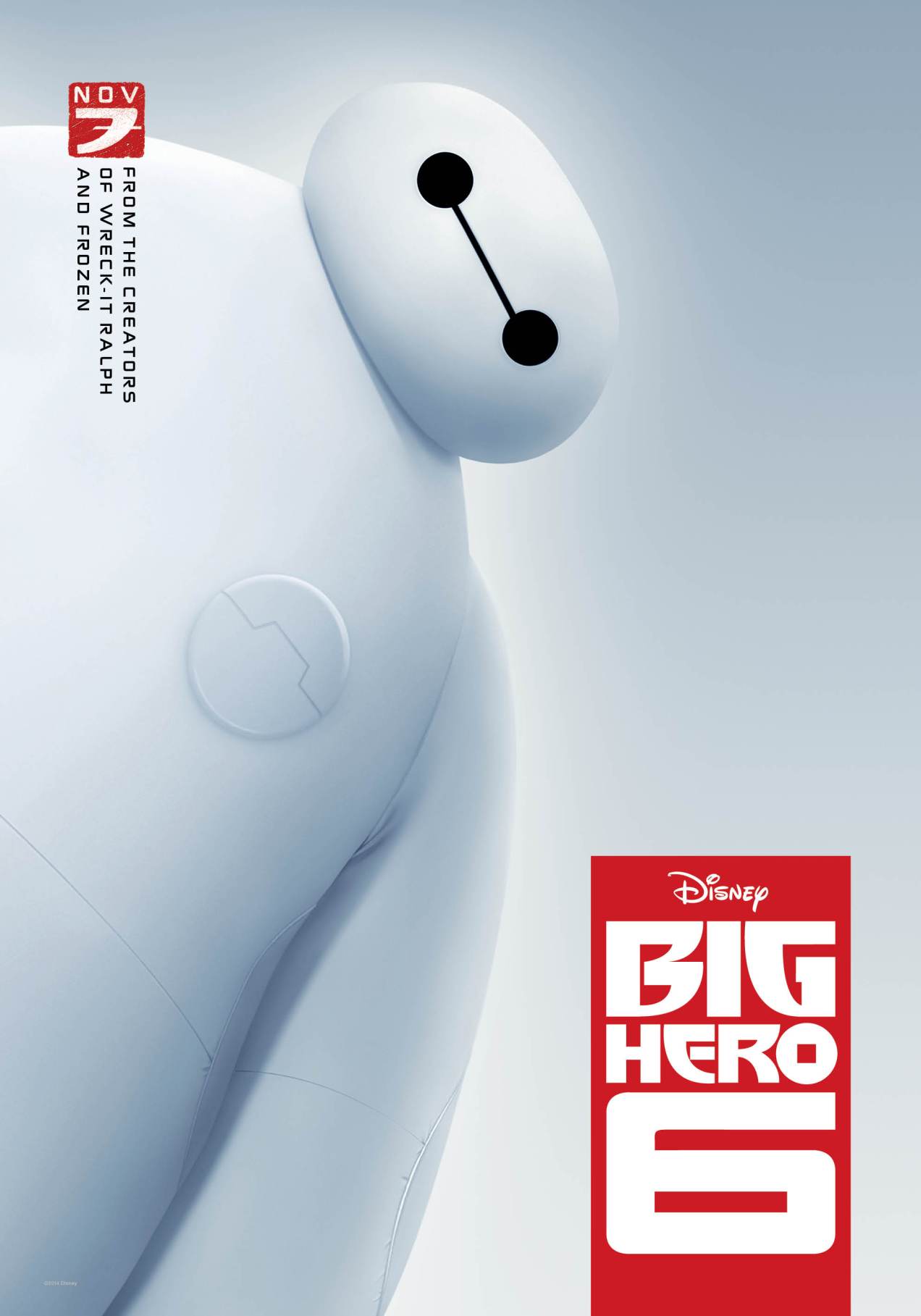
Big Hero 6

Genre: Animation

Directors: Don Hall, Chris Williams

Writers: Robert L. Baird, Daniel Gerson, Jordan Roberts, based on the comic by Duncan Rouleau, Steven T. Seagle

Voice Cast: Scott Adsit, Ryan Potter, Daniel Henney, T.J. Miller, Jamie Chung, Damon Wayans Jr., Genesis Rodriguez, James Cromwell, Alan Tudyk, Maya Rudolph

Running Length: 108 minutes

Synopsis: An action comedy adventure about brilliant robotics prodigy Hiro Hamada (Ryan Potter), who finds himself in the grips of a criminal plot that threatens to destroy the fast-paced, high-tech city of San Fransokyo. With the help of his closest companion—a robot named Baymax (Scott Adsit) – Hiro joins forces with a reluctant team of first-time crime fighters on a mission to save their city.

Review: We have all gotten used to the short film that precedes most animated films these days, but this could possibly be the first time that I feel a feature presentation has been somewhat hurt by the short film before it. While Big Hero 6 is a fun romp for both young and old, the emotional depth (nowadays more commonly referred to as “the feels”) actually pales in comparison to its companion six-minute short Feast, which is an excellent short film. And while this is a good, if somewhat unexpected, addition to the Marvel Comic Universe movies, the fact remains that there is a better superhero animation in the Disney/Pixar stable (no prizes for guessing which).

As always, I will touch on the short film first. Feast is a recounting of the relationship a Boston terrier has with his master over 12 years, except via the unusual angle of his food. It seems like such a simple conceit, but like the best of animation, it is evocative and manages to tell a very engaging story. There is a good chance that many animal lovers or pet owners will choke up (like I did) over Feast, which is high praise given that it unfolds in such a short span of screen time. If this is what writer-director Patrick Osborne can achieve in under ten minutes, I am definitely looking forward to his first feature film (surely not too far away).

Perhaps it’s a direct result of Pixar’s stellar output over the years (and to be fair, a smattering of animated films from rival studios) that expectations for animated films have risen dramatically. It doesn’t help that technology has advanced to a point that spectacular visuals are almost a given in any computer animated film these days, and often the differentiating factors come down to the storyline, the number of A-list actors in the voice cast, and the production design. The need to sell animated films with Hollywood actors has become almost a liability however, because not all name actors are necessarily good in voice roles. Thankfully, Big Hero 6 eschews this, going instead with a bunch of relatively lesser-known actors that do pretty well in their roles.

As for the visuals, there’s really nothing to complain about, except once again this is not a film that needs to be seen in 3D. The character designs are uniformly excellent, with some truly colourful and creative flourishes, and the setting of San Fransokyo is wonderfully imagined, creating an inventive mashup between San Francisco and Tokyo. Then, there’s Baymax – Disney has created a surefire marketing phenomenon with the most cuddly robot design I’ve ever seen, and despite straying far, FAR away from the source graphic novels, will capture the hearts and minds of audiences of all age groups.

This is not the first movie in the Marvel Comic Universe to work with a relatively obscure Marvel property, as Guardians of the Galaxy lays claim to being the first. There’s also an interesting parallel between the two movies, since both are about a motley crew of unlikely heroes, and also touches on grief and loss. I would say that the themes are better handled in Guardians of the Galaxy versus Big Hero 6, but this is a somewhat unfair comparison given that Big Hero 6 is aimed at a much younger audience. Given that there will be a lot of young ones watching the movie, the concept of death is actually quite elegantly handled, even more so than How to Train Your Dragon 2 (I’ll keep things vague although the full trailer does give part of this storyline away).

Most of the film stays pretty light-hearted with a number of fun action set pieces, and it would take a heart of stone not to be somewhat taken by Baymax and his lovable antics, so it is not difficult to recommend the film, especially for younger audiences. There are a number of more affecting moments, to be sure, but Feast manages to do better in this aspect than the whole of Big Hero 6 (hence the earlier comment about the short film hurting the feature film, something that I have not experienced prior). Although the superhero origin story is done to death at this point, Big Hero 6 offers a somewhat fresh perspective, even if it doesn’t match the narrative strength of The Incredibles, still the gold standard for animated superhero films a decade after its release.

P.S. The end credit sequence is a blast, and features one of the best cameos I have seen to date, particularly so for fans of the Marvel universe. Definitely worth staying through the credits for.

Rating: * * * (out of four stars)

Standard

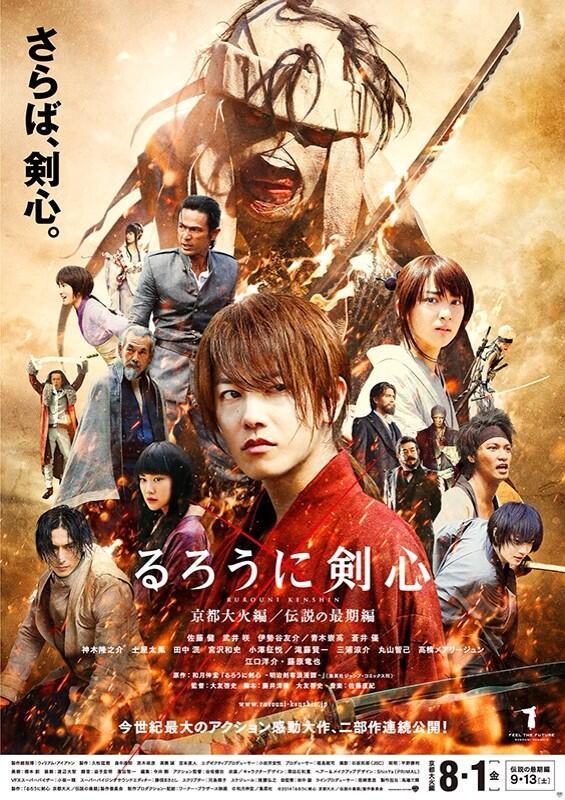
Rurouni Kenshin: The Legend Ends

Genre: Action

Director: Keishi Ohtomo

Writers: Kiyomi Fujii, Keishi Ohtomo, based on the original comic “Rurouni Kenshin” by Nobuhiro Watsuki

Cast: Takeru Satoh, Tatsuya Fujiwara, Emi Takei, Yusuke Iseya, Munetaka Aoki, Yu Aoi, Ryunosuke Kamiki, Tao Tsuchiya, Min Tanaka, Masaharu Fukuyama

Running Length: 135 minutes

Synopsis: To stop Makoto Shishio (Tatsuya Fujiwara) who aims to conquer Japan, Kenshin (Takeru Satoh) arrives in Kyoto and tries to face off against Shishio’s troops. However, his enemy has begun its course to start invading Tokyo with the steel-reinforced battleship. To save captured Kaoru (Emi Takei) who is thrown into the sea by Shishio’s men, Kenshin also dives in after her but is washed ashore alone, unconscious. Kenshin recovers with the help of Seijuro Hiko (Masaharu Fukuyama), the master of Kenshin who happens to find him on the shore. He realises he is no match for Shishio unless he learns the ultimate technique of his sword style, and begs the master to teach him. In the meantime, Shishio finds that Kenshin is still alive, and puts pressure on the government to find Kenshin and execute him in public for his sins during his days as the “Battosai the Killer”. As Kenshin faces his biggest challenge, can Kenshin really defeat his fiercest enemy Shishio, and be reunited with Kaoru?

Review: Unlike most sequels, the wait for The Legend Ends has been pretty short, with less than two months separating the release of Kyoto Inferno and The Legend Ends. The three-movie arc concludes with this film, and fortunately most of the loose ends from the previous movies are tied up here. The film is an unabashed “fan service” film, but works less successfully if one is not acquainted with the franchise and its characters. A major caveat: this is not a movie to watch on its own – at the very least, audiences are expected to have watched Kyoto Inferno, otherwise it would be near impossible to make head or tail of the proceedings.

Strangely, although The Legend Ends picks up where Kyoto Inferno left off, the starting reels are very slow going, and narratively the film comes to an almost complete standstill while Kenshin trains with his master. Such a structure only makes sense if the films are watched back to back, and this is indeed one of the biggest failings of The Legend Ends when seen on its own in the cinema.

Fortunately, the action picks up in the second half of the movie, with some of the best close-quarters swordfights I have seen in a long while, all done with little or no CG work involved. The amount of action in the second half more than makes up for the unenergetic first half, and once things get in gear the movie becomes much easier to get into. The plot remains somewhat muddled, with the supposed political intrigue failing to make much of an impression apart from being a plot device to move the film to its eventual conclusion.

The films are filled with familiar characters from the manga and anime (another indication of the extent of fan service accorded in the films), but the end result is that many of them get relatively short shrift. The most egregious of this is the Ten Swords, introduced in Kyoto Inferno and supposedly would prove to be challenges to Kenshin, but instead are mostly nothing more than fleeting cameos. Even Shishio is missing for a large part of the movie, again something that really only makes sense if the movies are viewed at one go. Once again, the romance between Kenshin and Kaoru remain unconvincing, and their eventual reunion feels anti-climactic despite a valiant attempt at buildup.

With The Legend Ends, it is clear that this Rurouni Kenshin two-parter should never have been structured in this manner. While it is satisfying to see the full story arc resolve, there is once again so much narrative excess in The Legend Ends that the two films ought to have been re-edited into a single, less rambling film. The success of The Legend Ends is assured, since anyone who watched Kyoto Inferno would definitely want to see how the story concludes, and there is enough in the film to warrant a visit to the cinema, but the viewing experience would have been much improved if the choice was made to combine the films.

Rating: * * * (out of four stars)

Standard

Rurouni Kenshin: Kyoto Inferno

Genre: Action, Drama

Director: Keishi Ohtomo

Writers: Kiyomi Fujii, Keishi Ohtomo, based on the original comic “Rurouni Kenshin” by Nobuhiro Watsuki

Cast: Takeru Satoh, Tatsuya Fujiwara, Emi Takei, Yusuke Iseya, Munetaka Aoki, Yu Aoi, Ryunosuke Kamiki, Tao Tsuchiya, Min Tanaka

Running Length: 139 minutes

Synopsis: Kenshin Himura (Takeru Satoh) is a legendary swordsman in the wars accompanying the turbulent fall of Japan’s Shogunate in the 19th century. Once feared as ‘Battosai the Killer’, he has adopted a peaceful life since the arrival of the ‘new age’ in Japanese history. But Makoto Shishio (Tatsuya Fujiwara), the ‘Shadow Killer’ who succeeded to Kenshin’s position in the service of the new government, has since then been active in the Kyoto underworld. Because he knew too much of the dark side of the new government, he was stabbed and his body set on fire. He survived, however and, wrapped in bandages, has raised an army of disaffected former samurai with the aim of overthrowing the new regime. Agreeing to a request by Toshimichi Okubo, the Home Minister, Kenshin leaves his friends in Tokyo and sets out for Kyoto. He and Shishio are a match in skill and in wits, but their aims are opposite. Kenshin seeks to preserve the nation without breaking his vow that he will kill no more.

Review: With Hollywood blockbusters crowding the cinemas, it’s little wonder that the jidaigeki (period drama) genre of Japanese cinema has become a shadow of its former self, and apart from the Rurouni Kenshin series itself, decent chanbara films have been few and far between. Kyoto Inferno is the follow up to the first Rurouni Kenshin film (in 2012), and perhaps more importantly, is part one of a two-part epic feature (Rurouni Kenshin: The Legend Ends opens in Singapore about a month later on 9 October). And much like other films that are cleaved into two, it’s perhaps a bit unfair to pass judgment on what essentially is half a movie and not on the entire body of work.

Yet, it’s also a necessity that each film should be able to stand on its own, and in a way Kyoto Inferno does succeed to a certain extent. Although the film is very slow going, Kyoto Inferno manages to establish the characters and their motives (it can get a little confusing, but prior knowledge of the Rurouni Kenshin series or the previous movie is not required), as well as set the stage for what would likely be a much more kinetic second film. This unevenness is one of the bigger problems of the film, because it is likely that there will be audiences that go into Kyoto Inferno expecting swordfights galore and not a weighty drama, even if it’s good drama for most of the film. Fortunately, the pace does pick up sporadically in a number of well choreographed action sequences. The action in Kyoto Inferno seems largely to be traditional stunt work, and CG has been kept to a minimum, a refreshing change from typical Hollywood fare these days.

Although no one is going to carry home award trophies for their acting in Kyoto Inferno, at least each actor bears a good resemblance to their manga/anime counterparts. Tatsuya Fujiwara does manage to impress as his turn as Shishio is appropriately menacing despite acting entirely behind a mask of bandages. Much emphasis is placed on the romance between Kenshin and Kaoru, this to me is the weakest link in the film, as the two actors share very little onscreen chemistry and the dalliance simply does not convince.

It seems to be a trend for filmmakers to split finales nowadays, and although in this case the wait is a fair bit shorter than usual, it is still a bugbear to me. Did this installment Rurouni Kenshin need to be played out over two full-length movies? The answer once again is no – there’s so much narrative excess in Kyoto Inferno that much of it could have been edited out in the first place with very little loss to the structure of the film. It remains to be seen if The Legend Ends would justify the two part treatment, but perhaps the better route would have been to release a single film cinematically then a director’s cut later on.

Rating: * * * (out of four stars)

Standard

Begin Again

Genre: Drama

Director: John Carney

Writer: John Carney

Cast: Mark Ruffalo, Keira Knightley, Adam Levine, Hailee Steinfeld, James Corden, Catherine Keener, Ceelo Green

Running Length: 104 minutes

Synopsis: Gretta (Keira Knightley) and her long-time boyfriend Dave (Adam Levine) are college sweethearts and songwriting partners who decamp for New York when he lands a deal with a major label. But the trappings of his new-found fame soon tempt Dave to stray, and a reeling, lovelorn Gretta is left on her own. Her world takes a turn for the better when Dan (Mark Ruffalo), a disgraced record-label exec, stumbles upon her performing on an East Village stage and is immediately captivated by her raw talent. From this chance encounter emerges an enchanting portrait of a mutually transformative collaboration, set to the soundtrack of a summer in New York City.

Review: As the old saying goes, lightning doesn’t strike twice – John Carney’s breakout indie hit, Once, was an excellent motion picture that won the hearts of many audiences and critics back in 2007, and also spawned a multi-Tony Award winning musical – and true to this, Carney’s Begin Again doesn’t manage to reach the heights that Once did. It’s essentially a variation on the same theme that Once covered, except with bigger stars and higher production values, but when evaluated on its own merits, Begin Again is still a charming enough movie, featuring some really great songs and generally authentic performances from the main cast.

It can get a little too cheesy for its own good (an example would be the music-sharing sequence), but Begin Again comes across as being a bit more genuine than the typical Hollywood romantic comedy. Mark Ruffalo and Keira Knightley share a good onscreen chemistry, and the “will they or won’t they” romantic tension between the two doesn’t come across as feeling too forced. However, the film suffers when the focus shifts away from this pairing – Adam Levine and Catherine Keener’s characters simply aren’t as fleshed out, and these extraneous plot threads become distracting and make the film feel a little more unfocused. The biggest offender would be the inclusion of Ceelo Green playing Ceelo Green – not only is his flashback sequence edited rather confusingly, there seems to be no good reason for his presence except perhaps to increase the celebrity count of the film.

Much like Once, the songs in Begin Again play a very important role, perhaps more so than some of the actors. And in this aspect, the film has managed to deliver in spades. Gregg Alexander (of the New Radicals and the one hit wonder “You Get What You Give”) co-wrote the songs, and many of these songs are catchy, heartfelt and (surprise surprise) decently performed by Keira Knightley. Adam Levine of course does a bang up job as well, and his rendition of Lost Stars is exemplary. The music manages to imbue even some of the more mediocre moments of Begin Again with a magical touch, and in a season filled with mega-budget action blockbusters, one could not really ask for more from a small-ish film like this one.

Rating: * * * (out of four stars)

Standard