Joy

Joy


Genre: Drama

Director: David O. Russell

Screenplay: David O. Russell, based on a story by Annie Mumolo and David O. Russell

Cast: Jennifer Lawrence, Bradley Cooper, Robert De Niro, Elizabeth Rohm, Edgar Ramirez, Virginia Madsen, Isabella Rossellini, Diane Ladd, Dascha Polanco

Running Length:  124 minutes

Synopsis: Joy is the wild story of a family across four generations centered on Joy Mangano (Jennifer Lawrence), the girl who becomes the woman who founds a business dynasty and becomes a matriarch in her own right. Betrayal, treachery, the loss of innocence and the scars of love, pave the road in this intense emotional and human comedy about becoming a true boss of family and enterprise facing a world of unforgiving commerce.

Review: If not for the interesting (true but heavily fictionalized) story of Joy Mangano and a riveting central performance by Jennifer Lawrence as the rags-to-riches businesswoman, Joy would have been a much more joyless affair to watch. This is David O. Russell’s first movie centred entirely on a female character, but Erin Brockovich this is not. It’s almost as though O. Russell is unable to make up his mind about how to go about making this “biopic” and the wild tonal and narrative shifts actually detract quite a bit from the cinematic experience.

The ensemble sequences and sprawling narrative in Joy don’t work as well as in O. Russell’s previous films, and his tendency of putting everyone in an enclosed space, shouting at one another really grates after a while. There are also odd surrealist moments that are absolutely unnecessary, jarring viewers out of the moment and probably scratching their heads in puzzlement. Even though many of O. Russell’s alumni make a return in the film, the sparks simply fail to fly in many of the interactions, because the characters are basically reduced to plot-forwarding caricatures this time round.

There is a glorious 30 minutes in Joy in which everything actually comes together, and that is the sequence which traces her first interaction with TV studio exec Neil Walker (Bradley Cooper) to when she makes her first live pitch on QVC. Lawrence’s transformation from unsure inventor to QVC pitchwoman is indeed magical, and her performance really sells it very well. Jennifer Lawrence has established herself as one of the best young actresses around, and her credible and sympathetic turn as Joy Mangano is yet another feather in her cap, though it’s not her best performance thus far.

Unfortunately, after the high of the QVC sequence, the film never finds a sure footing again, with the denouement feeling uncharacteristically rushed (case in point – a haircut is the sole visual shorthand O. Russell employs to signify the change and growth of Joy in a pivotal scene) and somehow inconsequential. While still a sporadically entertaining film, Joy doesn’t measure up to the previous efforts of O. Russell and feels like a rare misstep for the director.

Rating: ** ½ (out of four stars)

Standard

Star Wars: Episode VII – The Force Awakens

Genre: Sci-Fi, Drama

Director: J.J. Abrams

Screenplay: Lawrence Kasdan & J.J. Abrams and Michael Arndt, based on characters created by George Lucas

Cast: Harrison Ford, Mark Hamill, Carrie Fisher, Daisy Ridley, Oscar Isaac, John Boyega, Adam Driver, Peter Mayhew, Domhnall Gleeson, Anthony Daniels, Andy Serkis, Lupita Nyong’o             

Running Length: 136 minutes

Synopsis: Thirty years after defeating the Galactic Empire, Han Solo (Harrison Ford) and his allies face a new threat from the evil Kylo Ren (Adam Driver) and his army of Stormtroopers.

Review: The wait is finally over – a ten-year hiatus has followed Episode III: Revenge of the Sith, but Star Wars makes a somewhat triumphant return to the big screen, this time under the stewardship of its new owner (Disney) and directed not by George Lucas, but by J. J. Abrams. While it is a solid, very entertaining space opera, and a good start to the new Star Wars trilogy (and its spin off movies), The Force Awakens feels somewhat encumbered by the baggage of being the “true” sequel of essentially the most revered movie franchise of all time, and the exceptionally high expectations that follow such a status. Abrams has done a very good job giving fans what they expect, but nothing much more than that.

Abrams has chosen to develop four new characters to succeed the thrones of Han Solo, Luke Skywalker and Darth Vader, and the casting choices are quite astute. Daisy Ridley and John Boyega are great as the heroes-to-be for the new trilogy, and Ridley is in particular a revelation. This relatively unknown British actress brings a graceful intensity and quiet strength to her role as Rey, and her performance reminds one of a younger Kiera Knightley. Boyega isn’t as commanding as Finn, but works well as a companion to Rey (somehow I am reminded of Jennifer Lawrence and Joss Hutcherson’s pairing in the Hunger Games franchise). Oscar Isaac is given significantly less to do in the show, but shows promise as the swashbuckling pilot Poe. Adam Driver is also quite memorable as the Kylo Ren, menacing and petulant at the same time, though as the main villain of The Force Awakens he comes up a little short.

It is somewhat surprising, however, that the new droid BB-8 has managed to upstage everyone else in the film. Abrams pays a lot of attention to this new spherical orange and white droid, and although he has no real dialogue, BB-8 manages to express a surprising variation of feelings and emotions, even when he is in the periphery of a scene. That he is also responsible for some of the biggest laughs in the film is also just the cherry on top. BB-8’s “performance” comes close to (or even possibly surpasses) what was achieved by WALL-E’s Eve and WALL-E, which is the gold standard.

Apart from drama, a good space opera should also serve up a fair share of action sequences. In this aspect The Force Awakens is a mixed bag – the first aerial dogfight (involving the Millenium Falcon) is a treat, but the remaining action sequences (yes, even the lightsaber battles) come across as being somewhat perfunctory. There’s an old-school feel to many of these scenes, which does not necessarily work in the film’s favour.

While it’s not a necessity to watch the preceding six films in the franchise, The Force Awakens assumes (not unreasonably, given how ingrained Star Wars is in our pop culture) knowledge of the Star Wars universe, and doles out heaps of fan service to its fans. For a Star Wars fan like myself, it’s impossible not to feel a stir of emotions when the Millennium Falcon makes its first appearance, or when anyone from the original trilogy shows up – Han Solo! Chewbacca! Princess Leia! Artoo! Admiral Ackbar! – but I could almost sense that Abrams and team had an omnipresent checklist and was striving to check off every item by the time the end credits rolled. This slavishness to the original trilogy sometimes makes The Force Awakens feel like a reboot of the franchise instead of a sequel.

This is the most critical flaw of The Force Awakens, and despite its top-secret plot and requests to keep reviews and commentary spoiler-free, there really are very few surprises to be had along the way. This lack of originality and freshness is something that many fans (including myself) would be willing to overlook, just to have the satisfaction of watching a new Star Wars movie on the big screen, but The Force Awakens is not a film that holds up very well to repeat viewings without the rose-tinted glasses of fandom and nostalgia. However, as the necessary fan-servicing is now mostly out of the way, I hope that Episodes VIII and IX will be given the freedom to explore new stories instead of retreading the old and familiar.

Rating: * * * (out of four stars)

Standard

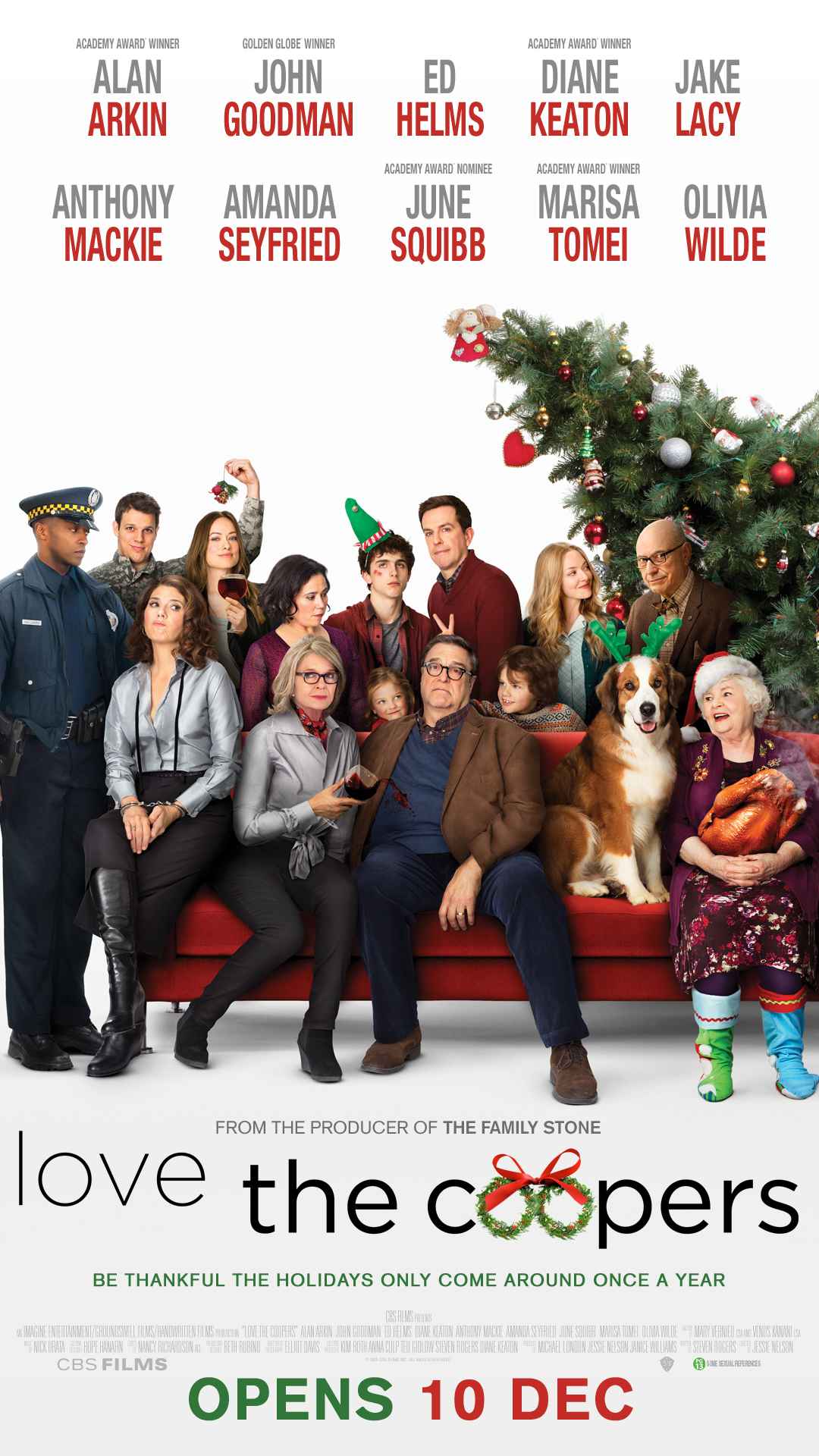
Love the Coopers

Genre: Comedy, Drama

Director: Jessie Nelson

Screenplay: Steven Rogers

Cast: Alan Arkin, John Goodman, Ed Helms, Diane Keaton, Anthony Mackie, Amanda Seyfried, June Squibb, Marisa Tomei, Olivia Wilde, Alex Borstein, Jake Lacy, Steve Martin (voice)

Running Length: 107 minutes

Synopsis: Love the Coopers follows the Cooper clan as four generations of extended family come together for their annual Christmas Eve celebration. As the evening unfolds, a series of unexpected visitors and unlikely events turn the night upside down, leading them all toward a surprising rediscovery of family bonds and the spirit of the holiday.

Review: It seems almost like there is one such movie every year – a family reunion dramedy during the festive season – but Love the Coopers is a wholly unremarkable addition to this sub-genre that works only on the most superficial level. And despite the title of the movie, there is very little reason to love the Coopers (or the movie).

One of the biggest problems with Love the Coopers is that the screenplay simply isn’t up to par. The characters are shallowly fleshed out, and most of them remain two-dimensional despite being played by a group of rather talented actors. Most of them are not given much to do, as there are obviously too many characters with too many plot lines that cannot be satisfactorily resolved in the film’s under-two-hour running time. It doesn’t help that some of these subplots are rather confusing (none more so than the interactions between Arkin’s Bucky and Seyfried’s Ruby, which seemed to suggest one thing but ended up being something else altogether).

There are also problems with the believability of some of the characters themselves – Anthony Mackie’s police officer Williams inexplicably opens up to Marisa Tomei’s Emma in a car ride, but I found myself hard-pressed to believe that a man that is apparently super-repressed would reveal his sexual orientation and troubled childhood to a near-complete stranger. Many of the inter-character conflicts either feel like a non-event or come across as being completely artificial, which further detracts from the cinematic experience.

That the whole film culminates in a hospital scene that shamelessly tries to tug at the heartstrings is perhaps to be expected, but given such a low emotional investment in the characters, the denouement rings as hollow as the rest of the film. Love the Coopers is watchable solely because of the collective charisma of the ensemble cast (even the voice of the family dog, who plays narrator, is voiced by Steve Martin), and even then barely passes muster.

Rating: * ½ (out of four stars)


Standard

Burnt

Genre: Drama

Director: John Wells

Screenplay: Steven Knight

Cast: Bradley Cooper, Sienna Miller, Omar Sy, Daniel Bruhl, Riccardo Scamarcio, Sam Keeley, Alicia Vikander, Matthew Rhys, Uma Thurman, Emma Thompson, Lily James, Sarah Greene

Running Length: 100 minutes

Synopsis: Adam Jones (Bradley Cooper) is a chef who destroyed his career with drugs and rock star behavior. He cleans up and returns to London, determined to redeem himself by spearheading a top restaurant that can earn him his third Michelin star.

Review: There’s a scene in Burnt where Bradley Cooper’s Adam expounds on why fast food is not given the credit he claims it deserves – and the answer is because they produce food that’s too consistent, and consistency is boring. The same, unfortunately, can be said of Burnt itself, as it comes across as a film that’s a little too generic and unmemorable as a whole.

It’s kind of a pity, especially since Bradley Cooper puts in a (by now) reliably solid performance, able to portray both the swaggering a-hole and the introspective, insecure ex-addict with aplomb and believability. However, his performance is let down by the middling script – the entire redemptive arc of Adam runs along an extremely predictable path, and anyone who’s seen a movie in the same mould (i.e. everyone) will not be surprised in any way, save for a single unexpected plot twist near the end of the film.

Also, for a film that deals in the rarefied world of haute cuisine, there’s surprisingly little attention paid to the food. While there are some aesthetically pleasing close-up shots of the dishes, the editing and montages generally feel too harried, with the camera rarely resting on any food shot for more than a second. This frenetic pace works better in a film like Chef, and ironically Chef actually pays more loving, measured attention to the food truck-style dishes than what Burnt does with its Michelin-star gourmet dishes.

While there are a good number of name actors in the film, they are generally given very little to do, with the only bright spark being Sienna Miller’s Helene, whose charming performance is a credible foil to Cooper. Other well-known faces like Emma Thompson and Uma Thurman feel criminally underused, serving more like props to help propel the plot along rather than actual characters. In the end, Burnt feels like a facsimile of a gourmet meal, one that will undoubtedly leave you feeling full, yet unsatisfied.   

Rating: * * ½ (out of four stars)

Standard

The Walk

Genre: Drama

Director: Robert Zemeckis

Screenplay: Robert Zemeckis and Christopher Browne, based on the book “To Reach the Clouds” by Philippe Petit

Cast: Joseph Gordon-Levitt, Ben Kingsley, Charlotte Le Bon, James Badge Dale, Clement Sibony, Cesar Domboy, Benedict Samuel, Ben Schwartz, Steve Valentine, Mark Camacho

Running Length: 124 minutes

Synopsis: Twelve people have walked on the moon, but only one man – Philippe Petit (Joseph Gordon-Levitt) – has ever, or will ever, walk in the immense void between the World Trade Center towers. Guided by his real-life mentor, Papa Rudy (Ben Kingsley), and aided by an unlikely band of international recruits, Petit and his gang overcome long odds, betrayals, dissension and countless close calls to conceive and execute their mad plan.

Review: Movies worth watching in 3D come extremely few and far between, and I’ve always advocated sticking to 2D for the large majority of films that offer both options. However, The Walk is a movie that truly deserves to be seen on the big screen and in 3D (fortunately, it’s available in IMAX 3D locally, the largest possible format), and it’s my recommendation to go that route in order to maximize the viewing experience that The Walk will provide. In fact, if one does not watch The Walk in IMAX 3D, there’s very little compelling reason to watch the film in any other format.

The Walk takes its own sweet time to get started, with the first hour being largely unnecessary exposition filled with characters that populate the film but possess little to no depth (unfortunately that includes Joseph Gordon-Levitt’s portrayal of Petit, though he still imbues the character with a boatload of charm). However, once we move on to the actual attempt to walk the wire across the two World Trade Center towers, things become a lot more interesting. The setup of the walk feels like a heist movie, and is quite an entertaining segment of the film. The logistical challenge of sneaking the equipment into the towers and the actual setup of the line is nothing to sniff at, and while truncated, Zemeckis does manage to wring a lot of entertainment value out of this third of the film.

And then there’s the last reel of the movie, which covers the walk itself. This is the big payoff for the film, and manages to counterbalance all the faults that the film contained prior to this glorious sequence. When viewed in IMAX 3D, the walk is nothing short of a spectacle – you could almost believe that the towers are real, and the dizzying sense of vertigo is enhanced with the huge screen and 3D. In fact, anyone with a fear of heights might find themselves feeling a bit of anxiety over how realistic some parts of the sequence are. The technical wizardry employed to bring this segment to life is truly impressive and I am pretty sure that The Walk is a shoo-in for at least a handful of technical award nominations next Oscar season.

This is not the first big-screen treatment of Petit’s historic walk across the twin towers, as it was also the subject matter of the eminently watchable documentary Man on Wire in 2008. Truth be told, the documentary tells the tale better, but in terms of visuals The Walk wins out by a large margin. This will not be a movie that would work well on the small screen, so make plans to head down to a cineplex near you if a visceral cinematic experience is what you’re after.

Rating: * * * (out of four stars)

Standard

The Martian

Genre: Drama, Sci-Fi

Director: Ridley Scott

Screenplay: Drew Goddard, based on the novel by Andy Weir

Cast: Matt Damon, Jessica Chastain, Michael Pena, Kate Mara, Sebastian Stan, Aksel Hennie, Jeff Daniels, Chiwetel Ejiofor, Kristin Wiig, Sean Bean

Running Length: 141 minutes

Synopsis: During a manned mission to Mars, Astronaut Mark Watney (Matt Damon) is presumed dead after a fierce storm and left behind by his crew. But Watney has survived and finds himself stranded and alone on the hostile planet. With only meager supplies, Watney must draw upon his ingenuity, wit and spirit to subsist and find a way to signal to Earth that he is alive. Millions of miles away, NASA and a team of international scientists work tirelessly to bring “the Martian” home, while his crewmates concurrently plot a daring, if not impossible, rescue mission. As these stories of incredible bravery unfold, the world comes together to root for Watney’s safe return.

Review: There has been a resurgence of space exploration movies in recent years, and while The Martian does not reach the heights of Interstellar and Gravity, it’s a very commendable effort nonetheless, featuring some of the best work from both Ridley Scott and Matt Damon in years. While the concept of The Martian certainly isn’t a new one (it would not be a stretch to describe the movie as “Cast Away” in space), it is an undeniably fun and fulfilling cinematic experience that will definitely be a crowd pleaser.

Despite what the trailers might suggest, The Martian is a movie that’s very light on action and very heavy on introspection and exposition. While it isn’t focused solely on Watney, with relatively big chunks of screen time split between the other crew members of the Ares 3 as well as the ground crew, a lot of time is spent observing Watney doing his utmost best to survive on a distant planet. Although some liberties have been taken with the science in the movie, a lot of it feels authentic and believable, which makes it even easier for the audience to identify with the proceedings, despite its alien setting. Both Andy Weir (author of the original novel) and NASA have been involved every step of the way, and the resulting authenticity of the movie is surely a direct result of this.

While the subject matter is quite serious, Ridley Scott maintains a light touch throughout the film, and there are many moments of humour that help to make the proceedings less dark than they could have been. Although The Martian runs over 2 hours, the film moves at a very brisk pace, and at no time does the film feel like it has lost any dramatic momentum despite cutting back and forth the three locales.The Martian is also a handsomely shot film, particularly when showcasing the barren vastness of Mars. There is, naturally, a large amount of visual effects employed in the film, but it never distracts from the actors or the storyline.

Although there is a very large and capable group of supporting actors, this is undoubtedly Matt Damon’s movie. Having to perform largely in isolation means that there are many stretches of the film where the thespian duties fall entirely on Damon, and he does an admirable job portraying the wide range of emotions that Watney undergoes. He easily becomes the emotional core of the movie, and audiences will assuredly be rooting for him long before the movie ends. It’s not difficult to imagine that he would likely be a frontrunner in the Oscar race in 2016. It’s not his first performance as a stranded astronaut (Interstellar being the first), but it’s definitely his best (so far).

Rating: * * * ½ (out of four stars)

Standard

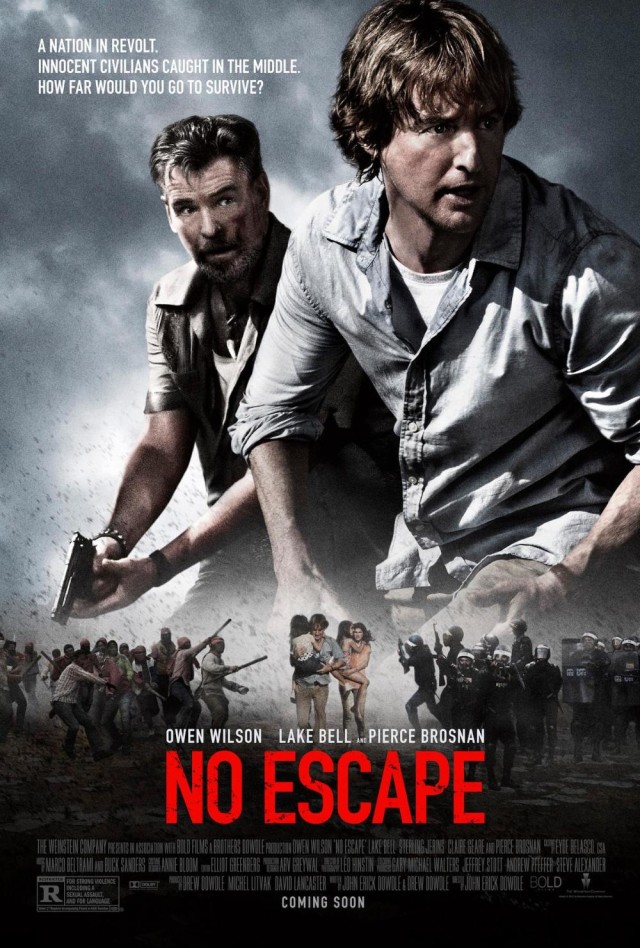
No Escape

Genre: Action, Drama

Director: John Erick Dowdle

Screenplay: John Erick Dowdle, Drew Dowdle

Cast: Owen Wilson, Lake Bell, Pierce Brosnan, Sterling Jerins, Claire Geare

Running Length: 106 minutes

Synopsis: No Escape centres on an American businessman (Owen Wilson) as he and his family settle into their new home in Southeast Asia. Suddenly finding themselves in the middle of a violent political uprising, they must frantically look for a safe escape as rebels mercilessly attack the city.

Review: One of my pet movie peeves is when any director chooses to use the shakycam effect to convey a “visceral” sense of action – apart from the found footage genre, there’s really no need to put viewers through a discomfiting viewing experience. No Escape is the latest in a long, long line of movies that abuses the shakycam effect, and it really managed to mar the cinematic experience of an already rather mediocre film. There’s also the issue that the entire film drips of a rather unkind xenophobia, undoubtedly amplified by the fact that Asian viewers like myself don’t seem be one of the target demographics that the Dowdle brothers are aiming for.

Set in an resolutely unnamed Southeast Asian country (and the subject of a real-life controversy, as Khmer lettering was used upside down on the police shields in the film, leading to outrage and a ban in Cambodia), No Escape does deliver some thrills along the way, but requires the audience to not think about the plot at all, as it is riddled with holes and necessitates the cast members to behave in the most reckless way possible, putting themselves into peril so as to advance the plot. Both the rebels (namely one murderous mob, with the leader sporting a prominent facial scar, because that’s probably the only way the directors felt “the Asians” could be identified) and the resistance (namely Pierce Brosnan and his local sidekick) seem to show up with alarming precision and frequency. It’s amazing how a nationwide coup could be reduced to such a simplistic face-off.

Although the country is unnamed, there are some really ridiculous conventions that John Erick Dowdle stoops to, reducing the locals to nothing more than seemingly irrational, bloodthirsty murderers and rapists. There’s even a scene where the protagonists are scuttling through a den of vice, which includes young prostitutes and (I kid you not) what appears to be an opium den. It’s seriously mind boggling how Dowdle’s perception of Southeast Asia seems stuck at the turn of the 20th Century, instead of being more rooted in current-day sensibilities and realities. As a Southeast Asian viewer, I am honestly quite insulted by such a portrayal.

Put aside all the social commentary and the filming techniques, and we are indeed left with a half-decent movie, with a good number of taut set-pieces, especially in the first few reels of the film. Both Owen Wilson and Lake Bell put in relatively strong performances despite playing against type, though Pierce Brosnan seems to be in this one solely for the paycheck (to be fair, his screen time is fairly limited). No Escape does become increasingly unraveled along the way, culminating in a really ridiculous, anti-climactic denouement that fails to make much sense. However, in all likelihood, the audience would have ceased to care about the movie by then, and are simply looking to escape the cinema once the credits roll.

Rating: * ½ (out of four stars)

Standard

Our Sister Mambo

Genre: Comedy, Drama

Director: Ho Wi Ding

Screenplay: Michael Chiang

Cast: Moses Lim, Michelle Chong, Audrey Luo, Ethel Yap, Oon Shu An, Joey Leong

Running Length: 93 minutes

Synopsis: Set against the backdrop of modern Singapore, Our Sister Mambo follows the well-meaning efforts of the spritely second daughter, Mambo (Michelle Chong) to get her sisters – big sister Grace (Ethel Yap), third sister Rose (Oon Shu An) and baby sister June (Joey Leong) hitched, with hiccups and misunderstandings along the way. 

Review: Although it’s somewhat of a corporate vanity project, being Cathay Organisation’s celebratory film marking its 80th anniversary, Our Sister Mambo is a watchable film with relatively few awkward moments, though it does comes across as being too safe a filmmaking venture at times. 

Based loosely on two movies from Cathay’s stable of classic films, Our Sister Hedy and The Greatest Civil War of Our Time, Our Sister Mambo has a slew of plotlines, all revolving around the (mis)adventures of the Wong family, consisting of a genial patriarch (Moses Lim), a Korea-obsessed matriarch (Audrey Luo) and their four daughters. Mambo (Michelle Chong) is the narrator and ostensibly the core of the movie, but unfortunately her lawyer-to-chef storyline is the least interesting of the six family members. That’s not to say that the rest of the plotlines are necessarily that much more interesting – while Michael Chiang does his darnedest to weave the thin story threads together, there are literally no surprises to be had here. In fact, Our Sister Mambo frequently feels like an extended episode of an 80s or 90s TV sitcom, especially so since Moses Lim was, for many Singaporeans, part of essential TV viewing in the mid-90s as the head of the Tan family in Under One Roof. 

While there are multiple familial conflicts that unfold in Our Sister Mambo, there’s never the sense that anything is at stake, and the script is too eager to resolve each plotline and move on to the next, as though there’s an invisible checklist that Wi Ding and Chiang are marking off. There’s also a lot of wasted comedic talent in the film – while Moses Lim, Michelle Chong and even Siti Khalijah are rather heavyweight comedians, almost none of it is on display here, with all three playing their characters on the straight and narrow. 

What does manage to save the show are a slew of great performances from the cast, none more so than Audrey Luo. Although believability is a bit stretched with her being cast opposite Moses Lim despite being literally half his age, the duo shares a great chemistry. Audrey further ups the game with excellent comic timing, and is the main source of the laughs in the show. The four actresses playing the Wong daughters all do a relatively decent job, and it’s only Moses who is, surprisingly, the weak link, with nothing much to do in the show at all. 

Constrained by the need to shoehorn the film into Cathay’s 80th anniversary, the association does at times sit uncomfortably with the rest of the proceedings, but the awkwardness is kept to a minimum, and we are even treated to appearances by Cathay heavyweights Grace Chang and Maria Menado – though I must contest the indignity of the decision to cut away repeatedly from Grace Chang’s recorded video message to focus on a very inconsequential element of the plot. 

Rating: * * ½ (out of four stars)

Standard

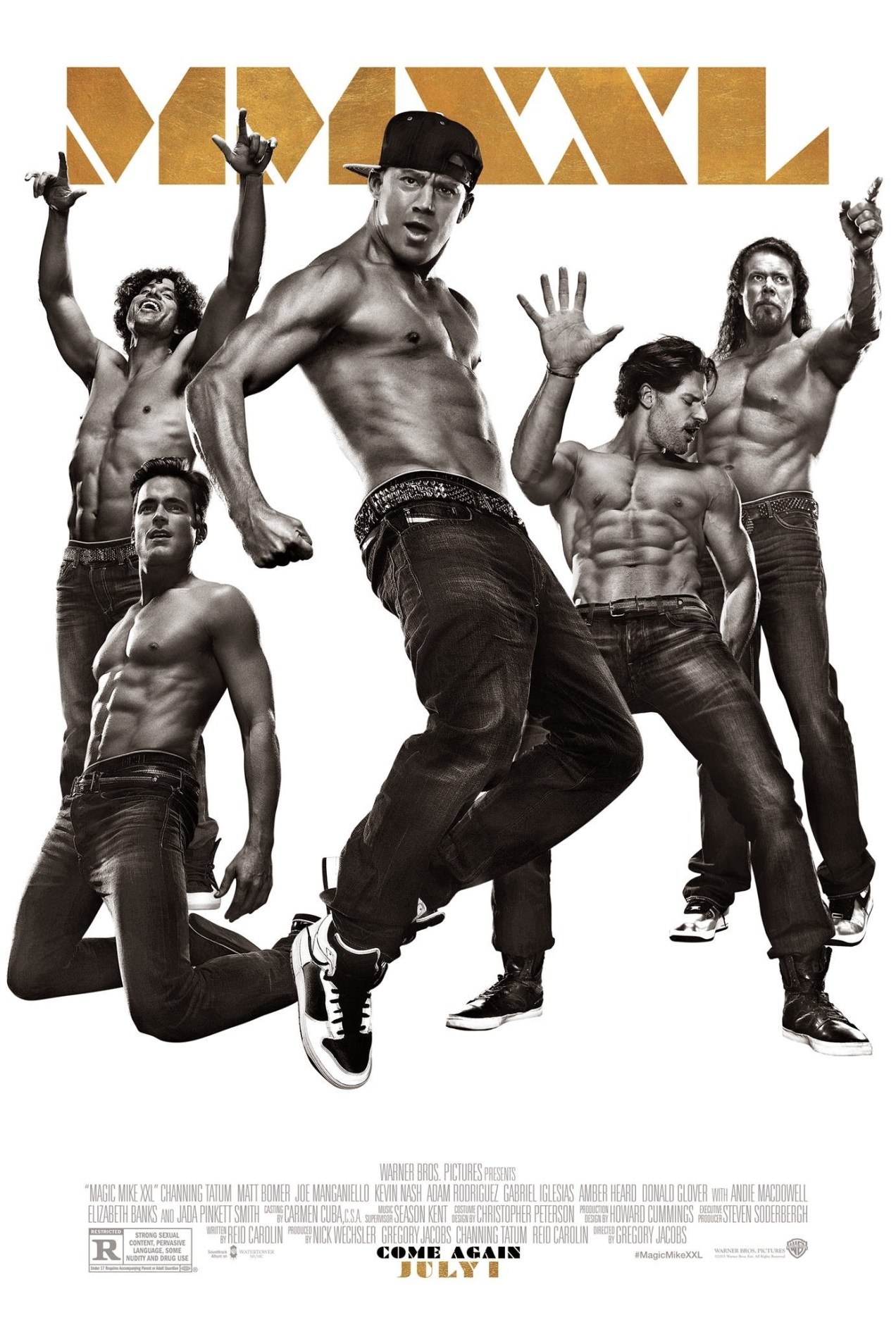
Magic Mike XXL

Genre: Drama

Director: Gregory Jacobs

Screenplay: Channing Tatum, Reid Carolyn

Cast: Channing Tatum, Matt Bomer, Joe Manganiello, Kevin Nash, Adam Rodriguez, Gabriel Iglesias, Amber Heard, Jada Pinkett Smith

Running Length:  115 minutes

Synopsis: Picking up the story three years after Mike (Channing Tatum) bowed out of the stripper life at the top of his game, Magic Mike XXL finds the remaining Kings of Tampa likewise ready to throw in the towel. But they want to do it their way: burning down the house in one last blow-out performance in Myrtle Beach, and with legendary headliner Magic Mike sharing the spotlight with them. On the road to their final show, with whistle stops in Jacksonville and Savannah to renew old acquaintances and make new friends, Mike and the guys learn some new moves and shake off the past in surprising ways.

Review: While Magic Mike was one of the bigger surprises in 2012 – although it’s about male strippers, in the end it was the power of storytelling that held the movie together, and not the strip acts – Magic Mike XXL is much less of a surprise. It’s essentially a road trip movie involving a bunch of old friends, except that they are “male entertainers” who get their kits off quite a number of times along the way. One thing that’s for sure – if you enjoyed the acts in the first Magic Mike, this aspect has been truly upsized (the movie title is not a lie) and more than earns the film its M18 rating, which probably isn’t a bad thing for the intended audiences.

There’s no real reason for this sequel to exist, and it clearly shows in the paper-thin plot that the film hangs onto. No matter, since the majority of audiences would have other things on their mind anyway. Yet, there’s a certain charm to the laid-back, almost impromptu style of storytelling that Magic Mike XXL has chosen to employ, which is in contrast to how Soderbergh chose to present the original Magic Mike. The film is also genuinely funny – there are little moments along the way that ensures a belly laugh or two, none more so than the hilarious gas station sequence where Richie (Joe Manganiello) tries to make the attendant smile.

What’s more interesting is that Magic Mike XXL is obtusely a girl-power movie: although the main cast is dripping with testosterone, the positions of power in the film are almost exclusively female – Jada Pinkett Smith as the steely yet sultry strip club owner cum (ahem) emcee, Andie McDowell’s cameo as an aging but rich Southern belle, Elizabeth Banks as the owner of the male stripper “convention”, and even all the women that are busy throwing money at the strippers. This is a movie made for the ladies (sorry guys – both straight and gay, although more the former than the latter), make no mistake about that.

And of course there’s the strip acts – lensed and edited impeccably by Soderbergh himself (under his Peter Andrews pseudonym) and choreographed flawlessly, the scenes in Domina and the finale really showcase what would imaginably be the top tier of male strip acts in the real world. Rarely has a movie been able to convey the steaminess of such acts without coming across as being sleazy, and while there are times where the movie toes the line, it will successfully leave many audiences feeling hot and bothered. And how can anyone actively hate on a film that can evoke such a visceral response?

Rating: * * * (out of four stars)

Standard

Good Kill

Genre: Drama

Director: Andrew Niccol

Screenplay: Andrew Niccol

Cast: Ethan Hawke, Bruce Greenwood, Zoe Kravitz, January Jones

Running Length: 102 minutes

Synopsis: In the shadowy world of drone warfare, combat unfolds like a video game – only with real lives at stake. After six tours of duty, Air Force pilot Tom Egan (Ethan Hawke) yearns to get back into the cockpit of a real plane, but he now fights the Taliban from an air-conditioned box in the Las Vegas desert. When he and his crew start taking orders directly from the CIA, and the stakes are raised, Egan’s nerves – and his relationship with his wife (January Jones) – begin to unravel. Revealing the psychological toll drone pilots endure as they are forced to witness the aftermath of their fight against insurgents, Andrew Niccol directs this riveting insider’s view of 21st-century warfare, in which operatives target enemies from half a world away.

Review: What happens when war can be conducted remotely, when obliterating human lives is reduced to an operator using a joystick thousands of miles away, and reviewing the carnage on a monitor? Does this reduce the emotional toll of war for the aggressor, and does it result in a more clinical, detached view of the casualties and collateral damage of waging a war? This is the grim scenario and tough questions that Good Kill puts forth, and is indeed one of the most relevant war movies that has been released in years. However, Andrew Niccol has directed and written the movie with a rather heavy hand, which actually lessens the impact that the movie has on audiences.

Ethan Hawke puts forth a solid, credible performance as Thomas Egan, and manages to convey a complex gamut of emotions without that many lines of dialogue. Unfortunately, the same cannot be said of his supporting cast – almost everyone is used either as a plot device or an expositional tool, and remains essentially dimensionless as characters.

Given the nature of the interactions in Good Kill, there is very little action to be had, but Niccol manages to ramp up the tension even given these confines. Although the action is viewed vicariously through a TV monitor and usually without any sound, it remains riveting and visceral, with such a high level of perceived realism that I found myself holding my breath each time the trigger is pulled. This is by far the most successful aspect of the film, and one that would likely stay with the viewer long after the credits roll.

Although it’s undeniable that Niccol has picked a very timely and relevant topic in Good Kill, his incessant soapboxing and moralizing comes across as a bit too much. It also doesn’t help that the various subplots (particularly the unnecessary romantic tension between Egan and new airman Suarez (Zoe Kravitz)).  Even the disembodied voice from Langley barking out executive commands via conference call falls prey to this, having to explain the administration’s rationale for issuing morally ambiguous kill orders at every turn. It’s a particularly clunky way of putting one’s point across, important as it may be.

Rating: * * * (out of four stars)

Standard