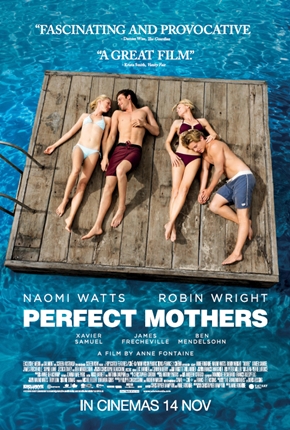
Perfect Mothers

Image

Genre: Drama

Director: Anne Fontaine

Writer: Christopher Hampton, based on “The Grandmothers” by Doris Lessing

Cast: Naomi Watts, Robin Wright, Ben Mendelsohn, Xavier Samuel, James Frecheville

Running Length: 111 minutes

Synopsis: A pair of childhood friends and neighbours falls for each other’s sons.

Review: Perfect Mothers is one of those movies with a pretty high “ick factor” – after all, it is about two lifelong female friends who fall for each other’s sons, which almost toes the lines of incest. However, viewers who can see beyond this point will find a movie that has strong visuals, is relatively well directed (although the film would have worked better with a tighter edit) and boasts some very strong central performances, particularly that of Robin Wright. It may not be everyone’s cup of tea, but at the very least it’s a beautiful movie to look at.

French director Anne Fontaine chose to film Perfect Mothers in Australia, and the cinematography is lush and sun-drenched, with an almost dreamy quality that at times seems at odds with the more serious tone of the screenplay. There are plenty of beach scenes – perhaps a little too many – and plenty of bare skin for audiences to ogle at. Although based on a novella named “The Grandmothers” (by the late Doris Lessing), both Robin Wright and Naomi Watts are simply a little too shapely and youthful to convince as grandmothers, more like women coping with a mid-life crisis.

However, what cannot be denied is that there are some very good performances to be found in the film. While Naomi Watts is given the somewhat flashier role (which she performs capably in), Robin Wright is the one that truly stands out with her restrained performance, perfectly nailing the vulnerabilities of her character without having to resort to theatrics. For the younger set, Xavier Samuel also puts in an excellent job as Lil’s son, wounded repeatedly by those he loves the most, and bridling with a silent rage that seems to intensify as the movie progresses.

 It’s tempting to dismiss Perfect Mothers outright simply because it deals with quite a taboo subject – is it right to lust after your friend’s son (and vice-versa)? It is definitely true that the film can’t really hit the right note in handling the subject matter, at times being overly melodramatic, and at other times coming off as being a little too flippant about the whole thing. There is more than a handful of unintentionally funny sequences, and given how serious the screenplay seems to want to be, very jarring and damaging to the tone of the movie. However, credit has to be given that at least Anne Fontaine managed to craft a decent film out of the subject matter – in less capable hands this may very well have come off as a much worse movie.

 Rating: * * ½ (out of four stars)

Standard

Gravity

Genre: Sci-Fi, Drama

Director: Alfonso Cuaron

Writers: Alfonso Cuaron and Jonas Cuaron

Cast: Sandra Bullock, George Clooney

Running Length: 91 minutes

Synopsis: Dr. Ryan Stone (Bullock) is a brilliant medical engineer on her first shuttle mission, with veteran astronaut Matt Kowalski (Clooney) in command. But on a seemingly routine mission, disaster strikes. The shuttle is destroyed, leaving Stone and Kowalski completely alone—tethered to nothing but each other and spiralling out into the blackness. The deafening silence tells them they have lost any link to Earth…and any chance for rescue. As fear turns to panic, every gulp of air eats away at what little oxygen is left. But the only way home may be to go further out into the terrifying expanse of space.

Review: Gravity is a master-class in how 3D can be used to a film’s advantage and to deepen the audience’s immersion. Despite running a mere 91 minutes, this is an intense and visually stunning movie that works best in IMAX 3D (completely worth the price of admission), with a stellar performance from Sandra Bullock that guarantees an Oscar nomination, if not a win. Although it’s not entirely without flaws, Gravity is easily one of the best movies released this year so far, and should be seen on the big screen as home video is unlikely to be able to successfully replicate the transcendent viewing experience.

The film opens with a single 20-minute take, and almost all of the exposition and scene-setting occurs in this sequence. It is a great technical achievement, and the scene is one that sets the tone of the whole movie. A caveat to those prone to motion sickness:  the latter minutes of this sequence could be taxing on your sensibilities, since it’s set in the first-person POV of Ryan Stone.

What ensues after the stage is set is an extremely intense hour of cinema – although the structure is very straightforward, the fact that Ryan Stone is essentially on her own (George Clooney’s character functions more like a cameo appearance despite him getting equal top billing to Sandra Bullock) in the vast confines of space means the challenge of performing even the simplest acts seems near insurmountable. Combined with what seems like an unrelenting wave of bad luck, it’s almost physically exhausting, in a good way, to witness Stone’s struggles to survive.

This is definitely Sandra Bullock’s strongest performance in her career, far outshining her somewhat overrated (Oscar-winning) performance in The Blind Side. Bullock has to carry nearly the entire movie on her own, and has no other characters to play off of for the majority of the movie (even Tom Hanks at least had Mr Wilson in Cast Away). It does veer a little towards schmaltz in the final minutes of the film, but she is definitely the one to beat in 2014’s Oscar race.

Because of the setting in space, viewing Gravity in 3D in the largest format possible will definitely aid in the sense of immersion one gets from the film. Alfonso Cuaron has succeeded in harnessing technology to deepen the viewing experience – it’s rare that one reacts instinctively to “duck” from a flying piece of debris without feeling a sense of cheesiness, but that’s exactly what I did on multiple occasions in Gravity. The 3D amplifies the vastness of space, yet paradoxically it also makes the viewer feel even more intimately linked to and focused on Bullock’s performance. It’s hard to tell how much of the experience will be lost on smaller screens at home, but to not at least view this once in a darkened theatre would be missing out on one of the movie events of the year.    

 * * * ½ (out of four stars)

Standard

Behind the Candelabra

Genre: Drama

Director: Steven Soderberg

Writer: Richard LaGravenese, based on Behind the Candelabra: My Life with Liberace by Scott Thorson and Alex Thorleifson

Cast: Michael Douglas, Matt Damon, Dan Aykroyd, Rob Lowe, Scott Bakula

Running Length: 118 minutes

Synopsis: Before Elvis, before Elton John, Madonna and Lady Gaga, there was Liberace: virtuoso pianist, outrageous entertainer and flamboyant star of stage and television. A name synonymous with showmanship, extravagance and candelabras, he was a world-renowned performer with a flair that endeared him to his audiences and created a loyal fan base spanning his 40-year career. Liberace (Michael Douglas) lived lavishly and embraced a lifestyle of excess both on and off stage. In summer 1977, handsome young stranger Scott Thorson (Matt Damon) walked into his dressing room and, despite their age difference and seemingly different worlds, the two embarked on a secretive five-year love affair. Behind the Candelabra takes a behind-the-scenes look at their tempestuous relationship – from their first meeting backstage at the Las Vegas Hilton to their bitter and public break-up.

Review: It is interesting to see Soderberg take on Liberace as his final movie project (at least for now), albeit a TV movie made for HBO (here in Singapore we will get to experience the movie on the big screen), since he isn’t necessarily the first director one would think of when it comes to someone as showy as Liberace. However, Behind the Candelabra is very much a success on many counts – it is a briskly paced biopic with two very strong lead performances, and though poignant at times, remains entertaining from start to end.

It’s easy to turn any movie about Liberace into a parody, since it would not take much effort (if at all) to focus on the camp factor of his life and loves. Yet, despite the amount of sequins, rhinestones and other manner of bling and kitsch in the movie, the one thing that it isn’t is campy. It’s a triumph that despite the larger-than-life character that was Liberace, Soderberg’s rendition of Liberace’s life with Scott Thorson is measured and even-handed. Soderberg treats the material with a great amount of respect (and to a certain extent, sympathy) and never plays any scene for laughs, much as there are mirthful moments in the film.

Michael Douglas may seem to be an odd choice to be Liberace on paper, but his performance is certainly the strongest in the movie. He nails the character completely from the word go, and essentially disappears into the role. For two hours, the firmly heterosexual Michael Douglas IS the showy, flashy and very homosexual Liberace. Matt Damon is almost able to stand toe to toe with Michael Douglas in his turn as Scott, and it’s commendable that for someone who’s almost double the actual age of Scott can bring out the naïveté and guile that underscores the character. Damon isn’t as convincing, however, in the later parts of the movie when he has to portray Scott as an increasingly desperate drug addict. One other surprise is Rob Lowe, who is truly memorable as a plastic surgeon who has obviously gone too far in the remaking of his own face, although it can be argued that his makeup plays an equally important part as his thespian skills.

Being made for TV, the experience of watching it on the big screen does make the smaller, more intimate moments in the film feel a little out of place. However, there are also moments that transcend the TV movie confines, almost all of them involving Michael Douglas. Though this is a movie made from viewpoint of Scott Thorson, this is very much a showcase of Michael Douglas at his most impressive. He is also augmented by fine directing from Soderberg, and strong production values all around, from the music to the art direction and set designs.

The movie ends off with Liberace uttering the phrase “Too much of a good thing… is wonderful!” and that essentially is what we have here: a wonderful movie that isn’t too much, despite it being about Liberace, and that really is a very good thing.   

Rating: * * * ½ (out of four stars)

Standard

That Girl in Pinafore

Genre: Drama

Director: Chai Yeewei

Writers: Chai Yeewei & Violet Lai

Cast: Daren Tan, Julie Tan, Seah Jiaqing, Kenny Khoo, Jayley Woo, Hayley Woo, Kelvin Mun, Sherly Devonne Ng

Running Length: 116 minutes

Synopsis: Set in Singapore in the early 90s, That Girl in Pinafore recounts the lives and love of a group of friends whose love of xinyao brings them together.

Review: At first glance, That Girl in Pinafore is immediately reminiscent of the 2011 Taiwan box office smash You Are the Apple of My Eye, and there definitely are similarities between the two films. Both tap into the power of nostalgia, and the story structure and character mix is almost identical. That Girl in Pinafore has one very big upside going for it (in Singapore at least), however – it’s a local movie, and it would be remiss to ignore the compounding effect of resonance on top of nostalgia. There would be no doubt that the movie will generate strong word of mouth, and barring the cinema operators’ whims and fancies, should see a relatively good run at the box office.

It’s also interesting to observe the small touches that director Yee Wei had put into the film – to enhance the veracity of the period setting, he managed to obtain relics from the bygone era, including pagers, old-school telephones, cassette tapes, and even a cheesy abdominal exercise machine.

However, strip away the nostalgia factor and the film does lose some of its sheen. The overt melodrama, especially in the final reel, wasn’t entirely necessary, and the young actors weren’t able to portray the weightier moments of the film well. The song performances were akin to Glee – although some of the new arrangements were interesting, the vocal quality (except perhaps Daren Tan, who is after all an ex-Project Superstar winner) of the cast was extremely uneven.

It was great to see part of my growing up days being re-enacted on the big screen, and that alone is worth the price of entry, but for audience members who are not acquainted with the xinyao movement or the early 90s would likely find the experience a more subdued one. There is no denying, however, that this is a heartfelt labour of love, and should receive kudos for bucking the norms of what defines a local movie. It’s also pleasant to note that despite having a slew of sponsors backing the movie, there were no overt product placements or awkward commercial messages.

Rating: * * * (out of four stars)

Standard

Before Midnight

Genre: Drama

Director: Richard Linklater

Writers: Richard Linklater & Ethan Hawke & Julie Delpy

Cast: Ethan Hawke, Julie Delpy

Running Length: 109 minutes

Synopsis: In Before Midnight, we meet Celine (Julie Delpy) and Jesse (Ethan Hawke) 9 years on. Almost 2 decades have passed since that first meeting on a train bound for Vienna, and we now find them in their early 40’s in Greece. Before the clock strikes midnight, we will again become part of their story.

Review: It’s rare for a movie these days to be entirely about dialogue, but Richard Linklater’s sequel to the well-loved Before Sunrise and Before Sunset movies is exactly that. Yes, this is about as much of a “talkie” as one can get, but when the dialogue is of such high quality it’s impossible to fault. Before Midnight bucks the increasingly popular trend of dumbing down movies for the largest possible mass audience, and yet remains such a pleasure to watch that audiences who are mentally prepared for the movie would find themselves richly rewarded.

A caveat: although Before Midnight can be viewed as a standalone movie, much of the context would be lost if one has not watched Before Sunrise and Before Sunset, so much so that it should almost be a prerequisite. Having gotten that out of the way, for viewers who are familiar with Jesse and Celine, this movie answers the “what if?” definitively – the two have become an item, and in the time the audience have spent apart from them, they have also become parents to a pair of twins. While it was all magical romance in the previous instalments, Before Midnight takes the duo in a slightly different direction. Interactions between the couple are now tinged with more real world weariness and bitterness, although it’s still clear that love remains between the two.

The truly impressive feat about Before Midnight is how real it all feels. There are moments in Before Midnight where it almost doesn’t feel like a scripted movie at all, and there’s a distinct sense of deja vu because all of it feels so familiar and so true to real life. The centrepiece in the latter part of the film is an argument between Jesse and Celine, and I dare say anyone who’s attached or married would find that scene eerily close to at least one occasion that they would have experienced themselves.  The first half of the film also features a dinner table conversation amongst friends that would possibly rank as the most memorable and impressive dramatic set piece this year. It may all seem prosaic at first, but the way that scene builds and builds (and its eventual conclusion) is simply remarkable writing and filmmaking.

Linklater never allows anything to overtake the interaction between the couple, with camerawork (and even the soundtrack) kept to a very simplistic level. Together with the fact that Ethan Hawke and Julie Delpy are both intimately acquainted with their respective characters (they are also credited as co-writers in this instalment, as they were in Before Sunset), it is little wonder that the level of verisimilitude is so high. It’s tempting to suggest that these characters are at least in part a reflection of the actors’ true selves, because it almost doesn’t feel like they are inhabiting a character at times.

While the previous films have been left relatively open-ended, the denouement of Before Midnight feels more definite. There seems to be little wiggle room and does seem to close off the possibility of another sequel, but when the level of enjoyment one can obtain from the trifecta, it would be a pleasure either way. It’s hard to imagine any other movie being able to reach such dramatic perfection this year.

Rating: * * * * (out of four stars)

Standard

The Great Gatsby * * 1/2

Genre: Drama

Director: Baz Luhrmann

Writers: Baz Luhrmann and Craig Pearce, based on the novel of the same name by F. Scott Fitzgerald

Cast: Leonardo DiCaprio, Tobey Maguire, Carey Mulligan, Joel Edgerton, Elizabeth Debicki, Isla Fisher

Running Length: 143 minutes

Synopsis: The Great Gatsby follows Fitzgerald-like, would-be writer Nick Carraway (Tobey Maguire) as he moves to New York City and takes up residence next door to a mysterious, party-giving millionaire, Jay Gatsby (Leonardo DiCaprio), and across the bay from his cousin, Daisy (Carey Mulligan), and her philandering, blue-blooded husband, Tom Buchanan (Joel Edgerton). Nick is drawn into the captivating world of the super rich, their illusions, loves and deceits.

Review: F. Scott Fitzgerald’s The Great Gatsby is widely regarded as one of the most important American novels of the 20th Century, and largely considered unfilmable, with previous attempts not really hitting the mark. Unfortunately, despite being a very beautiful movie, Baz Luhrmann’s attempt is also a misfire, falling into a rare category of film where its parts are greater than its sum total.

If you’re looking for a visual spectacle, The Great Gatsby delivers in spadefuls in its first reels. In true Baz Luhrmann tradition, the party sequence is visually dazzling, and the use of 3D makes the entire experience feel even more surreal. The beautiful costumes (designed by the houses of Prada and Brooks Brothers), gorgeous jewellery (by none other than Tiffany & Co) and excellent set design and art direction makes the viewing experience an opulent, decadent and highly enjoyable one, reminiscent of the visual excess of Luhrmann’s Moulin Rouge.

However, once the visual novelty wears out, there is very little to keep the viewer vested. Although the performances are mostly adequate (save Tobey Maguire’s terribly, terribly bland portrayal as Nick Carraway), none of the characters will be easy for audiences to identify with as they are essentially all flawed beings. Leonardo DiCaprio performs admirably as Gatsby, despite being forced (mystifyingly) to punctuate almost every sentence with “old sport”, and Carey Mulligan impresses in her small number of scenes, but many of the peripheral characters are nothing more than window dressing.

The pacing of the film is also very uneven, with parts of the movie being glacially deliberate and extremely out of step with the more exuberant sequences. The Great Gatsby would have benefited immeasurably with a more judicious edit and tighter running time. Luhrmann is respectful of the source novel, even quoting passages verbatim, but at times this just makes the film feel like an inferior knockoff of Luhrmann’s own Romeo + Juliet.

And, perhaps most surprisingly for a Baz Luhrmann film, even the visuals outlive their welcome. The 3D which was used to great effect in the first hour seems to have been forgotten in the second hour, and other than some terribly amateurish floating narrative text peppering the flashback sequences, there’s really nothing that makes 3D viewing experience significantly improved from the 2D one.

Baz Luhrmann should be given credit for attempting a project as difficult as The Great Gatsby, and there certainly are glimpses of genius in the way he approached the source material. However, this is a film that’s mired by a large number of small imperfections, frustratingly close to greatness yet falling short. It functions well as counter-programming to the summer blockbuster season, but isn’t exactly the breath of fresh air I was hoping to get from the film.

Rating: * * ½ (out of four stars)

Standard

The Vow * * 1/2

Genre: Drama

Director: Michael Sucsy

Writers: Abby Kohn, Marc Silverstein, Michael Sucsy

Cast: Channing Tatum, Rachel McAdams, Jessica Lange, Sam Neill

Running Length: 105 minutes

Synopsis: A car accident puts Paige (McAdams) in a coma, and when she wakes up with severe memory loss, her husband Leo (Tatum) works to win her heart again.

Review: Despite a “based on true events” premise, The Vow is about as rote a romantic drama as it gets. In fact, it almost seems Nicholas Sparks had a hand in it, even though that’s not actually the case. This is a movie squarely targeted at the women, and its box office success in the US is testament to the power of this demographic. Unwilling husbands and boyfriends will no doubt be dragged to the cinema to catch this, and while it won’t be an entirely moot outing, it’s hard to imagine any (straight) men getting into this movie.   

The best thing about The Vow is Rachel McAdams, who puts forth a great performance despite the limiting material here. There is, however, little real chemistry between her and Channing Tatum, and as a result their tortured romance post-trauma never comes across as being quite believable. Channing Tatum is obviously here as a pretty face and body, and although he tries hard to emote (with uneven results), Tatum would be most remembered for his multiple bare-bodied scenes here, including one where he shows off his bubble butt. Jessica Lange and Sam Neill seem to be downgrading their career trajectories by appearing in a film like this one, but at least Lange gets one good scene out of the movie, essentially out-acting every other cast member in those few minutes.

The Vow isn’t afraid to come across as being a cheesy melodrama, and it embraces both aspects with aplomb. In its own way, that’s a charming thing to do and The Vow works well as a date movie. Unfortunately, those looking to vesting more emotion into the movie may find themselves somewhat disappointed – very little is done with the premise of the movie, and eventually the script writes itself into a corner with no way out. The Vow avoids some of the expected clichés – no second bump on the head to magically restore Paige’s memory, for example – but the scribes add nothing in to replace the void. There’s no pat denouement apart from an end title card detailing the outcome of the real life couple, but at least Michael Sucsy has managed to resist injecting forced tragedy into the tale, unlike how a Nicholas Sparks novel/movie would have panned out.      

Rating: * * ½ (out of four stars)

Standard

J. Edgar * * *

Genre: Drama

Director: Clint Eastwood

Writer: Dustin Lance Black

Cast: Leonardo DiCaprio, Armie Hammer, Naomi Watts, Judi Dench

Running Length: 137 minutes

Synopsis: J. Edgar explores the public and private life of one of the most powerful, controversial and enigmatic figures of the 20th century. As the face of law enforcement in America for almost fifty years, J. Edgar Hoover (Leonardo DiCaprio) was feared and admired, reviled and revered. But behind closed doors, he held secrets that would have destroyed his image, his career and his life.

Review: J. Edgar is not one of Clint Eastwood’s strongest works, despite an excellent lead performance and a number of compelling scenes. Perhaps this is due partially to Dustin Lance Black’s script, which seems reluctant to delve deeper into J. Edgar’s psyche, choosing instead to present a rather superficial view of the man. There are lengthy scenes in the film which are very low key, and this is likely to lead to an emotional disconnect with the audience members.

The narrative structure of J. Edgar is, surprisingly, rather clunky, although it depends on the usual flashback and flashback-within-flashback shorthand. Although brownie points should be given for tackling a story that spans 7 decades, the segue between “present” and “past” is sometimes rather clumsily done. What is also extremely jarring is the subpar makeup, and the worst offender is that of Armie Hammer, who looks like he’s two hundred years old under a layer of overdone speckled makeup that truly detracts from audience immersion.    

The only actor to rise above the makeup is Leonardo DiCaprio, who puts forth a career-best performance as J. Edgar, perfectly portraying every aspect of the man. He disappears into the role, which is an essential part of any successful biographical depiction. It’s certainly an Oscar-worthy performance, but DiCaprio is unfortunately snubbed in this year’s nominations. Unsurprisingly, the only other actor that impresses is Judi Dench (mercifully not drowned under makeup) in her small handful of scenes – the scene where she utters the chilling “I would rather have a dead son than a daffodil for a son” is certainly one of the most emotionally impactful.  

What the script doesn’t shy away from is J. Edgar’s sexuality, and this is possibly one of the most overt depictions of J Edgar’s asexuality/homosexuality. Although it takes a while to get to J Edgar’s proclivities, when it does get there, the film is enlivened to such a great extent that his sexuality becomes the film’s focus. Not that there’s anything wrong in that, and this does make parts of the film somewhat akin to a tender love story (particularly the denouement), but given that plenty of J. Edgar’s life and career have been left out of the movie despite its length, one can’t help but feel slightly underwhelmed by the time the end credits roll.     

Rating: *** (out of four stars)

Standard

New Year’s Eve * * 1/2

Genre: Comedy / Drama

Director: Garry Marshall

Writer: Katherine Fugate

Cast: Michelle Pfeiffer, Zac Efron, Robert De Niro, Halle Berry, Jessica Biel, Seth Meyers, Katherine Heigl, Jon Bon Jovi, Ashton Kutcher, Lea Michele, Sarah Jessica Parker, Abigail Breslin, Josh Duhamel, Hilary Swank, Ludacris, Hector Elizondo,

Running Length: 118 minutes

Synopsis: The lives of several couples and singles in New York intertwine over the course of New Year’s Eve.

Review: Garry Marshall is back at the helm of yet another film in the ensemble cast genre after last year’s Valentine’s Day, and ups the ante this time by including even more celebrities (with some repeat appearances) and tackling a holiday far more ubiquitous than Valentine’s Day. However, the same problems that plagued Valentine’s Day resurfaces in New Year’s Eve – there are just too many things going on for one movie to address, and the result is a film that lacks focus and meat.

Although much of the film takes place around Times Square, the story involving Hilary Swank and the Times Square countdown isn’t as central as the story featuring Zac Efron and Michelle Pfeiffer. The checking off of Pfeiffer’s wishlist is an intriguing premise, but unfortunately the film simply doesn’t spend enough time to develop it further and to give it a satisfactory conclusion. The same can be said of every single storyline that develops (or more accurately, fails to develop) in the movie, and it’s tempting to imagine how much better New Year’s Eve could have been if at least half of the plots were cleaved off, and the remainder given a fairer share of the screen time.

Since most of the star wattage is simply used to power interest for the movie, a lot of the actors have roles that amount to nothing more than glorified cameos, and no one is really needed to showcase much thespian ability. The script does give pause for a few Oscar alumni to emote, but many of the scenes just feel too contrived to be able to wring much genuine emotion out from the audience. And though I am usually pretty tolerant of product placement in movies, New Year’s Eve does take it to a level so extreme that it borders on absurdity (yes, I’m looking at you, Nivea).   

As fluffy entertainment, New Year’s Eve is certainly qualified for the role. For anyone who enjoys spotting celebrity cameos the film definitely ticks all the boxes. However, the film is not as interesting as it thinks it is, and the mawkish sentimentality that pervades much of the movie actually hurts the film and take it down a notch further. It’s not a bad movie, for sure, and certainly better than Valentine’s Day, but still it barely manages to score a passing grade.

P.S. To make it the most bang for your buck, make sure to sit through the first half of the end credit sequence to catch some genuinely funny outtakes.

Rating: ** ½ (out of four stars)

Standard

The Twilight Saga: Breaking Dawn Part One * *

Genre: Drama

Director: Bill Condon

Writer: Melissa Rosenberg, based on the novel Breaking Dawn by Stephenie Meyer

Cast: Robert Pattinson, Kristen Stewart, Taylor Lautner

Running Length: 117 minutes

Synopsis: In Breaking Dawn Part One, the vampire Edward (Robert Pattinson) and human Bella (Kristen Stewart) are finally getting married, but an unexpected turn of events during their honeymoon threatens to unsettle their life together. Meanwhile, werewolf Jacob Black (Taylor Lautner) is torn between loyalty to his wolfpack and his devotion to Bella. 

Review: The Twilight series is practically critic-proof – there’s a whole bunch of rabid Stephenie Meyer fans who want nothing more than to see the books come to life on the big screen, and then there’s the “Twi-mom” phenomenon where normally rational women go absolutely gaga over Robert Pattinson. Who cares about storyline, thespian skills and quality when box office triumph is assured? Well, certainly not Summit Entertainment, who has deemed it fit to split the final installment of the Twilight series into two movies in an obvious money grab, even if the material does not justify such a move. The film is not a total wash – the last reel is actually pretty well done – but so much of the movie feels so perfunctory that it’s hard to look past the movie’s many shortcomings.
 
If compared to the previous Twilight films, Breaking Dawn really is marginally better – because there’s actually something else going on other than endless teenage angst that plagued the previous installments. However, the much vaunted bedroom-destroying sex scene is so tame it’s almost laughable, the showdown between Jacob and the wolf pack is actually laughable, and only the climactic delivery of Bella’s half-vampire baby actually manages to (pun intended) deliver.

There’s really no acting talent to be found here, even if the actors themselves have shown thespian quality in other films (except Taylor Lautner who’s really not much of an actor in any movie so far). And although the film’s budget is not small, the CGI is somewhat questionable, especially the wolves which just doesn’t seem at all realistic. Given the blah screenplay by Melissa Rosenberg, even a lauded director like Bill Condon can’t do much to elevate the movie to anything beyond mediocre.

It’s probably not very fair to judge Breaking Dawn Part 1, since well, it is not a complete movie. However, extrapolating what has already played out on screen, it’s hard to imagine Part 2 being much improved over Part 1. That probably won’t matter, since this far down the road in the Twilight franchise, only die hard fans should even consider watching this movie, and would probably find the experience a worthwhile one.

Rating: ** (out of four stars)

Standard