The Hunger Games: Mockingjay – Part 1

Genre: Sci-Fi, Action

Director: Francis Lawrence

Writers: Peter Craig and Danny Strong, based on the novel by Suzanne Collins

Cast: Jennifer Lawrence, Josh Hutcherson, Sam Claflin, Woody Harrelson, Donald Sutherland, Liam Hemsworth, Julianne Moore, Philip Seymour Hoffman, Jeffrey Wright, Elizabeth Banks, Natalie Dormer

Running Length: 123 minutes

Synopsis: The Hunger Games: Mockingjay – Part 1 opens with Katniss Everdeen (Jennifer Lawrence) in District 13 after she literally shatters the Hunger Games forever. Under the leadership of President Coin (Julianne Moore) and the advice of her trusted friends, Katniss spreads her wings as she fights to save Peeta (Josh Hutcherson) and a nation moved by her courage.

Review: Despite its best intentions, Mockingjay Part 1 is easily the weakest installment in the Hunger Games franchise thus far. Lionsgate had made the financially-lucrative (but creatively bankrupt) decision to cleave the final installment in two, but unfortunately Mockingjay Part 1 does not work well as a standalone movie, and ends in such an abrupt manner that it can potentially turn casual audiences off from making a return visit for Mockingjay Part 2. The final novel in the Hunger Games trilogy was the grandest in scale, but does not lend itself well to a (probable) 4-plus hour transition to the big screen. Mockingjay Part 1 is ponderously paced, meanders and feels drawn out, and is only sporadically interesting in its two hour plus running time. While the elements that made the first two movies good are still present, they are weighed down by too much unnecessary baggage.

Although “The Hunger Games” is still part of the title of Mockingjay, it is important to note that while there’s war and strife, there’s no Hunger Games being conducted in the movie. While this is not surprising for anyone who has read the novels (like myself), expectations of some audience members will surely be confounded. Mockingjay is a far more static movie, with a very minimal number of action setpieces. Much of it is set underground, in District 13, and with Katniss essentially neutered from most of the action (of any kind), it’s almost like the franchise is banking on the halo effect of her past two cinematic outings to coast by. Even though Jennifer Lawrence is a great actress, she’s really only effective in a handful of scenes in Mockingjay Part 1, a stark difference from the previous two films where she held the audience’s attention from beginning to end. The film does boast a very strong supporting cast of veteran actors, especially the late Philip Seymour Hoffman, but none of them are really given enough time to shine, despite the film’s length.

It doesn’t help that Peeta is separated from Katniss for essentially the whole movie – while Liam Hemsworth’s Gale is around Katniss, the love triangle is essentially DOA since there’s no chemistry whatsoever between Hemsworth and Lawrence, which has already been confirmed in the last two movies, but brought into starker contrast this time round. Fortunately, the romance is a smaller and less consequential component of the film compared to other YA offerings, so it doesn’t completely undermine the movie despite the clunkiness.

Since it’s essentially half a movie, it is difficult to judge if Mockingjay is a befitting swansong for the franchise until Part 2 is released (a full year later, in November 2015). It cannot be denied, however, that nothing much really happens in Mockingjay Part 1, since it’s merely a placeholder for the true conclusion of the film in Part 2, where surely there’s less inaction and an actual denouement. This is the film’s most glaring fault and drowns out almost every positive aspect. While it’s still a perfectly serviceable YA film (albeit a fair bit darker and brooding than most films in the same genre), Catching Fire had set up higher expectations which unfortunately are not met with this half of the finale.

Rating: * * ½ (out of four stars)

Standard

Interstellar

Genre: Sci-Fi, Drama

Director: Christopher Nolan

Writers: Jonathan Nolan, Chris Nolan

Cast: Matthew McConnaughey, Anne Hathaway, Jessica Chastain, Ellen Burstyn, John Lithgow, Michael Caine, Casey Affleck, Wes Bentley, Bill Irwin, Mackenzie Foy, Topher Grace, David Gyasi, Timothee Chalamet, David Oyelowo, Will Devane, Matt Damon

Running Length: 169 minutes

Synopsis: A group of explorers make use of a newly discovered wormhole to surpass the limitations on human space travel and conquer the vast distances involved in an interstellar voyage.

Review: If I were to pick just one word to describe Christopher Nolan’s latest film, it would have to be “ambitious” – Interstellar is an epic undertaking that doesn’t always succeed, but you have to give Nolan brownie points just for trying. Although this sounds like faint praise, Interstellar is actually an excellent cinematic experience – the sheer scope and spectacle of the film is more than enough reason to give this movie a once-over on the big screen (and I am serious about “big screen” – this movie deserves to be seen on IMAX – more on this later), and even if the final reels come a little unhinged, it does not undo what happens in the two hours prior.

Although the film runs almost three hours long, it never feels belaboured, and plotlines are so engaging and well developed that the 169 minute running time passes by very quickly. Nolan smartly intertwines plot heavy scenes with action setpieces which are nothing short of stunning, taking place on a variety of very different landscapes. If you thought the action setpieces in Nolan’s Inception and Batman trilogy were impressive, you ain’t seen nothing yet.

While Interstellar is essentially a sci-fi film, Nolan manages to inject a lot of emotionality into the proceedings. It treads the fine line between emotional resonance and cheesiness, but most of the time the drama does hit the right notes, none more so than a mid-movie segment in which the time warping capabilities of a black hole is brought into stark relief. Matthew McConnaughey is extremely impressive in this sequence, and without spoiling the proceedings, the range and depth of emotions that he displays in those five minutes could rival the entire cast of some other sci-fi films, and brings to mind Sandra Bullock’s similarly excellent turn in Gravity. The supporting cast is strong, but undeniably McConnaughey is the one that holds the entire film together. It would not be a surprise to see him nominated second year running for Best Actor.

That the film throws so many scientific principles and terms at the audience, and yet still remains rather accessible, is a feat in itself. Most of it seems legit too, especially since famed CalTech astrophysicist Kip Thorne consults on the film and is credited as an Executive Producer. It does get a bit too farfetched and clunky near the end, and the denouement feels a little rushed, as though Nolan is aware that dwelling too long on the postscript would bring the plot holes into focus. Interstellar is not as mind-bending as some of Nolan’s other work (it was pretty clear to me how the plot would pan out eventually, midway through), but audience members will nevertheless need to prepare for a mental workout when watching the film – this is not your usual Hollywood sci-fi action blockbuster.

In terms of technical accomplishment, Interstellar is about as flawless as it gets. Every technical aspect is remarkably executed – art direction, production design, sound, visual effects, CG work, cinematography, editing, musical score and more – one simply cannot ask for more in a movie. This is a big budget Hollywood movie done right, and I will be surprised if there would not be a flurry of nominations and awards in technical categories come awards season next year. Having been shot entirely on celluloid, bucking the digital trend, the film’s scale and beauty is best appreciated in IMAX, and is a necessity in my opinion.

Interstellar is such a massive undertaking that the fact that Nolan manages to pull it off is impressive enough, and for the film to actually be this accomplished means it automatically takes a spot in my best-of list for 2014. Despite some blemishes, it is the cinematic experience to beat in 2014, and much as it sounds like a cliché: if you watch one movie this year, make it Interstellar.

Rating: * * * ½ (out of four stars)

Standard

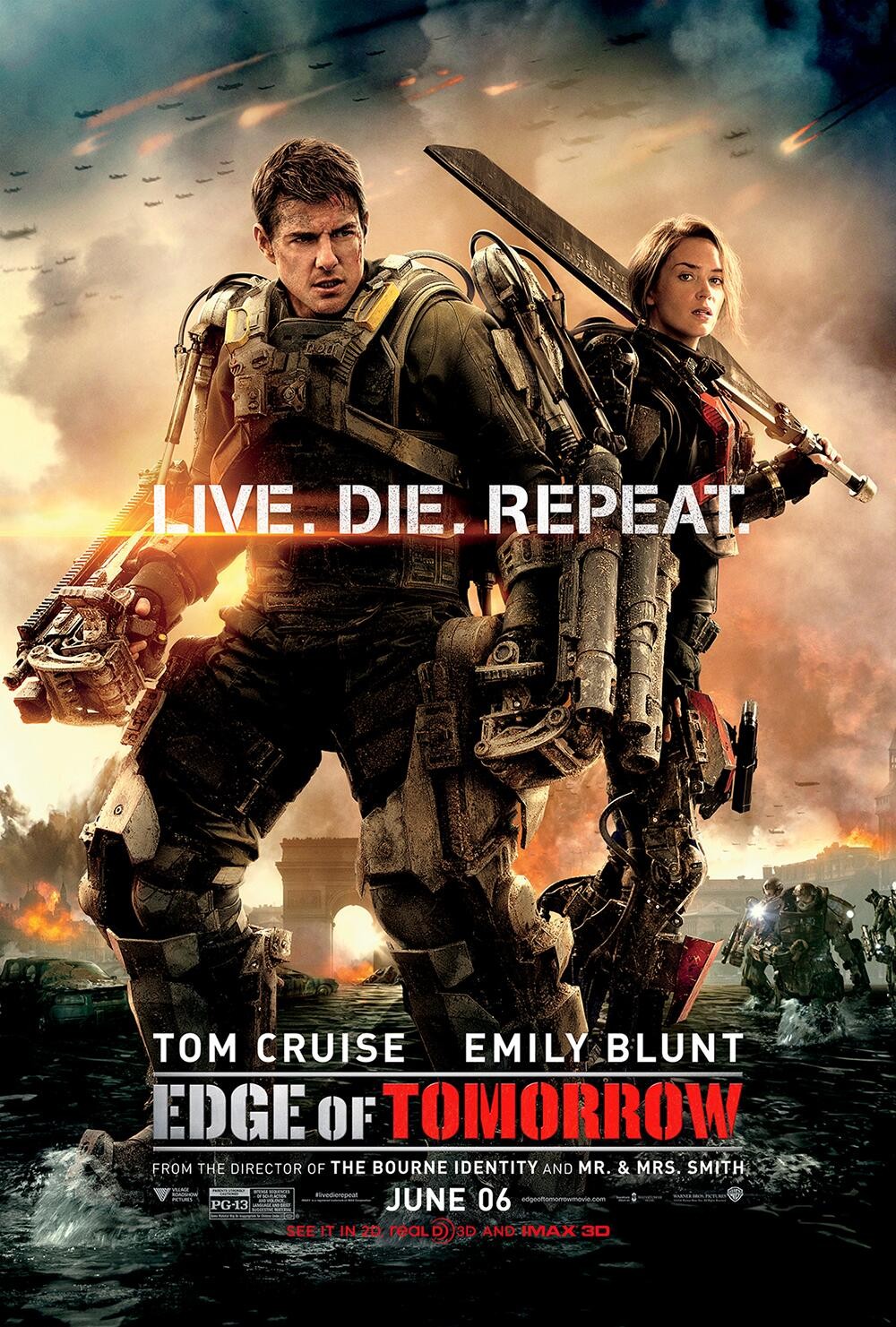
Edge of Tomorrow

edge_of_tomorrow_ver5_xlg

Genre: Sci-Fi, Action

Director: Doug Liman

Writers: Christopher McQuarrie, Jez Butterworth, John-Henry Butterworth, based on the novel “All You Need is Kill” by Hiroshi Sakurazaka

Cast: Tom Cruise, Emily Blunt, Bill Paxton, Brandon Gleeson, Noah Taylor

Running Length: 113 minutes

Synopsis: Edge of Tomorrow unfolds in a near future in which an alien race has hit Earth in an unrelenting assault, unbeatable by any military unit in the world. Major William Cage (Tom Cruise) is an officer who has never seen a day of combat when he is unceremoniously dropped into what amounts to a suicide mission. Killed within minutes, Cage now finds himself inexplicably thrown into a time loop forcing him to live out the same brutal combat over and over, fighting and dying again… and again. But with each battle, Cage becomes able to engage the adversaries with increasing skill, alongside Special Forces warrior Rita Vrataski (Emily Blunt). As Cage and Rita take the fight to the aliens, each repeated encounter gets them one step closer to defeating the enemy.

Review: Groundhog Day has withstood the test of time and almost two decades later, still remains one of my favourite movies. In my books, it’s no mean feat to be compared favourably to Groundhog Day, but that’s exactly what Edge of Tomorrow manages to achieve – it is essentially a sci-fi version of Groundhog Day, and although it’s a big budget action movie, the film is much better thought-out than the usual mindless summer action flick, and it’s the smaller moments that manages to impress more so than the effects-laden action setpieces.

While Edge of Tomorrow falters a little at the start, complete with the used-to-death news montage to set up the story, once the time loop starts kicking in the film becomes far more interesting. Doug Liman has obviously worked hard with the screenwriters to try and figure out exactly how much repetition audiences can take, and much like Groundhog Day, chooses to show only parts of each cycle to prevent audience fatigue. It generally works well, but there are moments where the plot does get lost. What really helps the movie is that it is not shy to inject humour into the proceedings, and indeed that are a handful of sequences that are laugh-out-loud funny, which makes Edge of Tomorrow a better-rounded movie than a typical sci-fi action film.

Tom Cruise is excellent as William Cage, mainly because he manages to dial his usual all-in-all-the-time intensity down for the role, and it certainly is refreshing to see him play a coward that dies and gets beaten down literally hundreds of times in the movie. Of course he does eventually blossom into the usual hero character he plays, but present here is at least a progression that is hardly seen in other movies headlined by Cruise. He is ably partnered by Emily Blunt, who is impossibly athletic and graceful in the film, and puts in a mesmerizing and believable performance. The only misstep is the attempt to develop a romantic liaison between the two actors, as while they share a good onscreen chemistry, the romance subplot feels undercooked and unconvincing.

And then there’s the film’s denouement, which is surely going to split audiences down the middle. Edge of Tomorrow ends with the usual CGI-laden, guns blazing finale, which really carries very little emotional heft as both the aliens and the cannon fodder are one-dimensional, and audience members are unlikely to feel vested. To avoid being spoilerly, all I can say is that the final scene is sure to throw audiences for a loop, which isn’t necessarily a good thing. Fortunately, the movie has built up enough goodwill along the way that even the head-scratching conclusion is unlikely to derail the positive sentiments. Will Edge of Tomorrow stand up to repeat viewings like Groundhog Day? I don’t think so, but at least the first time round will be fun and rather entertaining.

Rating: * * * ½ (out of four stars)

Standard

Godzilla

Image

Genre: Sci-Fi, Action

Director: Gareth Edwards

Writer: Max Borenstein, story by David Callaham

Cast: Aaron Taylor-Johnson, CJ Adams, Ken Watanabe, Bryan Cranston, Elizabeth Olsen, Carson Bolde, Sally Hawkins, Juliette Binoche, David Straitham

Running Length: 123 mins

Synopsis: An epic rebirth to Toho’s iconic Godzilla, this spectacular adventure pits the world’s most famous monster against malevolent creatures who, bolstered by humanity’s scientific arrogance, threaten our very existence.

Review: It’s been 16 years since Hollywood has put Godzilla on the big screen, and little wonder since the 1998 version was quite a misstep in terms of establishing the (then-planned) franchise. I’m pleased to say that the 2014 (re)incarnation is a far, far better movie.  Although it hiccups in terms of human drama, Godzilla manages to deliver on most other aspects, especially on Godzilla himself, and is a very satisfying stompy movie indeed.

The film does take its time to get started, with Godzilla not making a formal appearance till about the halfway point. This is largely due to Gareth Edwards attempting to ramp up the human drama in the movie, though it is somewhat unsuccessful. Despite populating the cast with an amazing amount of talent, no one actually gets to do much apart from Bryan Cranston. Ken Watanabe and Sally Hawkins are particularly wasted, reduced to nothing more than reciting expository dialogue. It is a pretty shocking waste of thespian chops, and the film would probably have done better just by focusing more on the monsters from the get-go.

Where the film does succeed, however, is giving the audience the human’s-eye view of the action once it gets going. Gareth Edwards regularly films the proceedings from the perspective of the humans, and this really helps to put the audience smack in the heart of the action. One particularly impressive scene is seen through Ford’s (Aaron Taylor-Johnson) face mask as he skydives past Godzilla – it is an impossibly intimate look at the big monsters and delivers dramatic flair in spades.

Kudos to the effects team as well for crafting Godzilla and monsters that look stunningly realistic (well, as realistic as we think giant monsters would look like anyway), and all the computer-generated mayhem and destruction are presented most convincingly. An excellent score by Alexander Desplat perfect augments the fantastic sound effects and mixing in the movie – it’s highly recommended that you watch Godzilla in a theatre with great acoustics, and rest assured that you can feel Godzilla’s roar in your bones if you do so. What’s not so recommended is the 3D in the movie – once again, the post-production 3D does nothing to enhance the viewing experience, and it would be better to stick to a big screen that’s devoid of the third dimension.

Although this isn’t identical to the Toho Godzilla movies that some of us grew up with, Gareth Edwards has done a very commendable job in maintaining the spirit of the old movies. Sure, the science is a bit junky still, and the central humans just aren’t interesting enough, but Godzilla himself is most impressively brought to life, in a mould that’s similar to the Japanese films that he once starred in. In fact, the movie could have been significantly improved if more focus was brought onto the monsters instead of the humans, but this is so much better than Hollywood’s previous attempt that it would seem nitpicky to ask for more. This may be Edwards’ first big budget directorial effort, but he has lived up to expectations (and more), and this film more than makes up for the 1998 travesty that almost killed Godzilla for good.

Rating: * * * (out of four stars)

Standard

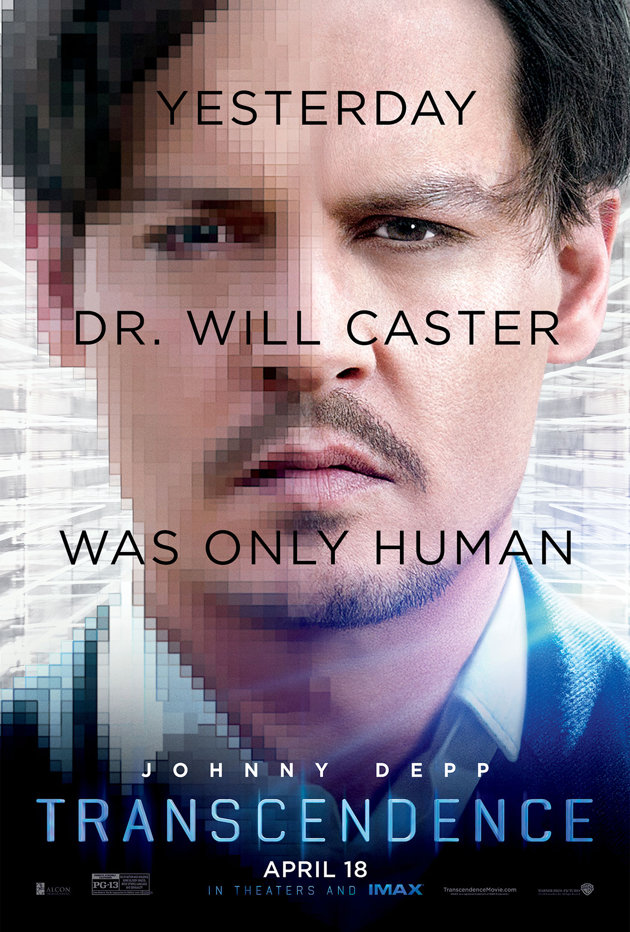
Transcendence

Image

Genre: Sci-Fi, Drama

Director: Wally Pfister

Writer: Jack Paglen

Cast: Johnny Depp, Rebecca Hall, Paul Bettany, Morgan Freeman, Cillian Murphy

Running Length: 119 mins

Synopsis: Dr. Will Caster (Johnny Depp) is the foremost researcher in the field of Artificial Intelligence, working to create a sentient machine that combines the collective intelligence of everything ever known with the full range of human emotions. His highly controversial experiments have made him famous, but they have also made him the prime target of anti-technology extremists who will do whatever it takes to stop him. However, in their attempt to destroy Will, they inadvertently become the catalyst for him to succeed—to be a participant in his own transcendence. For his wife Evelyn (Rebecca Hall) and best friend Max Waters (Paul Bettany), both fellow researchers, the question is not if they can… but if they should. Their worst fears are realized as Will’s thirst for knowledge evolves into a seemingly omnipresent quest for power, to what end is unknown. The only thing that is becoming terrifyingly clear is there may be no way to stop him.

Review: Transcendence is Wally Pfister’s first directorial outing after a good number of collaborations with Christopher Nolan as his DP, and it’s clear to see that Nolan has made more than an impression on Pfister’s directorial style – it’s almost as though Pfister had morphed into a Mini-Me version of Nolan, except without as much directorial flair. Pfister had set out to make a weighty, cerebral sci-fi movie in the mould of Inception, but the end result is more heavy-handed than weighty, more befuddling than thought-provoking. While it starts off intriguing and tries its best to captivate the audience, the movie sags under its own overplotting, eventually imploding in a most spectacular fashion into a hole-ridden, completely unbelievable denouement, after going nowhere with its plot for more than an hour.  

There are certainly things to like about Transcendence – the film is handsomely shot (on 35mm film no less), and both Rebecca Hall and Paul Bettany do a good job of being the focal points for much of the movie. Paul Bettany in particular turns in a particularly heartfelt performance, and becomes the emotional centre of Transcendence, and though it is definitely not intentional, Bettany becomes the person to root for in the film, eclipsing Rebecca Hall despite her continual presence. The technobabble is at least interesting for the first few reels, and the film does try its best to make a point about the over-reliance on computers and technology that plagues all of us these days.

However, for every positive aspect, negative aspects abound. The leading name on the poster may have been Johnny Depp, but he disappears for most of the movie, and given that he is playing an AI version of himself, it perhaps can be forgiven that his performance is flat and uninspired. The same goes for the rest of the supporting cast apart from Hall and Bettany, who are given nothing much to do except be devices for exposition. Even the usually great Morgan Freeman fails to impress, and that’s when you know something has gone awry.

Transcendence also makes the fatal flaw of trying to be smarter than the audience, but then actually not following through on the attempt. It’s immediately apparent – the movie is told from a flashback perspective of Max Waters, which essentially gives the ending away in the first five minutes. Usually this would mean that the movie has another reveal up its sleeves, but that’s not really the case in Transcendence, which leads one to question why the narrative structure was picked.

And in the second half of the movie, where nanotechnology plays a huge role, the script time and again requires audiences to fully suspend their disbelief and to accept the proceedings at face value. The technology is absurd, and the logic is nonexistent – this may be acceptable in a typical Summer action blockbuster, but not in a movie that’s trying so hard to be an intellectual one. It’s ineffective and rather insulting to the audience to be quite honest, especially given how the plot eventually writes itself into a very tight corner, and then plods to a long-expected but illogical conclusion that the audience has already (literally) seen coming from the start. And true to the shared DNA with Christopher Nolan, Pfister chooses to end off the movie with one final shot that is open to interpretation, much like Inception – the only difference being that I was absolutely not vested to even attempt any interpretation. Transcended, this has not.

Rating: * * ½ (out of four stars)

Standard

The Hunger Games: Catching Fire

Image

Genre: Sci-Fi / Adventure

Director: Francis Lawrence

Writers: Simon Beaufoy and Michael Arndt, based on the novel by Suzanne Collins

Cast: Jennifer Lawrence, Josh Hutcherson, Sam Claflin, Woody Harrelson, Donald Sutherland, Liam Hemsworth, Jena Malone, Philip Seymour Hoffman, Jeffrey Wright, Elizabeth Banks

Running Length: 146 minutes

Synopsis: Katniss Everdeen (Jennifer Lawrence) and Peeta Mellark (Josh Hutcherson) become targets of the Capitol after their victory in the 74th Hunger Games sparks a rebellion in the Districts of Panem.

Review: Being the middle installment of any book or movie franchise poses a unique problem – there’s no start and end to the story, and many audience members will leave the cinema feeling dissatisfied at the lack of a denouement. This is the case for Catching Fire, the follow up to last year’s box office blockbuster The Hunger Games (although now that they are splitting up Mockingjay into two films, Catching Fire doesn’t exactly sit right in the middle any more), but it’s very interesting to see where the film has brought the franchise to. It’s a much darker, broodier movie, and sets the tone for the even bleaker events unfolding in Mockingjay.

Armed with a much larger budget ($130 million versus the first film’s $78 million) and a new director who cut his teeth on music videos before moving to film, it’s almost a given that Catching Fire will be the handsomer movie. Coupled with impressive performances all round, particularly that of Jennifer Lawrence’s, and the compelling screenplay, it’s readily apparent that as the title suggests, the box office for the film would be quite fiery indeed. Catching Fire belongs to a rare breed of page-to-screen movies which would please both fans and non-fans alike.

A caveat – it is essential to have prior knowledge of The Hunger Games (whether in novel form or from the first movie) because Catching Fire jumps right into the narrative without any preamble. Anyone not initiated in any way before watching the movie would certainly find it hard to navigate around the multi-layered plot (masterfully put together by lauded scribes Simon Beaufoy and Michael Arndt) and figure out exactly what is going on. This is not a film that will be coherent on its own.

However, anyone who is already familiar with the Hunger Games backstory would find that Catching Fire has managed to elevate the franchise to way beyond a mere film catered for young adults (yes, Twilight, I’m looking at you). Yes, there’s a pseudo love triangle, and yes there are the occasional moments that lapse into pouty teen movie territory, but thankfully these are few and far between. Catching Fire is a somber movie dealing with rather adult themes, and even the Hunger Games itself is a more joyless event this time round – it’s clear that no matter who survives the Games, the victory will be a pyrrhic one. The film also concludes on a grim note, almost identical to how the Catching Fire novel ended.

Jennifer Lawrence reprises her role as Katniss Everdeen, and once again proves that she is definitely one of the best young actresses of our time. Katniss has been emotionally damaged after the conclusion of the first Hunger Games, and Jennifer Lawrence manages to flesh the character out further along this line. She manages to craft a tangible, strongly identifiable character out of Katniss, and commands the full attention of the audience whenever she appears.

The rest of the ensemble cast are very capable as well, particularly Woody Harrelson and Donald Sutherland, who both shine in the small number of scenes they have. The male heartthrobs Josh Hutcherson and Liam Hemsworth are the weakest links in the movie, but that may have been a construct of the script rather than due to a lack of thespian skills.

Costume design and art direction is superlative in Catching Fire – the costumes in particular are stunning, well worthy of many nominations (and potentially, wins) in the upcoming awards season. The increased budget also shows in the set design and effects, especially during the Quarter Quell itself.

Catching Fire is a complete package, even though the storyline isn’t – it boasts everything that the original Hunger Games has, and ups the ante in almost every way possible. The film has set the tone for the franchise, and it is now with great anticipation that I await the next two films in 2014 and 2015 to conclude the franchise.

Rating: * * * ½ (out of four stars)

Standard

Gravity

Genre: Sci-Fi, Drama

Director: Alfonso Cuaron

Writers: Alfonso Cuaron and Jonas Cuaron

Cast: Sandra Bullock, George Clooney

Running Length: 91 minutes

Synopsis: Dr. Ryan Stone (Bullock) is a brilliant medical engineer on her first shuttle mission, with veteran astronaut Matt Kowalski (Clooney) in command. But on a seemingly routine mission, disaster strikes. The shuttle is destroyed, leaving Stone and Kowalski completely alone—tethered to nothing but each other and spiralling out into the blackness. The deafening silence tells them they have lost any link to Earth…and any chance for rescue. As fear turns to panic, every gulp of air eats away at what little oxygen is left. But the only way home may be to go further out into the terrifying expanse of space.

Review: Gravity is a master-class in how 3D can be used to a film’s advantage and to deepen the audience’s immersion. Despite running a mere 91 minutes, this is an intense and visually stunning movie that works best in IMAX 3D (completely worth the price of admission), with a stellar performance from Sandra Bullock that guarantees an Oscar nomination, if not a win. Although it’s not entirely without flaws, Gravity is easily one of the best movies released this year so far, and should be seen on the big screen as home video is unlikely to be able to successfully replicate the transcendent viewing experience.

The film opens with a single 20-minute take, and almost all of the exposition and scene-setting occurs in this sequence. It is a great technical achievement, and the scene is one that sets the tone of the whole movie. A caveat to those prone to motion sickness:  the latter minutes of this sequence could be taxing on your sensibilities, since it’s set in the first-person POV of Ryan Stone.

What ensues after the stage is set is an extremely intense hour of cinema – although the structure is very straightforward, the fact that Ryan Stone is essentially on her own (George Clooney’s character functions more like a cameo appearance despite him getting equal top billing to Sandra Bullock) in the vast confines of space means the challenge of performing even the simplest acts seems near insurmountable. Combined with what seems like an unrelenting wave of bad luck, it’s almost physically exhausting, in a good way, to witness Stone’s struggles to survive.

This is definitely Sandra Bullock’s strongest performance in her career, far outshining her somewhat overrated (Oscar-winning) performance in The Blind Side. Bullock has to carry nearly the entire movie on her own, and has no other characters to play off of for the majority of the movie (even Tom Hanks at least had Mr Wilson in Cast Away). It does veer a little towards schmaltz in the final minutes of the film, but she is definitely the one to beat in 2014’s Oscar race.

Because of the setting in space, viewing Gravity in 3D in the largest format possible will definitely aid in the sense of immersion one gets from the film. Alfonso Cuaron has succeeded in harnessing technology to deepen the viewing experience – it’s rare that one reacts instinctively to “duck” from a flying piece of debris without feeling a sense of cheesiness, but that’s exactly what I did on multiple occasions in Gravity. The 3D amplifies the vastness of space, yet paradoxically it also makes the viewer feel even more intimately linked to and focused on Bullock’s performance. It’s hard to tell how much of the experience will be lost on smaller screens at home, but to not at least view this once in a darkened theatre would be missing out on one of the movie events of the year.    

 * * * ½ (out of four stars)

Standard

Pacific Rim * * * 1/2

Genre: Sci-Fi, Action

Director: Guillermo del Toro

Writers: Travis Beacham & Guillermo del Toro

Cast: Charlie Hunnam, Rinko Kikuchi, Idris Elba, Charlie Day, Max Martini, Ron Perlman

Running Length: 131 minutes

Synopsis: When legions of monstrous creatures, known as Kaiju, started rising from the sea, a war began that would take millions of lives and consume humanity’s resources for years on end. To combat the giant Kaiju, a special type of weapon was devised: massive robots, called Jaegers, which are controlled simultaneously by two pilots whose minds are locked in a neural bridge. But even the Jaegers are proving nearly defenseless in the face of the relentless Kaiju.

On the verge of defeat, the forces defending mankind have no choice but to turn to two unlikely heroes – a washed up former pilot (Charlie Hunnam) and an untested trainee (Rinko Kikuchi) – who are teamed to drive a legendary but seemingly obsolete Jaeger from the past. Together, they stand as mankind’s last hope against the mounting apocalypse.

Review: Pacific Rim is what the Transformers film should have been – it’s a behemoth of an effects movie, loud and brash and all guns blazing from the word go, but doesn’t eschew a proper storyline in exchange for CG effects and action sequences. Guillermo Del Toro has crafted a very impressive film here – minus some bad science and logic, this is about as entertaining as the monsters versus giant robots sub genre gets.

It’s clear that the film is targeted mainly at teenaged boys (just like Transformers), and so the proceedings remain very chaste throughout – there’s very little true violence and bloodshed (barring kaiju blood, but it’s about as gruesome as an ad for diapers, blue liquid and all), and virtually zero sexual chemistry between the two leads. The focus is really on the mecha and the monsters, which fortunately are rendered very well. Action sequences are cleanly shot, with none of the confusion that plagued all the Transformers movies, and the film is pretty evenly paced with little downtime.

Pacific Rim is also a rare action film which successfully balances the OTT action sequences with exposition, which allows audiences to feel more vested in the proceedings. There’s also immense attention paid to the finer details of the universe that Pacific Rim is set in – for example, Jaegers each have their own unique look and feel, and it’s readily apparent that a lot of painstaking work was put into making the Shatterdome and other environments look just right. Unlike Transformers and the ilk, there’s no lazy filmmaking to be found in Pacific Rim. This is also a film in which paying for a third dimension doesn’t feel like a pure money grab – the action sequences felt enhanced and even more visceral when viewed in (IMAX) 3D.

That’s not to say that the film is without issues – apart from the junky science (apparent even to a layperson like me), one of the biggest problems the movie has is with the choice of its main lead. Although Charlie Hunnam bears the looks and build of an all-American hero, his thespian skills leave much to be desired, and some of his line delivery is so poor it’s almost comical. To be fair, the rest of the cast is perfectly serviceable (Rinko Kikuchi and Mana Ashida, the child actress playing the younger version of Mako, are the most memorable), and the one scene where Raleigh and Mako face off in physical combat is flirtatious fun.   

Guillermo del Toro has not attempted a project of this size prior, but he has now shown that tackling a big summer blockbuster is not out of the question for him. Pacific Rim borders on being a guilty pleasure – it is hugely enjoyable with the standard trappings of an action film, and yet delves just enough beyond the superficial that it doesn’t become featureless, mindless action tedium. The final title card in the end credits pay tribute to Ray Harryhausen (master of stop motion animation films like the original Clash of the Titans) and Ishiro Honda (the director of Godzilla – the original film, not the pale Hollywood remake), and the film indeed is a shining example of how Harryhausen and Honda’s films would look like if made with the trappings of 21st Century technology and modern sensibilities.

Rating: * * * ½ (out of four stars)

Standard

After Earth * 1/2

Genre: Sci-Fi, Action

Director: M. Night Shyamalan

Writers: Gary Whitta and M. Night Shyamalan, based on a story by Will Smith

Cast: Will Smith, Jaden Smith

Running Length: 100 minutes

Synopsis: A crash landing leaves teenager Kitai Raige (Jaden Smith) and his legendary father Cypher (Will Smith) stranded on Earth, 1,000 years after cataclysmic events forced humanity’s escape. With Cypher critically injured, Kitai must embark on a perilous journey to signal for help, facing uncharted terrain, evolved animal species that now rule the planet, and an unstoppable alien creature that escaped during the crash. Father and son must learn to work together and trust one another if they want any chance of returning home.

Review: It’s quite obvious that Will Smith had designed After Earth to be a star vehicle for his son Jaden – after all, he wrote the story the screenplay was based on, and produced this movie together with his wife Jada. Unfortunately, it would seem that the payoff he would be getting out of the movie is likely going to be inadequate – there are so many misfires in After Earth it’s actually hard to pinpoint which is the straw that breaks the camel’s back. Suffice to say that if it’s true that Will Smith had intended the movie as the first of a trilogy, he’s going to have a really hard time making the next two films.

It’s not that After Earth is a bad movie, more that it is an ill-conceived one. Ostensibly a coming of age sci-fi flick that also features major father-son bonding, the fact that the two protagonists are separated for a large part of the film makes it nearly impossible for audiences to get a sense of any kinship between the two. This is not aided by the fact that Will Smith essentially spends the movie sitting in a chair, and Jaden’s perfunctory acting skills are not good enough for him to carry lengths of the movie on his own. In fact, there are times where the CGI and the set design (which are both genuinely well done) manage to make more of an impression than Jaden’s stilted performance.

This is exacerbated by the total lack of suspense – since Kitai is honestly the only actively moving actor in the movie, there’s never a true sense of danger even when Kitai gets into trouble. There’s never doubt that he would make it through the ordeal, so even if the character is placed in a situation that seems to lead to impending doom, his continued survival is the only outcome that would make any sense. This predictability greatly detracts from the viewing experience, resulting in a film that seems to drag even though it has a relatively short running time of under two hours.

M. Night Shyamalan has fallen so far from grace that the film has been marketed largely without his name on it, and After Earth would not be the movie that would pull him out from his downward spiral. There are no third-act twists in this film, but it may actually have fared better if there were one (and this is coming from someone who grew very tired of Shyamalan’s plot twists). It would at least have made the proceedings more interesting to sit through.

Rating: * ½ (out of four stars)

Standard

Star Trek: Into Darkness * * * 1/2

Genre: Sci-Fi, Action

Director: J.J. Abrams

Writers: Roberto Orci, Alex Kurtzman, Damon Lindelof

Cast: Chris Pine, Zachary Quinto, Benedict Cumberbatch, Karl Urban, Zoe Saldana, Simon Pegg, John Cho

Running Length: 133 minutes

Synopsis: When the crew of the Enterprise is called back home, they find an unstoppable force of terror from within their own organization has detonated the fleet and everything it stands for, leaving their world in a state of crisis. With a personal score to settle, Captain Kirk (Chris Pine) leads a manhunt to a war-zone world to capture a one man weapon of mass destruction.

Review: With the series reboot in 2009, Star Trek is no longer a movie franchise that solely appeals to a niche “Trekkie” audience. J. J. Abrams had made Star Trek cool and mainstream, and many people will walk into Star Trek: Into Darkness, four years later, with raised expectations (myself included). The good news is that Into Darkness manages to outdo its predecessor(s), raising the bar yet again for the Star Trek franchise. Into Darkness has something for fans of many genres – sci-fi, action, even drama, and although it has once again taken liberties with the “established” Star Trek canon, there’s very little to complain about otherwise.

A caveat: now that it’s the second movie post reboot, audiences will need to have watched the first movie in order to make sense of the interpersonal relationships aboard the starship Enterprise, as there is very little exposition in the film to cast more light on the Enterprise crew list. That does free up the narrative of Into Darkness, and instead of cast introductions, the film kicks off straight in the deep of a really fun, slightly implausible action sequence that sets the tone for the rest of the movie.

The original cast are back for the sequel, and as a whole the performances are more than adequate, with even the usually subpar Chris Pine having a few memorable moments. However, all performances pale to Benedict Cumberbatch’s tour de force turn as the central villain of the movie, and a mid-movie reveal will leave Trekkies gasping for breath (either in horror or in appreciation of the way Abrams has paid homage to the Trek films of yore). The intensity of Cumberbatch’s performance is astounding, and manages to outdo Eric Bana’s banal villain (pun unintended) in the first film many times over.

Into Darkness is yet another post-processed 3D film, which means that there’s really very little reason to view it in 3D. Save for a couple of scenes which displays reasonable three dimensionality, there’s no significant value-add shelling out the extra money for a 3D screening.

The screenplay has almost everything in it save the kitchen sink, deftly switching from action to comedy to character drama, and managing to pull off most of it with aplomb. The only flaw is in the film’s final reel, which feels like an unnecessary addition after what was ostensibly a climactic finale. The film thus ends on a whisper instead of a bang, but even this irregularity doesn’t detract too much from the enjoyment of the movie as a whole. And that’s essentially the reason why Into Darkness is a successful film – it manages to consistently entertain, and yet boasts a depth that is not commonly seen in summer blockbusters.

Unfortunately, with directorial duties for Star Wars looming, it is unlikely that J. J. Abrams will be behind the camera for the next Star Trek installment. However, he has laid such excellent groundwork for the franchise to continue, that it would take a large amount of ineptitude for the next director to screw it up.

Rating: * * * ½ (out of four stars)

Standard