Marvel’s The Avengers: Age of Ultron

Genre: Action

Director: Joss Whedon

Screenplay: Joss Whedon

Cast: Robert Downey Jr., Chris Hemsworth, Mark Ruffalo, Chris Evans, Scarlett Johansson, Jeremy Renner, Don Cheadle, Aaron Taylor-Johnson, Elizabeth Olsen, Paul Bettany, James Spader

Running Length: 141 minutes

Synopsis: When Tony Stark tries to jumpstart a dormant peacekeeping program, things go awry and Earth’s Mightiest Heroes, including Iron Man, Captain America, Thor, The Incredible Hulk, Black Widow and Hawkeye, are put to the ultimate test as the fate of the planet hangs in the balance. As the villainous Ultron emerges, it is up to The Avengers to stop him from enacting his terrible plans, and soon uneasy alliances and unexpected action pave the way for an epic and unique global adventure.

Review: It cannot be denied that despite being an utterly successful commercial venture (and having other film studios scrambling to create similar franchises), the Marvel Cinematic Universe is starting to feel a little tired. Although this is “just” the second proper Avengers movie, it is also the 11th film in the Cinematic Universe, with just one more film to go (Ant-Man, coming in July) before Phase 2 ends and Phase 3 begins with TEN more movies on the slate, stretching all the way to 2019. To say that there’s a surfeit of superhero movies is an understatement, and one does wonder how long the gravy train can keep on chugging. 

Thankfully, there’s a dichotomy in Avengers: Age of Ultron that is rarely seen in the Cinematic Universe – the film delivers on the big action sequences that people have come to expect from these movies, and yet focuses the plot largely on the smaller characters that don’t have a dedicated movie (or movies) to their name. This approach adopted by Joss Whedon is really only possible in a franchise as developed as the Marvel one, since there is the luxury of time to tell the tale over multiple movies, and Age of Ultron is better for it.

Ultron, the titular mega-villain, stands head and shoulders above many of the other bland villains that have populated much of the MCU movies. He poses a credible threat and is a worthy opponent to the Avengers, and because he is literally heartless, there is actually a sense of peril pervading parts of the movie. Joss Whedon also tries to humanize a number of the Avengers, most notably Bruce Banner, Black Widow and Haweye, as well as newcomers Quicksilver and Scarlet Witch, giving them romantic subplots and human backstories that fill in the gaps between the action set-pieces.

Although this may sound like nit-picking, it’s actually the action set-pieces that bring Age of Ultron down a notch. Like the first Avengers movie, action sequences come across as being slightly over-edited, with so many cuts that the action actually becomes a little muddled. This is most apparent in the showdown between the Hulk and Iron Man (in a pretty cool Hulkbuster suit), which is edited with such a quickfire pace that it almost feels like a scene out of the Transformers franchise – which is not a good thing. Watching the film in 3D also exacerbates the issue while adding virtually nothing in the third dimension, and an IMAX non-3D screening would probably be the most optimal viewing experience.

It’s become apparent, especially in Phase 2 of the MCU, that the movies can no longer be entirely judged on their individual merit. As a standalone film, Age of Ultron has its flaws in terms of pacing and editing, but when viewed as a key film in Phase 2 of the MCU, it fares better – not only does it wrap up some loose ends from the preceding movies, it also begins the narrative arc of Phase 3, introducing a number of new superheroes that should come into their own when the next Phase begins.  There is a compelling story to be found in Age of Ultron, and despite it being what is essentially the middle film in the Avengers trilogy (now a quadrilogy, to be exact), doesn’t suffer too much from the middle-child syndrome.

Rating: * * * (out of four stars)

Standard

Taken 3

Genre: Action

Director: Oliver Megaton

Screenplay: Luc Besson, Robert Mark Kamen

Cast: Liam Neeson, Maggie Grace, Famke Janssen, Forest Whitaker, Dougray Scott, Sam Spruell, Leland Orser, Jon Gries, Al Sapienza

Running Length: 118 minutes

Synopsis: Liam Neeson returns as ex-covert operative Bryan Mills, whose reconciliation with his ex-wife is tragically cut short when she is brutally murdered. Consumed with rage, and framed for the crime, he goes on the run to evade the relentless pursuit of the CIA, FBI and the police. For one last time, Mills must use his “particular set of skills,” to track down the real killers, exact his unique brand of justice, and protect the only thing that matters to him now – his daughter.

Review: Taken 3 is a perfect example of how Hollywood manages to run some movie franchises into the ground. When the first (and at that time, only) Taken movie was released, what was originally probably intended to be a B-list movie became an international hit, netting over US$200 million in box office, and establishing Liam Neeson’s second career as a bona-fide action star. The menacing voice message Bryan Miller leaves for his daughter’s captor is highly memorable even after seven years, and has become immortalized in pop culture. While spawning a sequel was an inevitability, this third (and seemingly final – thankfully) film in the franchise feels wholly unnecessary, and takes the franchise in a direction that betrays its origins: while the title is Taken 3, no one actually gets taken (except perhaps the audience, for a ride).

Playing out more like a knockoff of The Fugitive, this time around it’s Bryan’s ex-wife (a woefully underused Famke Janssen) who is murdered and Bryan conveniently being framed for her murder. This alone shifts the tone of the movie quite drastically versus the first two films – since no one is taken, there’s never that tension of Bryan doing the best he can to protect his family and free them from the grasp of the villains, which results in a far more subdued performance by Neeson. Neeson’s no-holds-barred takedown of the bad guys was what made the first Taken so eminently watchable, and outwitting the police in a largely blood-free manner for much of the movie makes Taken 3 feel like a geriatric, neutered outing when compared to its predecessors.

Gone too are the European locales, with the action centered in Los Angeles this time, yet the film still manages to whip out a Russian mobster villain on demand (and introduced in a terribly hackneyed flashback sequence), I guess to make the film feel just that bit more exotic. Although this is Oliver Megaton’s second Taken movie, the camerawork is just plain awful. Most of the action sequences are framed so poorly that it’s hard to discern the action, and Megaton’s questionable choice of employing shakycam movements even in non-action scenes, and a predilection for extreme closeups make viewing Taken 3 a potentially nauseating experience.

Unfortunately, in a film franchise not known for strength in plotting, Taken 3’s plot is the most convoluted and muddled of the three films, and by the final reel it seems that even the director has decided to no longer bother about the plot and just wrap it up at the earliest possible moment. I personally found the final reveals and the denouement to make no sense whatsoever, and would be appreciative of anyone who will be watching the movie to enlighten me on the finer workings of the plot (particularly “the warm bagel theory”). To add insult to injury, despite repeating ad nauseum in its marketing materials that Taken 3 is “one last time”, the film still chooses to leave a door open for a potential sequel. For the love of all that’s good and decent, dear Hollywood executives, please do not green light that project.

Rating: * (out of four stars)

Standard

Exodus: Gods and Kings

Genre: Action, Drama

Director: Ridley Scott

Writers: Adam Cooper, Bill Collage, Jeffrey Caine, Steven Zaillian

Cast: Christian Bale, Joel Edgerton, John Turturro, Aaron Paul, Ben Mendelsohn, Maria Valverde, Sigourney Weaver, Ben Kingsley, Isaac Andrews, Hiam Abbass, Indira Varma, Ewen Bremner, Golshifteh Farahani, Ghassan Massoud, Tara Fitzgerald, Maria Valverde, Andrew Barclay Tarbet

Running Length: 150 minutes

Synopsis: From acclaimed director Ridley Scott (Gladiator, Prometheus) comes the epic adventure Exodus: Gods and Kings, the story of one man’s daring courage to take on the might of an empire. Using state of the art visual effects and 3D immersion, Scott brings new life to the story of the defiant leader Moses (Christian Bale) as he rises up against the Egyptian Pharaoh Ramses (Joel Edgerton), setting 600,000 slaves on a monumental journey of escape from Egypt and its terrifying cycle of deadly plagues.

Review: It’s apt to quote from Ridley Scott’s own Gladiator, since it was the movie that made the sword-and-sandals epic cool again – “Are you not entertained?” Because this is one of the main problems I have with Exodus – although it is sufficiently stirring sporadically, and shows a really masterful use of CGI, the film is simply not that entertaining, bringing nothing new to the tale of the Ten Commandments, and actually ends up being less interesting than Cecil B. DeMille’s still-definitive 1956 version.

Perhaps it’s because Ridley Scott didn’t seem to set out to make a religious epic, and much like Darren Aronofsky’s Noah earlier in the year, attempts to make certain scenes more secular and logical, that the film takes a big hit. The parting of the Red Sea certainly feels more realistic, but does not inspire any awe. The plagues visited upon Egypt are brilliant CGI setpieces, but at the same time come across as being perfunctory, as though Scott is checking off an invisible list of the ten plagues, just making sure that they all end up in the film. The burning bush and the Ten Commandments seem more like afterthoughts, and are not given the dramatic heft that they should have been. The personification of God is also a questionable decision – I am not sure if assigning an actor to play God (literally) is more effective than a loud booming voice, as clichéd as the latter sounds.

Although Scott and his team of 4 writers correctly presume that a good majority of the audience would be at least somewhat familiar with the story of Moses, broad narrative gaps appear in the film, which almost makes the film feel disjointed. And yet, the film devotes so much time to the setup that when thing finally get going in the last hour, the pacing suddenly speeds up and the entire proceedings start feeling rushed. To add insult to injury, after a rather stirring finale act of crossing the Red Sea, Scott decided to keep the narrative running just a bit too long, leading to a drawn out and wholly anticlimactic denouement.

Putting aside the fact that the film is populated by white actors instead of ethnic actors more appropriate to the story’s locations, even the A-list names in the cast feel a bit out of place. The normally supremely dependable Christian Bale feels a little stilted in his portrayal as Moses, and Joel Edgerton basically depends on his bronzer and guyliner to carry his performance as Ramses. These are not bad performances by any measure, but again, so much drama is dialed back that it just comes across as being too muted for an epic film like this one. Other notable actors like Ben Kingsley, Sigourney Weaver, John Turturro and Aaron Paul barely register, completely wasted in parts where they have too little to do.

Thankfully, the few action setpieces are quite rousing, if never reaching the level of Scott’s best films. Also, for a film that’s steeped in CG by necessity, Exodus actually comes across as being visually stunning without being too clearly artificial (though there’s absolutely no necessity to catch the film in 3D). In this day and age where a straight-up biblical epic may no longer be palatable to the general audience, both experiments in 2014 have been only moderately successful. There is really no reason to remake The Ten Commandments, and the results only serve to reinforce this. Here’s hoping that Scott’s next cinematic outing (The Martian, coming in end 2015) would prove to be a more compelling film.

Rating: * * ½ (out of four stars)

Standard

The Hunger Games: Mockingjay – Part 1

Genre: Sci-Fi, Action

Director: Francis Lawrence

Writers: Peter Craig and Danny Strong, based on the novel by Suzanne Collins

Cast: Jennifer Lawrence, Josh Hutcherson, Sam Claflin, Woody Harrelson, Donald Sutherland, Liam Hemsworth, Julianne Moore, Philip Seymour Hoffman, Jeffrey Wright, Elizabeth Banks, Natalie Dormer

Running Length: 123 minutes

Synopsis: The Hunger Games: Mockingjay – Part 1 opens with Katniss Everdeen (Jennifer Lawrence) in District 13 after she literally shatters the Hunger Games forever. Under the leadership of President Coin (Julianne Moore) and the advice of her trusted friends, Katniss spreads her wings as she fights to save Peeta (Josh Hutcherson) and a nation moved by her courage.

Review: Despite its best intentions, Mockingjay Part 1 is easily the weakest installment in the Hunger Games franchise thus far. Lionsgate had made the financially-lucrative (but creatively bankrupt) decision to cleave the final installment in two, but unfortunately Mockingjay Part 1 does not work well as a standalone movie, and ends in such an abrupt manner that it can potentially turn casual audiences off from making a return visit for Mockingjay Part 2. The final novel in the Hunger Games trilogy was the grandest in scale, but does not lend itself well to a (probable) 4-plus hour transition to the big screen. Mockingjay Part 1 is ponderously paced, meanders and feels drawn out, and is only sporadically interesting in its two hour plus running time. While the elements that made the first two movies good are still present, they are weighed down by too much unnecessary baggage.

Although “The Hunger Games” is still part of the title of Mockingjay, it is important to note that while there’s war and strife, there’s no Hunger Games being conducted in the movie. While this is not surprising for anyone who has read the novels (like myself), expectations of some audience members will surely be confounded. Mockingjay is a far more static movie, with a very minimal number of action setpieces. Much of it is set underground, in District 13, and with Katniss essentially neutered from most of the action (of any kind), it’s almost like the franchise is banking on the halo effect of her past two cinematic outings to coast by. Even though Jennifer Lawrence is a great actress, she’s really only effective in a handful of scenes in Mockingjay Part 1, a stark difference from the previous two films where she held the audience’s attention from beginning to end. The film does boast a very strong supporting cast of veteran actors, especially the late Philip Seymour Hoffman, but none of them are really given enough time to shine, despite the film’s length.

It doesn’t help that Peeta is separated from Katniss for essentially the whole movie – while Liam Hemsworth’s Gale is around Katniss, the love triangle is essentially DOA since there’s no chemistry whatsoever between Hemsworth and Lawrence, which has already been confirmed in the last two movies, but brought into starker contrast this time round. Fortunately, the romance is a smaller and less consequential component of the film compared to other YA offerings, so it doesn’t completely undermine the movie despite the clunkiness.

Since it’s essentially half a movie, it is difficult to judge if Mockingjay is a befitting swansong for the franchise until Part 2 is released (a full year later, in November 2015). It cannot be denied, however, that nothing much really happens in Mockingjay Part 1, since it’s merely a placeholder for the true conclusion of the film in Part 2, where surely there’s less inaction and an actual denouement. This is the film’s most glaring fault and drowns out almost every positive aspect. While it’s still a perfectly serviceable YA film (albeit a fair bit darker and brooding than most films in the same genre), Catching Fire had set up higher expectations which unfortunately are not met with this half of the finale.

Rating: * * ½ (out of four stars)

Standard

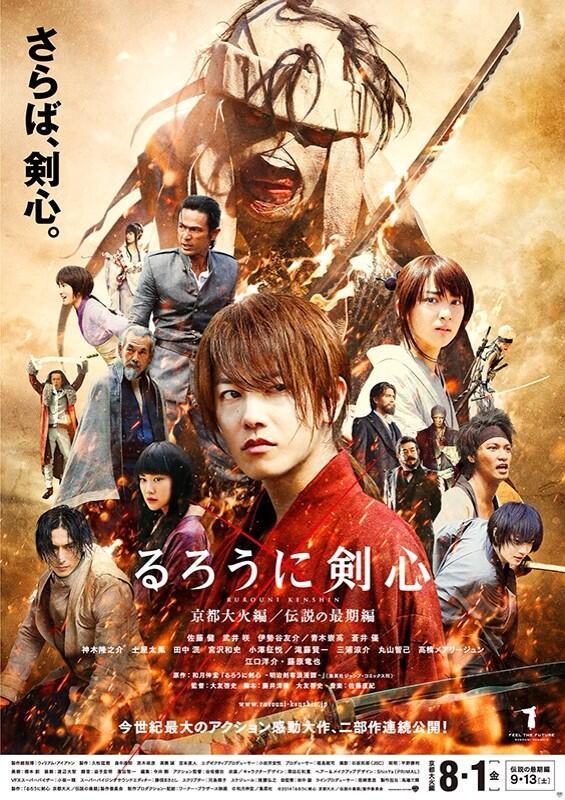
Rurouni Kenshin: The Legend Ends

Genre: Action

Director: Keishi Ohtomo

Writers: Kiyomi Fujii, Keishi Ohtomo, based on the original comic “Rurouni Kenshin” by Nobuhiro Watsuki

Cast: Takeru Satoh, Tatsuya Fujiwara, Emi Takei, Yusuke Iseya, Munetaka Aoki, Yu Aoi, Ryunosuke Kamiki, Tao Tsuchiya, Min Tanaka, Masaharu Fukuyama

Running Length: 135 minutes

Synopsis: To stop Makoto Shishio (Tatsuya Fujiwara) who aims to conquer Japan, Kenshin (Takeru Satoh) arrives in Kyoto and tries to face off against Shishio’s troops. However, his enemy has begun its course to start invading Tokyo with the steel-reinforced battleship. To save captured Kaoru (Emi Takei) who is thrown into the sea by Shishio’s men, Kenshin also dives in after her but is washed ashore alone, unconscious. Kenshin recovers with the help of Seijuro Hiko (Masaharu Fukuyama), the master of Kenshin who happens to find him on the shore. He realises he is no match for Shishio unless he learns the ultimate technique of his sword style, and begs the master to teach him. In the meantime, Shishio finds that Kenshin is still alive, and puts pressure on the government to find Kenshin and execute him in public for his sins during his days as the “Battosai the Killer”. As Kenshin faces his biggest challenge, can Kenshin really defeat his fiercest enemy Shishio, and be reunited with Kaoru?

Review: Unlike most sequels, the wait for The Legend Ends has been pretty short, with less than two months separating the release of Kyoto Inferno and The Legend Ends. The three-movie arc concludes with this film, and fortunately most of the loose ends from the previous movies are tied up here. The film is an unabashed “fan service” film, but works less successfully if one is not acquainted with the franchise and its characters. A major caveat: this is not a movie to watch on its own – at the very least, audiences are expected to have watched Kyoto Inferno, otherwise it would be near impossible to make head or tail of the proceedings.

Strangely, although The Legend Ends picks up where Kyoto Inferno left off, the starting reels are very slow going, and narratively the film comes to an almost complete standstill while Kenshin trains with his master. Such a structure only makes sense if the films are watched back to back, and this is indeed one of the biggest failings of The Legend Ends when seen on its own in the cinema.

Fortunately, the action picks up in the second half of the movie, with some of the best close-quarters swordfights I have seen in a long while, all done with little or no CG work involved. The amount of action in the second half more than makes up for the unenergetic first half, and once things get in gear the movie becomes much easier to get into. The plot remains somewhat muddled, with the supposed political intrigue failing to make much of an impression apart from being a plot device to move the film to its eventual conclusion.

The films are filled with familiar characters from the manga and anime (another indication of the extent of fan service accorded in the films), but the end result is that many of them get relatively short shrift. The most egregious of this is the Ten Swords, introduced in Kyoto Inferno and supposedly would prove to be challenges to Kenshin, but instead are mostly nothing more than fleeting cameos. Even Shishio is missing for a large part of the movie, again something that really only makes sense if the movies are viewed at one go. Once again, the romance between Kenshin and Kaoru remain unconvincing, and their eventual reunion feels anti-climactic despite a valiant attempt at buildup.

With The Legend Ends, it is clear that this Rurouni Kenshin two-parter should never have been structured in this manner. While it is satisfying to see the full story arc resolve, there is once again so much narrative excess in The Legend Ends that the two films ought to have been re-edited into a single, less rambling film. The success of The Legend Ends is assured, since anyone who watched Kyoto Inferno would definitely want to see how the story concludes, and there is enough in the film to warrant a visit to the cinema, but the viewing experience would have been much improved if the choice was made to combine the films.

Rating: * * * (out of four stars)
Standard

Rurouni Kenshin: Kyoto Inferno

Genre: Action, Drama

Director: Keishi Ohtomo

Writers: Kiyomi Fujii, Keishi Ohtomo, based on the original comic “Rurouni Kenshin” by Nobuhiro Watsuki

Cast: Takeru Satoh, Tatsuya Fujiwara, Emi Takei, Yusuke Iseya, Munetaka Aoki, Yu Aoi, Ryunosuke Kamiki, Tao Tsuchiya, Min Tanaka

Running Length: 139 minutes

Synopsis: Kenshin Himura (Takeru Satoh) is a legendary swordsman in the wars accompanying the turbulent fall of Japan’s Shogunate in the 19th century. Once feared as ‘Battosai the Killer’, he has adopted a peaceful life since the arrival of the ‘new age’ in Japanese history. But Makoto Shishio (Tatsuya Fujiwara), the ‘Shadow Killer’ who succeeded to Kenshin’s position in the service of the new government, has since then been active in the Kyoto underworld. Because he knew too much of the dark side of the new government, he was stabbed and his body set on fire. He survived, however and, wrapped in bandages, has raised an army of disaffected former samurai with the aim of overthrowing the new regime. Agreeing to a request by Toshimichi Okubo, the Home Minister, Kenshin leaves his friends in Tokyo and sets out for Kyoto. He and Shishio are a match in skill and in wits, but their aims are opposite. Kenshin seeks to preserve the nation without breaking his vow that he will kill no more.

Review: With Hollywood blockbusters crowding the cinemas, it’s little wonder that the jidaigeki (period drama) genre of Japanese cinema has become a shadow of its former self, and apart from the Rurouni Kenshin series itself, decent chanbara films have been few and far between. Kyoto Inferno is the follow up to the first Rurouni Kenshin film (in 2012), and perhaps more importantly, is part one of a two-part epic feature (Rurouni Kenshin: The Legend Ends opens in Singapore about a month later on 9 October). And much like other films that are cleaved into two, it’s perhaps a bit unfair to pass judgment on what essentially is half a movie and not on the entire body of work.

Yet, it’s also a necessity that each film should be able to stand on its own, and in a way Kyoto Inferno does succeed to a certain extent. Although the film is very slow going, Kyoto Inferno manages to establish the characters and their motives (it can get a little confusing, but prior knowledge of the Rurouni Kenshin series or the previous movie is not required), as well as set the stage for what would likely be a much more kinetic second film. This unevenness is one of the bigger problems of the film, because it is likely that there will be audiences that go into Kyoto Inferno expecting swordfights galore and not a weighty drama, even if it’s good drama for most of the film. Fortunately, the pace does pick up sporadically in a number of well choreographed action sequences. The action in Kyoto Inferno seems largely to be traditional stunt work, and CG has been kept to a minimum, a refreshing change from typical Hollywood fare these days.

Although no one is going to carry home award trophies for their acting in Kyoto Inferno, at least each actor bears a good resemblance to their manga/anime counterparts. Tatsuya Fujiwara does manage to impress as his turn as Shishio is appropriately menacing despite acting entirely behind a mask of bandages. Much emphasis is placed on the romance between Kenshin and Kaoru, this to me is the weakest link in the film, as the two actors share very little onscreen chemistry and the dalliance simply does not convince.

It seems to be a trend for filmmakers to split finales nowadays, and although in this case the wait is a fair bit shorter than usual, it is still a bugbear to me. Did this installment Rurouni Kenshin need to be played out over two full-length movies? The answer once again is no – there’s so much narrative excess in Kyoto Inferno that much of it could have been edited out in the first place with very little loss to the structure of the film. It remains to be seen if The Legend Ends would justify the two part treatment, but perhaps the better route would have been to release a single film cinematically then a director’s cut later on.

Rating: * * * (out of four stars)

Standard

Marvel’s Guardians of the Galaxy

Genre: Action, Comedy

Director: James Gunn

Writers: James Gunn, Nicole Perlman, based on the Marvel comic book by Dan Abnett and Andy Lanning

Cast: Chris Pratt, Zoe Saldana, Dave Bautista, Vin Diesel, Bradley Cooper, Lee Pace, Michael Rooker, Karen Gillan, Djimon Hounsou, John C. Reilly, Glenn Close, Benicio Del Toro, Laura Haddock

Running Length: 120 minutes

Synopsis: An action-packed, epic space adventure, Marvel’s Guardians of the Galaxy expands the Marvel Cinematic Universe into the cosmos, where brash adventurer Peter Quill (Chris Pratt) finds himself the object of an unrelenting bounty hunt after stealing a mysterious orb coveted by Ronan (Lee Pace), a powerful villain with ambitions that threaten the entire universe. To evade the ever-persistent Ronan, Quill is forced into an uneasy truce with a quartet of disparate misfits-Rocket (Bradley Cooper), a gun-toting raccoon, Groot (Vin Diesel), a tree-like humanoid, the deadly and enigmatic Gamora (Zoe Saldana) and the revenge-driven Drax the Destroyer (Dave Bautista). But when Quill discovers the true power of the orb and the menace it poses to the cosmos, he must do his best to rally his ragtag rivals for a last, desperate stand-with the galaxy’s fate in the balance.

Review: This is going to sound like hyperbole, but Guardians of the Galaxy is probably one of the best comedies I’ve seen in years, the most entertaining Marvel Cinematic Universe movie yet, and definitely the most fun movie I’ve managed to watch this Summer. Is it perfect? Nope, but it is almost impossible to harbour any ill will against an action blockbuster that’s this entertaining and so full of heart. That it comes with an amazing 1970s soundtrack is just the cherry on top – as we all already know from X-Men: Days of Future Past, 70s songs tend to make superhero films better.

Perhaps it’s because Guardians of the Galaxy is such an obscure part of the Marvel canon, that director James Gunn and co-writer Nicole Perlman have a freedom that not many other directors and scribes involved in the Marvel Cinematic Universe are allowed. That sense of irreverence is what makes Guardians of the Galaxy such a pleasure to watch – this is what the MCU is like after-hours, kicking back on the recliner with a Bud Light in hand. I am willing to bet that even the most seasoned moviegoers will find themselves surprised by some of the plot turns in the film, because the film is not afraid to confound expectations unlike the usual “serious” superhero movies.

Yet, what makes Guardians of the Galaxy extra special is that despite the humour and the zaniness, this is a movie with a lot of heart. Even in the confines of an action movie, the main characters are fully developed – yes, even Groot, who is about two levels above being monosyllabic – and very relatable to the audience. These are not inaccessible superheroes, billionaires or gods, but a bunch of adventurers who have less than noble motives, and are all damaged in their own ways. This organic emotional vulnerability (versus say, Superman’s weakness to kryptonite) is refreshing and adds a dimensionality to the movie that is rarely seen in other movies in the same genre.

I must admit I had doubts when Chris Pratt was cast in the lead role of Guardians of the Galaxy – he’s been a dependable costar both in films and on TV, but is he able to shoulder the lead role of a multimillion dollar action blockbuster? My doubts are totally unfounded, as Chris Pratt is a perfect fit for the role. Not only did he buff up for the role (Pratt can justifiably be called hot now), his perfect comic timing is actually critical for the movie’s success. In fact, his performance here reminds me of Harrison Ford’s two iconic roles as Han Solo and Indiana Jones. While Zoe Saldana and Dave Bautista are both serviceable complements, what’s truly impressive is that the two animated characters of Rocket and Groot are not only voiced perfectly by Bradley Cooper and Vin Diesel, they actually carry as much thespian weight as the other live action characters. All five lead characters share great onscreen chemistry, and any combination of the five works well, which is truly a rarity. It’s also a testament to the advance of CG imagery that they manage to integrate so well into the proceedings. The villains don’t fare as well, however, and everyone from Lee Pace to Karen Gillan to Josh Brolin are unmemorable and merely serve to advance the plot along.

The film is also very capable in its other technical aspects. Production design and art direction is excellent, with brand new worlds that are vibrant and meticulously built, with great attention to detail. For once, watching the movie in 3D also seems to be a worthy investment and not an unnecessary expense. It also lives up to its name as an action blockbuster, with a number of well-choreographed, well-animated space dog fights as well as close quarter battles that get the adrenalin flowing.

Personally, despite a Summer season with a good number of quality superhero movies, Guardians of the Galaxy ranks as number one for me. Although the MCU output so far has had relatively few clunkers, Guardians of the Galaxy still stands out as being such a unique and special entity that gets so many things right, that I’m inclined to also say that this is the best MCU movie to date. There does seem to be a surfeit of unresolved plotlines, but given that the sequel is already greenlit, it’s not too major a concern. It’s going to be a long, long wait to July 2017 when we will finally be able to rejoin the Guardians on their next, hopefully equally zany and entertaining, adventure.

P.S If you thought that nothing could be more inane than The Avengers’ shawarma end credits coda, well, stay around for the coda to this one. One only hopes that the character reference in the coda does not suggest a remake to what I feel was a TERRIBLE movie the first time round.

Rating: * * * ½ (out of four stars)

Standard

The White Haired Witch of the Lunar Kingdom

Genre: Action, Romance, Drama

Director: Jacob Cheung

Writers: Kang Qiao, Wang Bing, Guo Jinle, Shi Heran, Zhu Yale

Cast: Fan Bingbing, Huang Xiaoming, Vincent Chao, Wang Xuebing

Running Length: 103 minutes

Synopsis: At the end of the Ming Dynasty, corruption is rife, a traitor is in power and the Jin army is threatening war. In the Northwest, famine is rife. Jade Raksha (Fan Bing Bing), a female pugilist thought of as evil throughout the empire, helps the victims of the famine by arresting and killing corrupt officials.

Meanwhile, the future successor of the Wudang Sect, Zhuo Yihang (Huang Xiaoming) is dispatched to Beijing to pay tribute to the emperor. He encounters Jade Raksha and sees that she is not the evil person she is rumored to be. Despite their differences, they begin to fall in love.

Review: Cinemagoers who are familiar with the source novel by Liang Yusheng will know that Ronny Yu’s iconic Bride with White Hair in 1993 did not do the novel any justice, and really the final product did not feel like a “proper” adaptation, more a wuxia film inspired by the novel. In this new 2014 incarnation, Jacob Cheung and his team of writers have managed to include a lot more of the novel and historical context into the film, but it is still a rather uneven effort.

The White Haired Witch of the Lunar Kingdom (what a mouthful!) runs a lean 103 minutes, but boy is it overstuffed, especially when it comes to the plot – incorporating political intrigue, a Romeo and Juliet-esque romance, a wuxia movie, and a half-baked “undercover cop” plot element in such a short amount of time is an unwise endeavour, since it just means everything is given short shrift.

The biggest problem to arise from this is that the central romance between Jade Raksha and Zhuo Yi Hang simply does not come across as being convincing, despite commendable thespian efforts from both Huang Xiaoming and Fan Bing Bing. Due to this lack of emotional heft, it is quite difficult to feel vested in either character, regardless of how hard the director tries. And tries he does, complete with an at-times overbearing score and a cheesy song segment that seems to have been transplanted intact from the early 90s wuxia films.

The film does have its merits, however, with impressive production design – the costumes (by the Oscar-winning Timmy Yip) in particular are quite well done, and the action choreography by Stephen Tung delivers, though annoyingly there are very few scenes in which the action is allowed to play out. While it may be a bit too emo and busy for its own good, The White Haired Witch of the Lunar Kingdom remains one of the better Chinese films I’ve seen this year to date, which says quite a bit about the state of the Chinese film industry these days.

Rating: * * ½ (out of four stars)

Standard

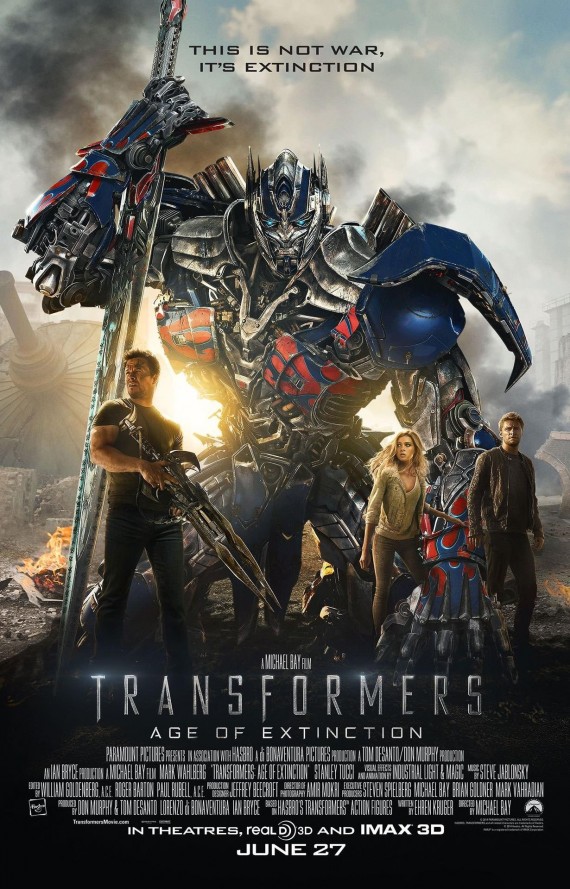
Transformers: Age of Extinction

Genre: Action

Director: Michael Bay

Writer: Ehren Kruger, based on Hasbro’s Transformers action figures

Cast: Mark Wahlberg, Stanley Tucci, Kelsey Grammer, Nicola Peltz, Jack Reynor, Sophia Myles, Li Bingbing, Titus Welliver, T.J. Miller

Running Length: 165 minutes

Synopsis: A mechanic and his daughter make a discovery that brings down Autobots and Decepticons – and a paranoid government official – on them.

Review: By the end of a very trying 165 minutes, the only thoughts of extinction I had in my mind were the (futile) ones about the franchise itself. Despite a reboot with a brand new cast of humans, Age of Extinction is essentially a showcase of all the worst possible traits of a Michael Bay action blockbuster – it’s hopelessly self-indulgent, totally devoid of any depth or character development, and features explosion upon explosion upon explosion (Michael Bay is not joking when he says he loves to blow shit up) way past the point of tedium. Add to that a complete disregard of subtlety with its scores of product placements (just imagine Jack Neo given the reins of a Hollywood blockbuster) and the fact that this is the first installment for another planned trilogy, it’s difficult for me to muster up anything positive to say about the movie at all. The irony is that the film is a criticism-proof one, sure to net massive box office no matter what anyone says about it, especially since every other summer blockbuster giving the film a very wide berth.

Ehren Kruger once again returns as the scribe for Age of Extinction, but the screenplay practically writes itself, given that it’s really no different from all the Transformers movies before it. Despite this, somehow Age of Extinction is the longest-running Transformers movie yet (oh how I tremble at using the word “yet” – as if there’s a potential that the next two movies could run even longer than the current marathon length), though “only” by an extra ten minutes. Much like the previous Transformers, there’s still no reason for Age of Extinction to run this long – it’s a bloated behemoth of a movie that would really have worked far, far better if it was shaved down to about 90 minutes, but it wouldn’t be a Michael Bay movie if not for excess, would it?

Although the action is much clearer this time round, further improving upon Dark of the Moon, it is also mind-numbing to sit through a seemingly infinite number of action sequences, and because the audience is never vested in the outcome due to the paucity of plot, none of it actually feels like it matters in any way. That being said, the editing of the film still leaves a lot to be desired, and Bay’s signature style of rapid-fire editing becomes increasingly annoying the longer the film unspools.

In an attempt (I presume) to stir things up visually, and also obviously because Chinese money is being invested in the franchise, the finale moves the action to China and Hong Kong, but with the final confrontation running almost an hour long, the catatonia sets in long before the end credits had rolled. The change in location does not make any part of the movie feel fresh in any way, and the same tired movie tropes are paraded in front of the audience. The much-vaunted appearance of the Dinobots is woefully short and inconsequential, with the new robots being nothing more than a ride for the existing Autobots. I honestly can’t imagine any fanboys of the Dinobots feeling sated by their existence in the movie.

The entire human cast of the first trilogy has been jettisoned, and the replacement cast is indeed better (Mark Wahlberg is a far more agreeable presence than Shia LaBeouf), but with such a bare-bones script (and frequently laughable dialogue), there’s simply not much the cast could do to rescue the movie. The only actor to make any impression is Stanley Tucci, and that’s really only because he’s playing a broad caricature of Steve Jobs and gets all the funny lines in the script. I did, however, appreciate the fact that Li Bingbing was given a whole lot more to do than Fan Bingbing in X-Men: Days of Future Past. There’s no doubt that financially, Age of Extinction will make a ton of money, ensuring that the next movie will not be far away, but given the terrible state of affairs for this current film, it’s hard to imagine anyone other than action junkies and Transformers fans feeling enthused about another future episode of this mechanical, soulless franchise.

Rating: * (out of four stars)

Standard

22 Jump Street

22-jump-street-poster1-405x600

Genre: Action, Comedy

Directors: Phil Lord, Christopher Miller

Writers: Michael Bacall, Oren Uziel, Rodney Rothman, based on the television series “21 Jump Street” created by Patrick Hasburgh and Stephen J. Cannell.

Cast: Channing Tatum, Jonah Hill, Peter Stormare, Wyatt Russell, Amber Stevens, Jillian Bell, Ice Cube, Keith Lucas, Kenny Lucas

Running Length: 111 minutes

Synopsis: After making their way through high school (twice), big changes are in store for officers Schmidt (Jonah Hill) and Jenko (Channing Tatum) when they go deep undercover at a local college. But when Jenko meets a kindred spirit on the football team, and Schmidt infiltrates the bohemian art major scene, they begin to question their partnership. Now they don’t have to just crack the case – they have to figure out if they can have a mature relationship. If these two overgrown adolescents can grow from freshmen into real men, college might be the best thing that ever happened to them.

Review: The box office success of 21 Jump Street all but ensured a sequel would happen, and just two years down the road Phil Lord and Christopher Miller (who seem to be able to do no wrong in their directing career thus far) are back with 22 Jump Street. This is a sequel that nudges and winks constantly at all the stale conventions of sequels, and it relentless lampoons all these conventions, making it one of the most self-aware sequels I have ever seen.

Nothing is spared – it understands that almost all sequels are inferior retreads to the originals, turns the “meet cute” scenario on its head, pokes fun at the increasingly ridiculous action setpieces in movies these days, and brings bromance to its most extreme, Brokeback Mountain-esque incarnation. Not everything works, but there definitely are enough moments in 22 Jump Street to justify its existence.

Nothing has changed from 21 Jump Street in this sequel, and the premise is identical – the two cops have to infiltrate a learning institution to find the source of a new designer drug. It’s moved from high school to college, and there’s a tacked on spring break segment (easily the weakest link in the movie), but despite the change in address the same positives and negatives that the first movie had is also intact here. The movie is still hit-and-miss when it comes to the comedy (but when it’s funny it’s laugh-out-loud hilarious), the running time is still a bit too long, and the central story really isn’t all that interesting.

Yet somehow the movie works, sometimes even better than the first. The chemistry between Channing Tatum and Jonah Hill has become more assured, which is even more important this time round because of the focus on their bromance. Ice Cube continues playing the best “angry black Captain” in recent memory, and manages to steal the limelight every time he appears on screen. It’s probably a good thing that he has limited screentime, or he would have probably stolen the entire show from the main leads. Ice Cube is also key to what’s probably the best scene in the movie – his reaction to a revelation – and it is an absolutely priceless sequence, almost worth the price of entry on its own. While 22 Jump Street is unlikely to forge new fans of the franchise, moviegoers who appreciated the first movie would definitely find things to like about this sequel, uneven as it may be.

P.S. The distributor has requested not to discuss an element of the movie, so I can only cryptically mention that there is a rather well executed sequence, but one must be patient in order to see it in its entirety.

Rating: * * * (out of four stars)

Standard