Unbroken

Genre: Drama

Director: Angelina Jolie

Screenplay: Joel Coen & Ethan Coen, Richard LaGravenese and William Nicholson, based on the book by Laura Hillenbrand

Cast: Jack O’Connell, Domhnall Gleeson, Miyavi, Garrett Hedlund, Finn Wittrock, Jai Courtney, John Magaro, Luke Treadaway, Alex Russell, John D’Leo, Vincenzo Amato, Ross Anderson, C.J. Valleroy, Maddalena Ischiale

Running Length: 137 minutes

Synopsis: Unbroken is an epic drama that follows the incredible life of Olympian and war hero Louis “Louie” Zamperini (Jack O’Connell) who, along with two other crewmen, survived in a raft for 47 days after a near-fatal plane crash in WWII – only to be caught by the Japanese Navy and sent to a prisoner-of-war camp.

Adapted from Laura Hillenbrand’s popular book, Unbroken brings to the big screen Zamperini’s unbelievable and inspiring true story about the resilient power of the human spirit.

Review: Unbroken is a very, very well-made film, excelling in its technical aspects and honestly quite an achievement for second-time director Jolie, who had embarked on making a second war-related movie after her little-seen directorial debut (2011’s In the Land of Blood and Honey). However, the film also feels sterile and perfunctory, lacking heart and a deeper emotionality, despite an excellent performance by newcomer Jack O’Connell. And even though it already runs over two hours, there’s this sense of incompleteness, that there’s a bigger story to be told of what happened to Zamperini after his traumatic ordeal, which deserves more than a few seconds worth of title cards before the end credit crawl.

Louie Zamperini’s life story is an incredible one – in a short span of years, he goes from Olympic athlete to an army officer surviving a plane crash, being stranded almost fifty days at sea on a life raft, followed by more than two years of torture and suffering in various POW camps. Based on Laura Hillenbrand’s biography of Zamperini, Unbroken tells a mostly straight tale, but Jolie chooses not to touch on the lighter aspects of his life. Zamperini was a born leader and apparently devised ways to make life more bearable for himself and his fellow inmates, but this is not covered in the film at all. Jolie instead focuses almost entire on the brutality that Zamperini endured, which makes the narrative more one-sided than it should be. There’s also no redemptive arc in the film, even though it is a significant portion of the biography, which mutes the impact of Unbroken further.

Performances of the ensemble cast are almost uniformly good, with the exception being Miyavi, who plays Zamperini’s sadistic tormentor Mutsushiro “The Bird” Watanabe, who hams it up a little too much and becomes more caricaturish than truly evil. Jack O’Campbell is a relatively fresh face, but manages to take on both the physical and emotional aspects of the role well. It is a difficult role to undertake, but he manages to give an excellent performance, not just in the big moments, but even in the small nuances of action and movement in the quiet scenes.

Jolie had assembled a highly proficient team of technicians for Unbroken, from the Coen Brothers being involved in the script, to Alexandre Desplat for the scoring and Roger Deakins in cinematography. It all works admirably well, especially so for the stunning cinematography by Deakins (which has been aptly rewarded with a nomination in the upcoming Academy Awards), accompanied by excellent production design by Jon Hutman. However, she may still have bitten off a bit more than she could chew with Unbroken as a sophomore effort, resulting in a somewhat lopsided movie that does not sufficiently engage.

Rating: * * ½ (out of four stars)

Standard

The Imitation Game

Genre: Drama

Director: Morten Tyldum

Screenplay: Graham Moore, based on the book “Alan Turing: The Enigma” by Andrew Hodges

Cast: Benedict Cumberbatch, Keira Knightley, Matthew Goode, Allen Leech, Matthew Beard, Charles Dance, Mark Strong

Running Length: 114 minutes

Synopsis: Famously leading a motley group of scholars, linguists, chess champions and intelligence officers, Alan Turing (Benedict Cumberbatch) was credited with cracking the so-called unbreakable codes of Germany’s World War II Enigma machine. An intense and haunting portrayal of a brilliant, complicated man, The Imitation Game follows a genius who under nail-biting pressure helped to shorten the war and, in turn, save thousands of lives.

Review: Although The Imitation Game is thematically similar to The Theory of Everything, it ranks as the better biopic. The Imitation Game is more willing to show the darker side of things, occasionally dips its toes into thriller category, and boasts equally strong lead performances, which makes it a better cinematic experience overall. While Eddie Redmayne astonishes with his physical transformation, Benedict Cumberbatch impresses with superior thespian skills.

Intertwining three periods in Turing’s life, The Imitation Game begins in 1952, with Alan Turing being investigated and arrested for “gross indecency” – as homosexuality was still illegal back in the 50s – and using the police interrogation as the launching point of a recounting of his exploits in World War II at Bletchley Park. Turing was instrumental in cracking the German Enigma machine, which helped decode German radio messages and led to an earlier conclusion of the War, but he sadly committed suicide at the young age of 41, one year after he was found guilty and chose chemical castration over prison time. There are also earlier flashbacks to the 1920s, when Turing was a schoolboy who is just discovering his sexuality and experiencing his first crush.

The decision to focus on just three periods in Turing’s life is an astute one. By going deep instead of going wide, Tyldum and Moore have managed to create a multidimensional portrait of Turing, aided of course by the superlative performance of Benedict Cumberbatch. Cumberbatch manages to capture the essence of Turing, from his complete social awkwardness to his laser-like focus on solving Enigma, from his brilliance to his isolation. It is a pitch-perfect performance, and firmly establishes Cumberbatch as one of the top talents in the industry.

Special mention must also go to Alex Lawther playing the younger Alan Turing, who also manages to capture the nuances required to realistically portray a conflicted teenager coming to terms with his love for a fellow schoolboy. Keira Knightley once again shows that she is best in unconventional roles and not as a wide-eyed ingénue, though she isn’t given that much to do in the film.

Opting to eschew the more technical aspects of how Enigma was solved, certain scenes in The Imitation Game do stretch plausibility somewhat, though they do add more excitement to what’s essentially a very academic activity. Solving Enigma takes place around the midpoint of the film, but it’s really what unfolds after that makes the film an engrossing one. In the end, Turing’s brilliance and his contributions to ending the war is undermined by a society that condemned his sexuality, resulting in a life that ended way before it should have. The Imitation Game does not shy away from the ugly truth, making it an engrossing if dark movie to watch.

Rating: * * * ½ (out of four stars)

Standard

The Theory of Everything

Genre: Drama

Director: James Marsh

Screenplay: Anthony McCarten, based on the book “Travelling to Infinity: My Life with Stephen” by Jane Hawking

Cast: Eddie Redmayne, Felicity Jones, Charlie Cox, Emily Watson, Simon McBurney, David Thewlis, Maxine Peake

Running Length: 123 minutes

Synopsis: The Theory of Everything tells the story of one of the world’s greatest living minds, astrophysicist Stephen Hawking (Eddie Redmayne), and his marriage to Jane Hawking (Felicity Jones), and their eventual separation.

Review: There’s an inherent difficulty, presumably, when making a biopic of someone who is still alive, and in The Theory of Everything, this is exacerbated since it is about one of the most brilliant minds of our time. There is a reverence in James Marsh’s direction, a restraint in portraying the more negative aspects between Stephen Hawking’s marriage to his first wife, Jane, that makes the film feel detached and a little neutered. Fortunately, Eddie Redmayne’s performance is a spectacular one, so much so that it manages to make the flaws of the film a lot easier to bear.

The Theory of Everything is a well-made film – production values are good and the cast’s performances are all fine, but it all comes across as feeling very safe and conventional. Perhaps due to covering such an extended time period, there are only superficial looks into Hawking’s life and loves, providing as much insight into Hawking as skimming through his Wikipedia entry.

Eddie Redmayne’s portrayal of Hawking is a revelation, rising head and shoulders above the rather mediocre script. An actor with a relatively short CV, there’s nothing in his career prior to The Theory of Everything that suggested his acting capabilities being able to pull off something of this magnitude. And yet he does, not just in his ability to mimic the real Hawking, trapped in a wheelchair and his body contorted and ravaged by motor neurone disease, but in the scenes leading up to the disease becoming full-blown, where little movements suggest the eventual onset of the disease.

Redmayne completely disappears into character and it’s one of those physical transformations that Hollywood loves (in the Oscar wars, he seems to be shaping up to be the one to beat, despite an extremely stacked nominations list this year). When eventually Redmayne has to play the entirely incapacitated Hawking (who has also by then lost his ability to speak), he is essentially acting with just his eyes and is akin to Mathieu Amalric’s seminal performance  in The Diving Bell and the Butterfly. Felicity Jones put forth a spirited performance as Jane Hawking, but no one else really manages to come close to him.

Although the film is based on Jane Hawking’s second memoir about her life with Stephen, the speed at which the narrative goes through the years means that there’s actually very little meaningful conflict between the leads, resulting in a pretty flat narrative tone. This is particularly noticeable in the final reels, when Stephen and Jane’s marriage is on the rocks, because everyone still remains unyieldingly nice and civil towards each other. Treating the subject matter with kid gloves neuters it, rendering some of the scenes less powerful than they should have been. As it stands, while it’s a good, well-made biopic, it probably wouldn’t stand the test of time as being a definitive biopic of Stephen (or Jane) Hawking.

Rating: * * * (out of four stars)

Standard

Birdman or (The Unexpected Virtue of Ignorance)

Genre: Drama, Comedy

Director: Alejandro Gonzalez Inarritu

Screenplay: Alejandro Gonzalez Inarritu, Nicolas Giacobone, Alexander Dinelaris, Armando Bo

Cast: Michael Keaton, Edward Norton, Naomi Watts, Andrea Riseborough, Emma Stone, Amy Ryan, Zach Galiafianakis, Lindsay Duncan

Running Length: 120 minutes

Synopsis: Birdman is a black comedy that tells the story of an actor, Riggan Thompson (Michael Keaton) – famous for portraying an iconic superhero – as he struggles to mount a Broadway play. In the days leading up to opening night, he battles his ego and attempts to recover his family, his career, and himself.

Review: If I had to pick just one word to describe Birdman, it would have to be “dazzling”. Not only is the film breathtaking in its technical achievements, it also happens to be an excellent ensemble film, with superlative performances coming from almost everyone in the cast, and boasts an entertaining plot to boot. This is one of the best cinematic experiences I have had in quite some time, and even this early into 2015, I would imagine it to be pretty difficult for any movie to trump Birdman for pole position for the rest of the year.

Although Alejandro Gonzalez Inarritu has had a pretty impressive CV to date (his four previous feature films – Amores Perros, 21 Grams, Babel and Biutiful – have all received critical acclaim), they have uniformly been pretty serious, “downer” films. Birdman seems to be the first time the director is having fun, and the result is a film that is a joy to sit through from start to finish, and is so intricately layered that it would be wise to plan ahead and avoid any toilet breaks throughout the 2-hour running time.

It almost seems like an impossible task, but Inarritu, together with cinematographer Emmanuel Lubezki (fresh off his Oscar win for Gravity last year), has managed to create an illusion of a film that is composed of a single, uninterrupted take. Yes, it is essentially a one trick pony, but when the trick is so visually impressive it’s hard to criticize the endeavour. The long and immaculately choreographed tracking shots are incredible to observe, and although not entirely seamless, is an exhilarating cinematic accomplishment. As expected, Lubezki has secured an Oscar nomination and I cannot see any more deserving winner this year.

Michael Keaton gives a career-best performance as Riggan Thompson, and because the role of Riggan Thompson seems to mirror Keaton’s real life career (Keaton walked away from the Batman franchise almost 20 years ago, after a successful two-movie run), the lines between make-believe and reality are blurred to the benefit of the film’s narrative. Equally on form is Edward Norton, perfectly cast as the equally talented and egotistic Mike Shiner, again seemingly lampooning Norton’s real-life method acting quirks. The rest of the cast is uniformly excellent, with special mention going to Emma Stone, who knocks it out of the park playing the damaged, fresh out of rehab daughter of Thompson (and sets the screen alight with the crackling chemistry between her and Norton in a few short, but key sequences).

In this era of tired sequels, endless remakes and big budget Hollywood blockbusters, gems like Birdman come few and far between. That it is both technically accomplished and still an eminently entertaining film is the cherry on top. It feels fresh despite treading familiar tropes, and much like its jazz soundtrack, is reminiscent of improv of the highest caliber. I cannot recommend this enough, and anyone who professes a love for cinema needs to watch Birdman at least once.

Rating: * * * * (out of four stars)

Standard

Exodus: Gods and Kings

Genre: Action, Drama

Director: Ridley Scott

Writers: Adam Cooper, Bill Collage, Jeffrey Caine, Steven Zaillian

Cast: Christian Bale, Joel Edgerton, John Turturro, Aaron Paul, Ben Mendelsohn, Maria Valverde, Sigourney Weaver, Ben Kingsley, Isaac Andrews, Hiam Abbass, Indira Varma, Ewen Bremner, Golshifteh Farahani, Ghassan Massoud, Tara Fitzgerald, Maria Valverde, Andrew Barclay Tarbet

Running Length: 150 minutes

Synopsis: From acclaimed director Ridley Scott (Gladiator, Prometheus) comes the epic adventure Exodus: Gods and Kings, the story of one man’s daring courage to take on the might of an empire. Using state of the art visual effects and 3D immersion, Scott brings new life to the story of the defiant leader Moses (Christian Bale) as he rises up against the Egyptian Pharaoh Ramses (Joel Edgerton), setting 600,000 slaves on a monumental journey of escape from Egypt and its terrifying cycle of deadly plagues.

Review: It’s apt to quote from Ridley Scott’s own Gladiator, since it was the movie that made the sword-and-sandals epic cool again – “Are you not entertained?” Because this is one of the main problems I have with Exodus – although it is sufficiently stirring sporadically, and shows a really masterful use of CGI, the film is simply not that entertaining, bringing nothing new to the tale of the Ten Commandments, and actually ends up being less interesting than Cecil B. DeMille’s still-definitive 1956 version.

Perhaps it’s because Ridley Scott didn’t seem to set out to make a religious epic, and much like Darren Aronofsky’s Noah earlier in the year, attempts to make certain scenes more secular and logical, that the film takes a big hit. The parting of the Red Sea certainly feels more realistic, but does not inspire any awe. The plagues visited upon Egypt are brilliant CGI setpieces, but at the same time come across as being perfunctory, as though Scott is checking off an invisible list of the ten plagues, just making sure that they all end up in the film. The burning bush and the Ten Commandments seem more like afterthoughts, and are not given the dramatic heft that they should have been. The personification of God is also a questionable decision – I am not sure if assigning an actor to play God (literally) is more effective than a loud booming voice, as clichéd as the latter sounds.

Although Scott and his team of 4 writers correctly presume that a good majority of the audience would be at least somewhat familiar with the story of Moses, broad narrative gaps appear in the film, which almost makes the film feel disjointed. And yet, the film devotes so much time to the setup that when thing finally get going in the last hour, the pacing suddenly speeds up and the entire proceedings start feeling rushed. To add insult to injury, after a rather stirring finale act of crossing the Red Sea, Scott decided to keep the narrative running just a bit too long, leading to a drawn out and wholly anticlimactic denouement.

Putting aside the fact that the film is populated by white actors instead of ethnic actors more appropriate to the story’s locations, even the A-list names in the cast feel a bit out of place. The normally supremely dependable Christian Bale feels a little stilted in his portrayal as Moses, and Joel Edgerton basically depends on his bronzer and guyliner to carry his performance as Ramses. These are not bad performances by any measure, but again, so much drama is dialed back that it just comes across as being too muted for an epic film like this one. Other notable actors like Ben Kingsley, Sigourney Weaver, John Turturro and Aaron Paul barely register, completely wasted in parts where they have too little to do.

Thankfully, the few action setpieces are quite rousing, if never reaching the level of Scott’s best films. Also, for a film that’s steeped in CG by necessity, Exodus actually comes across as being visually stunning without being too clearly artificial (though there’s absolutely no necessity to catch the film in 3D). In this day and age where a straight-up biblical epic may no longer be palatable to the general audience, both experiments in 2014 have been only moderately successful. There is really no reason to remake The Ten Commandments, and the results only serve to reinforce this. Here’s hoping that Scott’s next cinematic outing (The Martian, coming in end 2015) would prove to be a more compelling film.

Rating: * * ½ (out of four stars)
Standard

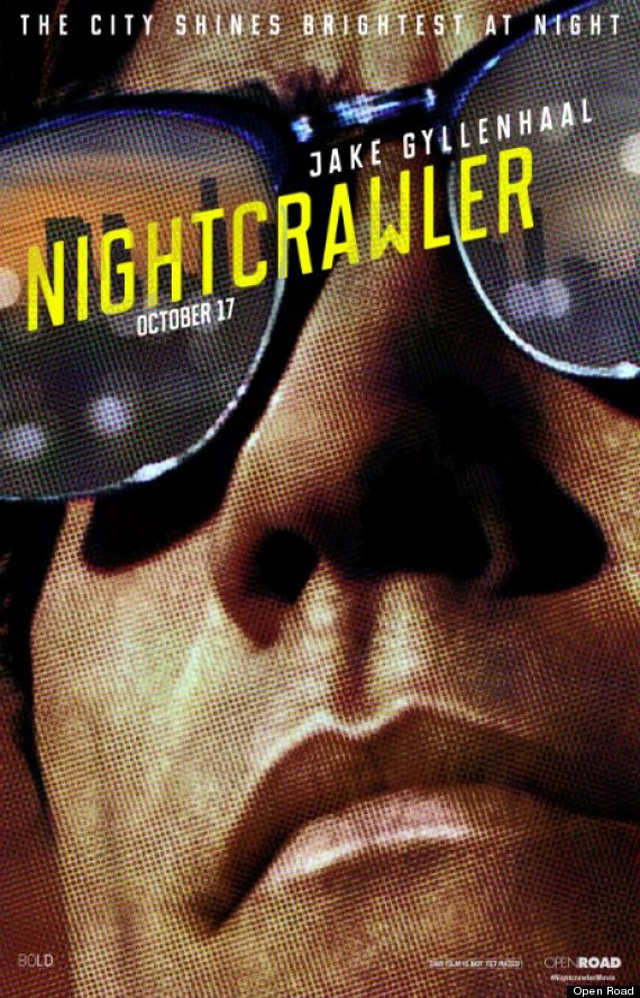
Nightcrawler

Genre: Drama

Director: Dan Gilroy

Writer: Dan Gilroy

Cast: Jake Gyllenhaal, Rene Russo, Riz Ahmed, Bill Paxton

Running Length: 117 minutes

Synopsis: Nightcrawler is a thriller set in the nocturnal underbelly of contemporary Los Angeles. Jake Gyllenhaal stars as Lou Bloom, a driven young man desperate for work who discovers the high-speed world of L.A. crime journalism. Finding a group of freelance camera crews who film crashes, fires, murder and other mayhem, Lou muscles into the cut-throat, dangerous realm of nightcrawling – where each police siren wail equals a possible windfall and victims are converted into dollars and cents. Aided by Rene Russo as Nina, a veteran of the blood-sport that is local TV news, Lou blurs the line between observer and participant to become the star of his own story.

Review: Jake Gyllenhaal has had an excellent body of work so far, with wide-ranging roles that manage to impress time and again (Enemy, Brokeback Mountain, Jarhead, Prisoners, and many more). However, his performance in Nightcrawler is undoubtedly his best yet, and that says a lot about how good it is – highly deserving of a great run at the awards season next year, and on its own is reason enough to give Nightcrawler a go. While Nightcrawler is not without some flaws, it has a mesmerising central performance around a smart, always engaging film, making it impossible to look away for the entire 2-hour running time. This is the poster child for movies that don’t accord audiences any good moments for a pee break.

The most immediate comparison that one can make to Gyllenhaal’s performance is that of Robert De Niro’s in Taxi Driver – Lou Bloom is as much of an anti-hero as Travis Bickle was, although Bloom definitely has less of a moral compass than Bickle. And it’s an equally transformative, unforgettable performance – Gyllenhaal totally disappears into the role, fully embodifying Bloom not just in his physicality (he lost over 20 pounds of weight for the role) but in every aspect. It’s clear that in Nightcrawler, Bloom is the antagonist, and his soulless eyes, forced smile and ruthless, sociopathic focus on the end game is unyieldingly creepy yet fascinating to observe. This is easily one of the best performances of the year, on par with the mind searing turn by Rosamund Pike in Gone Girl.

While Gyllenhaal carries the film on his performance alone, the supporting cast is also quite capable – Rene Russo (Dan Gilroy’s wife, by the way) is the only female presence in the film and leaves a strong impression as the network executive that’s almost willing to do anything for ratings. Bill Paxton plays a small but important role in the film, and despite limited screen time gives a memorable performance as well. Riz Ahmed’s Rick acts as the human foil for Lou, but at times does feel more like a convenient plot device rather than a convincingly written character.

Dan Gilroy pulls double duty as director (his debut) and screenwriter, and manages to excel at both. With such solid performers on board, he wisely chooses a straightforward, unflashy directorial style, but is aided by Robert Elswit hitting it out of the park with excellent cinematography – nighttime Los Angeles has not looked so spectacular since the equally lush take in 2011’s Drive. The scripting is impeccable, and although I question the veracity of how network news footage is acquired (and the sensationalism of news is a very tired, old trope), Gilroy is masterful in ramping up the suspense all the way to the explosive, macabre, yet strangely satisfying denouement.

Rating: * * * ½ (out of four stars)

Standard

Interstellar

Genre: Sci-Fi, Drama

Director: Christopher Nolan

Writers: Jonathan Nolan, Chris Nolan

Cast: Matthew McConnaughey, Anne Hathaway, Jessica Chastain, Ellen Burstyn, John Lithgow, Michael Caine, Casey Affleck, Wes Bentley, Bill Irwin, Mackenzie Foy, Topher Grace, David Gyasi, Timothee Chalamet, David Oyelowo, Will Devane, Matt Damon

Running Length: 169 minutes

Synopsis: A group of explorers make use of a newly discovered wormhole to surpass the limitations on human space travel and conquer the vast distances involved in an interstellar voyage.

Review: If I were to pick just one word to describe Christopher Nolan’s latest film, it would have to be “ambitious” – Interstellar is an epic undertaking that doesn’t always succeed, but you have to give Nolan brownie points just for trying. Although this sounds like faint praise, Interstellar is actually an excellent cinematic experience – the sheer scope and spectacle of the film is more than enough reason to give this movie a once-over on the big screen (and I am serious about “big screen” – this movie deserves to be seen on IMAX – more on this later), and even if the final reels come a little unhinged, it does not undo what happens in the two hours prior.

Although the film runs almost three hours long, it never feels belaboured, and plotlines are so engaging and well developed that the 169 minute running time passes by very quickly. Nolan smartly intertwines plot heavy scenes with action setpieces which are nothing short of stunning, taking place on a variety of very different landscapes. If you thought the action setpieces in Nolan’s Inception and Batman trilogy were impressive, you ain’t seen nothing yet.

While Interstellar is essentially a sci-fi film, Nolan manages to inject a lot of emotionality into the proceedings. It treads the fine line between emotional resonance and cheesiness, but most of the time the drama does hit the right notes, none more so than a mid-movie segment in which the time warping capabilities of a black hole is brought into stark relief. Matthew McConnaughey is extremely impressive in this sequence, and without spoiling the proceedings, the range and depth of emotions that he displays in those five minutes could rival the entire cast of some other sci-fi films, and brings to mind Sandra Bullock’s similarly excellent turn in Gravity. The supporting cast is strong, but undeniably McConnaughey is the one that holds the entire film together. It would not be a surprise to see him nominated second year running for Best Actor.

That the film throws so many scientific principles and terms at the audience, and yet still remains rather accessible, is a feat in itself. Most of it seems legit too, especially since famed CalTech astrophysicist Kip Thorne consults on the film and is credited as an Executive Producer. It does get a bit too farfetched and clunky near the end, and the denouement feels a little rushed, as though Nolan is aware that dwelling too long on the postscript would bring the plot holes into focus. Interstellar is not as mind-bending as some of Nolan’s other work (it was pretty clear to me how the plot would pan out eventually, midway through), but audience members will nevertheless need to prepare for a mental workout when watching the film – this is not your usual Hollywood sci-fi action blockbuster.

In terms of technical accomplishment, Interstellar is about as flawless as it gets. Every technical aspect is remarkably executed – art direction, production design, sound, visual effects, CG work, cinematography, editing, musical score and more – one simply cannot ask for more in a movie. This is a big budget Hollywood movie done right, and I will be surprised if there would not be a flurry of nominations and awards in technical categories come awards season next year. Having been shot entirely on celluloid, bucking the digital trend, the film’s scale and beauty is best appreciated in IMAX, and is a necessity in my opinion.

Interstellar is such a massive undertaking that the fact that Nolan manages to pull it off is impressive enough, and for the film to actually be this accomplished means it automatically takes a spot in my best-of list for 2014. Despite some blemishes, it is the cinematic experience to beat in 2014, and much as it sounds like a cliché: if you watch one movie this year, make it Interstellar.

Rating: * * * ½ (out of four stars)

Standard

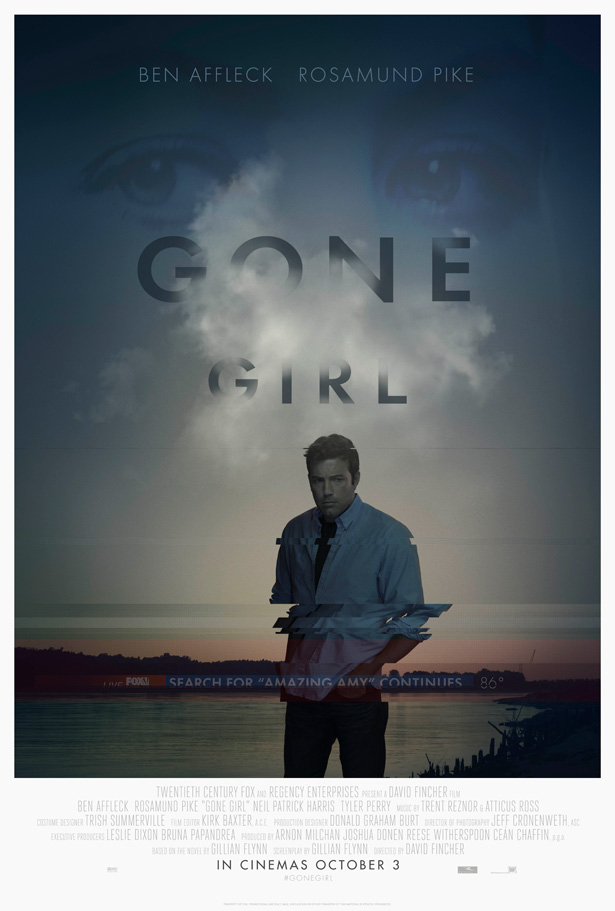
Gone Girl

Genre: Drama

Director: David Fincher

Writer: Gillian Flynn, based on her novel of the same name

Cast: Ben Affleck, Rosamund Pike, Neil Patrick Harris, Tyler Perry, Carrie Coon, Kim Dickens, Patrick Fugit, David Clennon, Lisa Banes, Missi Pyle, Emily Ratajkowski, Casey Wilson, Lola Kirke, Boyd Holbrook, Sela A. Ward

Running Length: 149 minutes

Synopsis: On the occasion of his fifth wedding anniversary, Nick Dunne (Ben Affleck) reports that his beautiful wife, Amy (Rosamund Pike), has gone missing. Under pressure from the police and a growing media frenzy, Nicks portrait of a blissful union begins to crumble. Soon his lies, deceits and strange behavior have everyone asking the same dark question: Did Nick Dunne kill his wife?

Review: I have long been an ardent fan of David Fincher’s work, and it comes as no surprise (to me at least) that his latest, Gone Girl, is yet another excellent cinematic achievement. Adapted from Gillian Flynn’s bestselling 2012 novel of the same name, Gone Girl is flawlessly directed, capably supported by Fincher’s regular crew, and features a number of brilliant performances, none more so than Rosamund Pike’s career-defining turn as Amy Dunne. Gone Girl is an impossibly deft mix of a police procedural, a whodunit, a domestic drama, and a darkly comic exploration of the state of media culture in present times. It runs a long 149 minutes, but is deeply absorbing from the get-go, and qualifies easily as one of the must-watch films this year.

It is best to enter a viewing of Gone Girl with little to no foreknowledge of the plot, and thankfully the trailers released for the film has not managed to give anything away (kudos to 20th Century Fox for showing enough restraint and respect for the film). As is my practice, this review will not contain any obvious spoilers, but readers who are averse to spoilers of any magnitude may want to avoid proceeding any further till after watching the movie.

It’s really quite impossible to take the story of Gone Girl seriously, and it goes far, far down the rabbit hole in terms of implausibility. But therein lies the beauty of pairing the source material with Fincher – even though I knew it made no sense whatsoever, it did not detract from the viewing experience at all because the film was so well made. All the Fincher regulars are involved – the film is shot beautifully by cinematographer Jeff Cronenweth, edited flawlessly by Kirk Baxter (the dual timeline narrative structure could not have been easy to edit coherently), and the pulsing, electronica-infused classical score is perfectly suited to the film’s unsettling nature.

What truly makes the movie stand out, however, is the quality of performances from all the actors involved. Every speaking role leaves a strong impression, particularly Kim Dickens whose hard-as-nails police investigator effortlessly steals the limelight every time she makes an appearance. Then there are the twin performances from Ben Affleck and Rosamund Pike – Affleck has proven his solid acting skills in previous outings, but here he is an inspired choice as the cocky writer who gradually loses his dignity and pride. The constantly shifting perspective means you can never be too sure of Nick’s intents and motives, and Affleck manages to convince in an understated, restrained yet nuanced performance.

And then there’s Rosamund Pike. Pike has done solid work in supporting roles over the years, but here she is a revelation as Amy. The role requires a truly broad emotional scope, and she manages to nail all of them, from wide-eyed ingénue to demure enchantress to being cold and calculative. Charismatic yet chilling, her performance consistently demands the attention of the audience, and feels like it’s multiple roles compressed into one.  That she manages to fully embody this complex character is a triumph – this is a star-making role for Pike and one I feel that’s deserving of an Oscar nomination, if not a win. (A side anecdote – her performance in a scene was so impressive that some audience members in the normal screening I attended began to applaud spontaneously.)

That the story and its internal logic starts to unravel in Gone Girl’s final reels isn’t all too material to the enjoyment of the film – by then, Fincher and team have managed to weave such an engrossing, deliciously macabre tale that the old adage that it’s the journey, not the destination rings true. Anyone with a penchant for the twisted will definitely relish this dark, stylish and sexy movie.

Rating: * * * * (out of four stars)

Standard

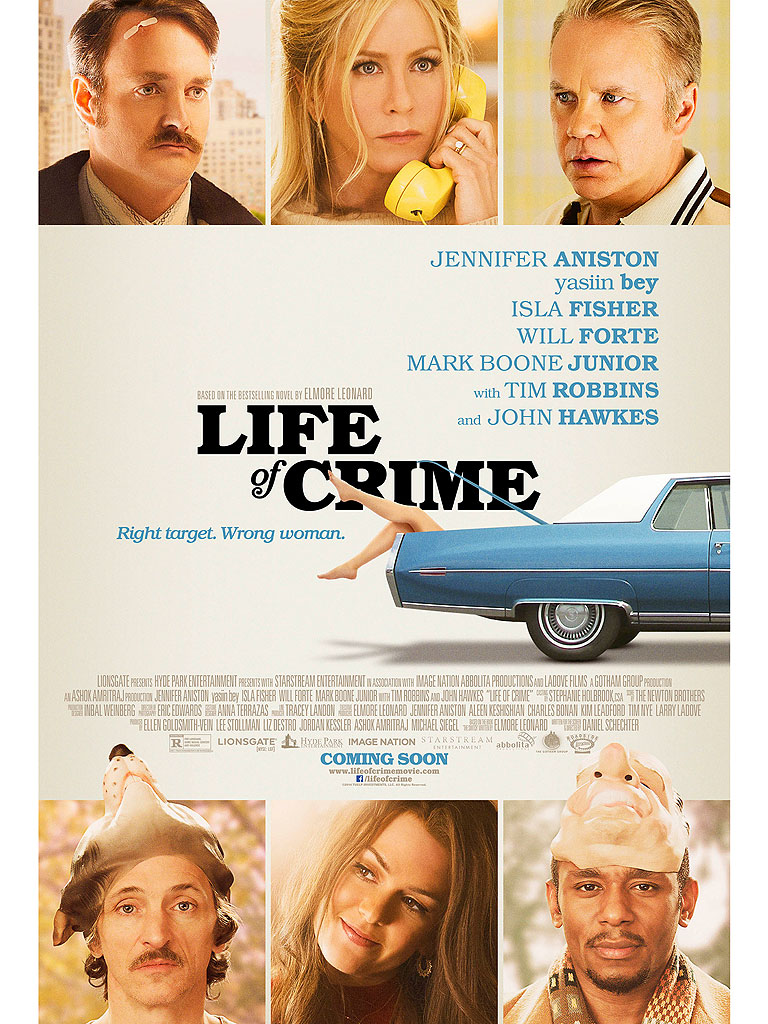
Life of Crime

Genre: Drama

Director: Daniel Schechter

Writer: Daniel Schechter, based on the novel “The Switch” by Elmore Leonard

Cast: Jennifer Aniston, Mos Def (as Yasiin Bey), Isla Fisher, Will Forte, Mark Boone Junior, Tim Robbins, John Hawkes

Running Length: 99 minutes

Synopsis: Mickey (Jennifer Aniston), the wife of a corrupt real estate developer (Tim Robbins) is kidnapped by two common criminals (Yasiin Bey and John Hawkes), who intend to extort him with inside information about his crooked business and off-shore accounts. But the husband decides he’d actually rather not pay the ransom to get back his wife, setting off a sequence of double crosses and plot twists that could only come from the mind of Elmore Leonard.

Review: One can be forgiven, in the opening minutes of Life of Crime, for thinking that the projectionist had somehow played a reel of American Hustle by mistake. And indeed, the film does bear some resemblance to American Hustle, since both a crime capers set in the 70s. Life of Crime is the more low-key movie, and though the plot is sporadically entertaining, the film does not leave much of an impression by the time the credits roll.

There have been a good number of Elmore Leonard adaptations over the years, and this one sits in the middle of the pack. Having not read the source novel, I am unsure how faithful the adaptation is, but suffice to say that the plot and its twists would not be very surprising for anyone with a rudimentary knowledge of caper movies. Having said that, there are a good number of scenes which are set up quite well and the characters’ interactions are rather interesting to observe. Dialogue is also classic Elmore Leonard, which is to be expected since he was quite involved in the project prior to his death last year.

Jenifer Aniston is most known for her comedic roles, but has proven she has what it takes to be a thespian in some smaller movies. She is actually very good here, much better than I had expected, and easily becomes the emotional centre of the film. She is quite capably supported by the rest of the ensemble cast, and I actually enjoyed this ensemble more than the American Hustle posse of characters. However, the cast is less memorable than prior Leonard adaptations (a good handful come to mind – Out of Sight, Jackie Brown, Get Shorty), and although it provides light entertainment, the slightly meandering plot and relatively low energy level of the film did leave me feeling a bit underwhelmed at the end.

Rating: * * ½ (out of four stars)

Standard

If I Stay

Genre: Drama

Director: R. J. Cutler

Writer: Shauna Cross, based on the novel by Gayle Forman

Cast: Chloe Grace Moretz, Mireille Enos, Jamie Blackley, Joshua Leonard, Liana Liberato, Aisha Hinds, Stacy Keach, Lauren Lee Smith, Gabrielle Rose, Jakob Davies, Gabrielle Cerys Haslett

Running Length: 107 minutes

Synopsis: Mia Hall (Chloe Grace Moretz) thought the hardest decision she would ever face would be whether to pursue her musical dreams at Juilliard or follow a different path to be with the love of her life, Adam (Jamie Blackley).  But what should have been a carefree family drive changes everything in an instant, and now her own life hangs in the balance.  Caught between life and death for one revealing day, Mia has only one decision left, which will not only decide her future but her ultimate fate.

Review: There’s a certain familiarity that comes with YA adaptations these days – it’s almost invariably set in the perspective of the teenage girl (that is the target demographic, after all), and regardless of the quality of the movie, the soundtrack will always be quite listenable, though bordering on the mournful, emo side. If I Stay does not vary from these conventions at all, but despite the best intentions of first-time feature film director Cutler (who had previously cut his teeth on documentaries) and the concerted thespian effort of Chloe Grace Moretz, the film comes across as being just a hair too manipulative and mawkish to earn a solid recommendation.

The narrative structure deviates from the norm – although it starts with a typical first person narrative, the catastrophic accident that lands Mia comatose in hospital also seems to cause an out of body experience for her, and the remainder of the film sees Mia moving about metaphysically (so to speak) in the hospital, unseen and unheard by those around her, coupled with multiple flashbacks to key moments in her life to date. This structure makes it different from most other YA adaptations, but fails to hide the fact that the story is really quite banal, with most of the flashbacks failing to resonate emotionally, despite the rather insistent efforts of the scribe. Therein lies the biggest problem of If I Stay, that it feels way too artificial, from the too-hip parents, the too-cute couple and the incessantly eloquent bon mots that seem to tumble out at will from all the characters’ mouths.

Chloe Grace Moretz is a relatively young actress (just 17 years old) but has been rather prolific of late, and her strong work in If I Stay is one of the key reasons why the film remains watchable. Setting aside the fact that Mia is way too precocious to be believable, Moretz manages to put together a nuanced performance that is far better than the source material would require. Moretz manages to outclass almost everyone in the cast, and the thespian shortcomings of Jamie Blackley in particular are unfortunately thrust into the spotlight quite regularly. If I Stay ends up being a decidedly mixed bag of offerings, a pedestrian YA adaptation that has limited appeal outside of fans of the source novel.

Rating: * * (out of four stars)

Standard