The Imitation Game

Genre: Drama

Director: Morten Tyldum

Screenplay: Graham Moore, based on the book “Alan Turing: The Enigma” by Andrew Hodges

Cast: Benedict Cumberbatch, Keira Knightley, Matthew Goode, Allen Leech, Matthew Beard, Charles Dance, Mark Strong

Running Length: 114 minutes

Synopsis: Famously leading a motley group of scholars, linguists, chess champions and intelligence officers, Alan Turing (Benedict Cumberbatch) was credited with cracking the so-called unbreakable codes of Germany’s World War II Enigma machine. An intense and haunting portrayal of a brilliant, complicated man, The Imitation Game follows a genius who under nail-biting pressure helped to shorten the war and, in turn, save thousands of lives.

Review: Although The Imitation Game is thematically similar to The Theory of Everything, it ranks as the better biopic. The Imitation Game is more willing to show the darker side of things, occasionally dips its toes into thriller category, and boasts equally strong lead performances, which makes it a better cinematic experience overall. While Eddie Redmayne astonishes with his physical transformation, Benedict Cumberbatch impresses with superior thespian skills.

Intertwining three periods in Turing’s life, The Imitation Game begins in 1952, with Alan Turing being investigated and arrested for “gross indecency” – as homosexuality was still illegal back in the 50s – and using the police interrogation as the launching point of a recounting of his exploits in World War II at Bletchley Park. Turing was instrumental in cracking the German Enigma machine, which helped decode German radio messages and led to an earlier conclusion of the War, but he sadly committed suicide at the young age of 41, one year after he was found guilty and chose chemical castration over prison time. There are also earlier flashbacks to the 1920s, when Turing was a schoolboy who is just discovering his sexuality and experiencing his first crush.

The decision to focus on just three periods in Turing’s life is an astute one. By going deep instead of going wide, Tyldum and Moore have managed to create a multidimensional portrait of Turing, aided of course by the superlative performance of Benedict Cumberbatch. Cumberbatch manages to capture the essence of Turing, from his complete social awkwardness to his laser-like focus on solving Enigma, from his brilliance to his isolation. It is a pitch-perfect performance, and firmly establishes Cumberbatch as one of the top talents in the industry.

Special mention must also go to Alex Lawther playing the younger Alan Turing, who also manages to capture the nuances required to realistically portray a conflicted teenager coming to terms with his love for a fellow schoolboy. Keira Knightley once again shows that she is best in unconventional roles and not as a wide-eyed ingénue, though she isn’t given that much to do in the film.

Opting to eschew the more technical aspects of how Enigma was solved, certain scenes in The Imitation Game do stretch plausibility somewhat, though they do add more excitement to what’s essentially a very academic activity. Solving Enigma takes place around the midpoint of the film, but it’s really what unfolds after that makes the film an engrossing one. In the end, Turing’s brilliance and his contributions to ending the war is undermined by a society that condemned his sexuality, resulting in a life that ended way before it should have. The Imitation Game does not shy away from the ugly truth, making it an engrossing if dark movie to watch.

Rating: * * * ½ (out of four stars)

Standard

The Theory of Everything

Genre: Drama

Director: James Marsh

Screenplay: Anthony McCarten, based on the book “Travelling to Infinity: My Life with Stephen” by Jane Hawking

Cast: Eddie Redmayne, Felicity Jones, Charlie Cox, Emily Watson, Simon McBurney, David Thewlis, Maxine Peake

Running Length: 123 minutes

Synopsis: The Theory of Everything tells the story of one of the world’s greatest living minds, astrophysicist Stephen Hawking (Eddie Redmayne), and his marriage to Jane Hawking (Felicity Jones), and their eventual separation.

Review: There’s an inherent difficulty, presumably, when making a biopic of someone who is still alive, and in The Theory of Everything, this is exacerbated since it is about one of the most brilliant minds of our time. There is a reverence in James Marsh’s direction, a restraint in portraying the more negative aspects between Stephen Hawking’s marriage to his first wife, Jane, that makes the film feel detached and a little neutered. Fortunately, Eddie Redmayne’s performance is a spectacular one, so much so that it manages to make the flaws of the film a lot easier to bear.

The Theory of Everything is a well-made film – production values are good and the cast’s performances are all fine, but it all comes across as feeling very safe and conventional. Perhaps due to covering such an extended time period, there are only superficial looks into Hawking’s life and loves, providing as much insight into Hawking as skimming through his Wikipedia entry.

Eddie Redmayne’s portrayal of Hawking is a revelation, rising head and shoulders above the rather mediocre script. An actor with a relatively short CV, there’s nothing in his career prior to The Theory of Everything that suggested his acting capabilities being able to pull off something of this magnitude. And yet he does, not just in his ability to mimic the real Hawking, trapped in a wheelchair and his body contorted and ravaged by motor neurone disease, but in the scenes leading up to the disease becoming full-blown, where little movements suggest the eventual onset of the disease.

Redmayne completely disappears into character and it’s one of those physical transformations that Hollywood loves (in the Oscar wars, he seems to be shaping up to be the one to beat, despite an extremely stacked nominations list this year). When eventually Redmayne has to play the entirely incapacitated Hawking (who has also by then lost his ability to speak), he is essentially acting with just his eyes and is akin to Mathieu Amalric’s seminal performance  in The Diving Bell and the Butterfly. Felicity Jones put forth a spirited performance as Jane Hawking, but no one else really manages to come close to him.

Although the film is based on Jane Hawking’s second memoir about her life with Stephen, the speed at which the narrative goes through the years means that there’s actually very little meaningful conflict between the leads, resulting in a pretty flat narrative tone. This is particularly noticeable in the final reels, when Stephen and Jane’s marriage is on the rocks, because everyone still remains unyieldingly nice and civil towards each other. Treating the subject matter with kid gloves neuters it, rendering some of the scenes less powerful than they should have been. As it stands, while it’s a good, well-made biopic, it probably wouldn’t stand the test of time as being a definitive biopic of Stephen (or Jane) Hawking.

Rating: * * * (out of four stars)

Standard

Birdman or (The Unexpected Virtue of Ignorance)

Genre: Drama, Comedy

Director: Alejandro Gonzalez Inarritu

Screenplay: Alejandro Gonzalez Inarritu, Nicolas Giacobone, Alexander Dinelaris, Armando Bo

Cast: Michael Keaton, Edward Norton, Naomi Watts, Andrea Riseborough, Emma Stone, Amy Ryan, Zach Galiafianakis, Lindsay Duncan

Running Length: 120 minutes

Synopsis: Birdman is a black comedy that tells the story of an actor, Riggan Thompson (Michael Keaton) – famous for portraying an iconic superhero – as he struggles to mount a Broadway play. In the days leading up to opening night, he battles his ego and attempts to recover his family, his career, and himself.

Review: If I had to pick just one word to describe Birdman, it would have to be “dazzling”. Not only is the film breathtaking in its technical achievements, it also happens to be an excellent ensemble film, with superlative performances coming from almost everyone in the cast, and boasts an entertaining plot to boot. This is one of the best cinematic experiences I have had in quite some time, and even this early into 2015, I would imagine it to be pretty difficult for any movie to trump Birdman for pole position for the rest of the year.

Although Alejandro Gonzalez Inarritu has had a pretty impressive CV to date (his four previous feature films – Amores Perros, 21 Grams, Babel and Biutiful – have all received critical acclaim), they have uniformly been pretty serious, “downer” films. Birdman seems to be the first time the director is having fun, and the result is a film that is a joy to sit through from start to finish, and is so intricately layered that it would be wise to plan ahead and avoid any toilet breaks throughout the 2-hour running time.

It almost seems like an impossible task, but Inarritu, together with cinematographer Emmanuel Lubezki (fresh off his Oscar win for Gravity last year), has managed to create an illusion of a film that is composed of a single, uninterrupted take. Yes, it is essentially a one trick pony, but when the trick is so visually impressive it’s hard to criticize the endeavour. The long and immaculately choreographed tracking shots are incredible to observe, and although not entirely seamless, is an exhilarating cinematic accomplishment. As expected, Lubezki has secured an Oscar nomination and I cannot see any more deserving winner this year.

Michael Keaton gives a career-best performance as Riggan Thompson, and because the role of Riggan Thompson seems to mirror Keaton’s real life career (Keaton walked away from the Batman franchise almost 20 years ago, after a successful two-movie run), the lines between make-believe and reality are blurred to the benefit of the film’s narrative. Equally on form is Edward Norton, perfectly cast as the equally talented and egotistic Mike Shiner, again seemingly lampooning Norton’s real-life method acting quirks. The rest of the cast is uniformly excellent, with special mention going to Emma Stone, who knocks it out of the park playing the damaged, fresh out of rehab daughter of Thompson (and sets the screen alight with the crackling chemistry between her and Norton in a few short, but key sequences).

In this era of tired sequels, endless remakes and big budget Hollywood blockbusters, gems like Birdman come few and far between. That it is both technically accomplished and still an eminently entertaining film is the cherry on top. It feels fresh despite treading familiar tropes, and much like its jazz soundtrack, is reminiscent of improv of the highest caliber. I cannot recommend this enough, and anyone who professes a love for cinema needs to watch Birdman at least once.

Rating: * * * * (out of four stars)

Standard

Into the Woods

Genre: Musical

Director: Rob Marshall

Screenplay: James Lapine, based on the musical by Stephen Sondheim and James Lapine

Cast: Anna Kendrick, Daniel Huttlestone, James Corden, Emily Blunt, Christine Baranski, Tammy Blanchard, Lucy Punch, Tracey Ullman, Lilla Crawford, Meryl Streep, Simon Ruddell Beale, Joanna Riding, Johnny Depp, Billy Magnussen, Mackenzie Mauzy, Annette Crosbie, Chris Pine, Richard Glover, Frances de la Tour

Running Length: 124 minutes

Synopsis: Into the Woods is a modern twist on the beloved Brothers Grimm fairy tales, intertwining the plots of a few choice stories and exploring the consequences of the characters’ wishes and quests. The musical follows the classic tales of Cinderella (Anna Kendrick), Little Red Riding Hood (Lilla Crawford), Jack and the Beanstalk (Daniel Huttlestone), and Rapunzel (MacKenzie Mauzy)—all tied together by an original story involving a baker and his wife (James Corden & Emily Blunt), their wish to begin a family and their interaction with the witch (Meryl Streep) who has put a curse on them.

Review: Although it may seem like a kid-friendly movie – after all, it’s a mashup of Little Red Riding Hood, Jack and the Beanstalk, Cinderella and Rapunzel – Into the Woods is anything but. Adapted from Stephen Sondheim’s 1986 musical, there has been some modifications to the tale (unsurprising, given it’s Disney releasing the film and the story features a bunch of Disney Princesses), but the story is still a dark, albeit comical one. Rob Marshall has won acclaim previously for directing a stage-to-screen musical (Chicago), and although Into the Woods is perfectly serviceable as an adaptation, there’s no real wow factor in the transition, despite the star-studded cast.

Although I believe that Meryl Streep is likely to get her 19th Oscar nomination for her role as the witch (her singing is, surprisingly, quite decent), she’s not the focal point of the movie. And despite once again displaying her formidable talent in singing, neither is Anna Kendrick’s turn as Cinderella, which is honestly quite a bland, dispirited performance. It is Emily Blunt and James Corden who form the emotional centre of the film, and Blunt especially impresses, managing to steal the limelight from anyone sharing her scenes (yes, even Streep) and having a nice enough singing voice to complement her acting chops. Chris Pine also deserves a special mention for his extremely exuberant performance as Prince Charming.

This is Rob Marshall’s third movie musical, and yet the director still shows little flair in translating stage to screen. Although already more expansive than both Chicago and Nine’s stage-bound setpieces, Into the Woods still feels somewhat claustrophobic despite its woods settings, with little visual invention. That is, except the excellent “Agony” sequence, which sees Chris Pine and Billy Magnussen unabashedly hamming it up in what is essentially a medieval MTV. If more of Into the Woods was filmed in the same vein, it would definitely have stood out from the rest of the pack.

In other aspects, the film generally fares well. Art direction and production design (particularly the costumes) are well done, and most of the CG effects are acceptable, apart from the really lackluster work on the giantess. One could assume that Disney picked up on this adaption because it is a reimagining of its own Disney Princesses franchise (Snow White and Sleeping Beauty were however excluded from the film version, ostensibly because their appearance in the musical wasn’t the most family friendly, if you catch my drift), much like how it greenlit the live action Maleficent. However, while Maleficent is a far more imaginative work, Into the Woods is just a rudimentary adaptation that thankfully still manages to entertain.

Rating: * * ½ (out of four stars)

Standard

Taken 3

Genre: Action

Director: Oliver Megaton

Screenplay: Luc Besson, Robert Mark Kamen

Cast: Liam Neeson, Maggie Grace, Famke Janssen, Forest Whitaker, Dougray Scott, Sam Spruell, Leland Orser, Jon Gries, Al Sapienza

Running Length: 118 minutes

Synopsis: Liam Neeson returns as ex-covert operative Bryan Mills, whose reconciliation with his ex-wife is tragically cut short when she is brutally murdered. Consumed with rage, and framed for the crime, he goes on the run to evade the relentless pursuit of the CIA, FBI and the police. For one last time, Mills must use his “particular set of skills,” to track down the real killers, exact his unique brand of justice, and protect the only thing that matters to him now – his daughter.

Review: Taken 3 is a perfect example of how Hollywood manages to run some movie franchises into the ground. When the first (and at that time, only) Taken movie was released, what was originally probably intended to be a B-list movie became an international hit, netting over US$200 million in box office, and establishing Liam Neeson’s second career as a bona-fide action star. The menacing voice message Bryan Miller leaves for his daughter’s captor is highly memorable even after seven years, and has become immortalized in pop culture. While spawning a sequel was an inevitability, this third (and seemingly final – thankfully) film in the franchise feels wholly unnecessary, and takes the franchise in a direction that betrays its origins: while the title is Taken 3, no one actually gets taken (except perhaps the audience, for a ride).

Playing out more like a knockoff of The Fugitive, this time around it’s Bryan’s ex-wife (a woefully underused Famke Janssen) who is murdered and Bryan conveniently being framed for her murder. This alone shifts the tone of the movie quite drastically versus the first two films – since no one is taken, there’s never that tension of Bryan doing the best he can to protect his family and free them from the grasp of the villains, which results in a far more subdued performance by Neeson. Neeson’s no-holds-barred takedown of the bad guys was what made the first Taken so eminently watchable, and outwitting the police in a largely blood-free manner for much of the movie makes Taken 3 feel like a geriatric, neutered outing when compared to its predecessors.

Gone too are the European locales, with the action centered in Los Angeles this time, yet the film still manages to whip out a Russian mobster villain on demand (and introduced in a terribly hackneyed flashback sequence), I guess to make the film feel just that bit more exotic. Although this is Oliver Megaton’s second Taken movie, the camerawork is just plain awful. Most of the action sequences are framed so poorly that it’s hard to discern the action, and Megaton’s questionable choice of employing shakycam movements even in non-action scenes, and a predilection for extreme closeups make viewing Taken 3 a potentially nauseating experience.

Unfortunately, in a film franchise not known for strength in plotting, Taken 3’s plot is the most convoluted and muddled of the three films, and by the final reel it seems that even the director has decided to no longer bother about the plot and just wrap it up at the earliest possible moment. I personally found the final reveals and the denouement to make no sense whatsoever, and would be appreciative of anyone who will be watching the movie to enlighten me on the finer workings of the plot (particularly “the warm bagel theory”). To add insult to injury, despite repeating ad nauseum in its marketing materials that Taken 3 is “one last time”, the film still chooses to leave a door open for a potential sequel. For the love of all that’s good and decent, dear Hollywood executives, please do not green light that project.

Rating: * (out of four stars)

Standard

Night at the Museum: Secret of the Tomb

Genre: Comedy

Director: Shawn Levy

Screenplay: David Guion, Michael Handelman, story by Mark Friedman, David Guion, Michaelk Handelman, based on characters created by Thomas Lennon, Robert Ben Garant

Cast: Ben Stiller, Robin Williams, Owen Wilson, Steve Coogan, Ricky Gervais, Dan Stevens, Rebel Wilson, Skyler Gisondo, Rami Malek, Patrick Gallagher, Mizuo Peck, Andrea Martin, Ben Kingsley, Rachel Harris, Matt Frewer, Dick Van Dyke, Mickey Rooney, Bill Cobbs, Anjali Jay, Crystal the Monkey.

Running Length: 97 minutes

Synopsis: With the help of favourite and new characters, security guard Larry Daley (Ben Stiller) travels to London to unlock the true secret that brings the museum to life. It’s a thrilling race against time to restore the tablet’s power, before it’s gone forever.

Review: There was really no reason for Night at the Museum to get a sequel, much less two, and yet here we are, finally ending what is now a trilogy of Night at the Museum movies with Secret of the Tomb. While the franchise has never broken any new ground, it has always been entertaining and has performed respectably well at the box office. This is unsurprising since the movies are family friendly, with a very recognizable roster of stars fronting them. This last installment is particularly poignant (though unintentionally so), however, being one of the last (if not the last) big screen outings for two actors that have passed on, namely Mickey Rooney and Robin Williams.

Secret of the Tomb suffers a bit from been-there, done-that, as it brings nothing new at all, despite a shift of location to London. It does manage to introduce even more characters, the most memorable of all being Rebel Wilson’s quite funny turn as the night guard in the British Museum, and also Dan Stevens (of Downton Abbey) who hams it up as a rather clueless Sir Lancelot. While not particularly fresh, the film still entertains, particularly a brilliant sequence in London which sees an excellent cameo (try not to spoiler yourself as this is a really fun one) from one of the most famous Hollywood stars around. There was probably no way that Robin Williams would have known this was one of his last performances, but it’s a grand, elegiac one, which acts as a fitting sendoff for the actor.

Visual effects in Secret of the Tomb are well done, seamlessly matching live action to CG animation. Levy does try to mix things up a little, most evidently so in a visually inventive sequence in an MC Escher painting. However, it seems that Levy and team are also aware that they have milked the franchise dry, and whilst not a definitive conclusion to the franchise, the way Secret of the Tomb concludes suggests that there will no longer be any further additions to the canon. Which honestly is a good thing, since I cannot imagine there being enough of a story left for yet another sequel.

Rating: * * ½ (out of four stars)

Standard

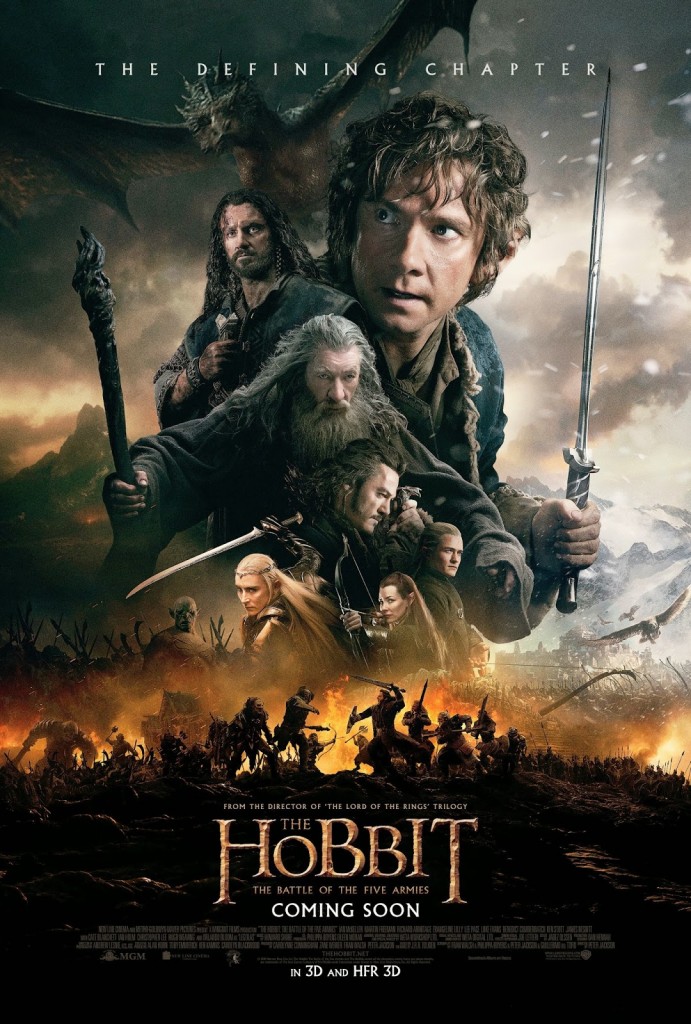
The Hobbit: The Battle of the Five Armies

Genre: Fantasy

Director: Peter Jackson

Writers: Fran Walsh, Philippa Boyens, Peter Jackson & Guillermo del Toro, based on the novel “The Hobbit” by J. R. R. Tolkien

Cast: Martin Freeman, Ian McKellan, Richard Armitage, Luke Evans, Orlando Bloom, Evangeline Lilly, Lee Pace, Stephen Fry, Cate Blanchett, Hugo Weaving, Christopher Lee, Benedict Cumberbatch (voice)

Running Length: 144 minutes

Synopsis: The Hobbit: The Battle of the Five Armies brings to an epic conclusion the adventures of Bilbo Baggins (Martin Freeman), Thorin Oakenshield (Richard Armitage) and the Company of Dwarves. The Dwarves of Erebor have reclaimed the vast wealth of their homeland, but now must face the consequences of having unleashed the terrifying Dragon, Smaug, upon the defenseless men, women and children of Lake-town.

As he succumbs to dragon-sickness, the King Under the Mountain, Thorin Oakenshield, sacrifices friendship and honor in his search for the legendary Arkenstone. Unable to help Thorin see reason, Bilbo is driven to make a desperate and dangerous choice, not knowing that even greater perils lie ahead. An ancient enemy has returned to Middle-earth. Sauron, the Dark Lord, has sent forth legions of Orcs in a stealth attack upon the Lonely Mountain. As darkness converges on their escalating conflict, the races of Dwarves, Elves and Men must decide—unite or be destroyed. Bilbo finds himself fighting for his life and the lives of his friends as five great armies go to war.

Review: By this third installment, it’s safe to say that The Hobbit trilogy is kind of a misnomer, since the titular character doesn’t really factor all that much into the proceedings, made most abundantly clear in this episode, The Battle of the Five Armies. This is a natural outcome of trying to stretch out what is essentially a children’s storybook into a fantasy epic, in an attempt to make The Hobbit trilogy’s breadth and scope similar to the Lord of the Rings trilogy. So much material in the three Hobbit movies aren’t even in the novel that it is moot to discuss the faithfulness of the movie to the source, and not all additions work in the movies’ favour.

That said, The Battle of the Five Armies is easily the best film in the trilogy, far trumping the soporific An Unexpected Journey and an improvement upon the sporadically interesting The Desolation of Smaug. The film opens with Smaug raining fiery destruction on Lake-town, and the CG effects, especially Smaug himself, remain a sight to behold. The action never really lets up from there, culminating in an epic battle sequence lasting more than an hour, with the expansive battle coming close to the best scenes in the Lord of the Rings trilogy. Bookended by these two setpieces, The Battle of the Five Armies feels closest to being a complete entity of its own, unlike the two films that came before it, both of which ended very abruptly. There can be a case made for too much CGI as the trilogy progresses, but it’s hard to argue that the end results are very impressive and rightfully lends an epic feel to the sequences. (A side note: HFR 3D remains a little too sharp for my own preferences, but at least the 3D is not entirely redundant in the film, unlike almost every other title that decides to open in 3D.)

It’s no secret that there are plenty of embellishments in The Hobbit trilogy to pad out the thin storyline, even creating characters that were not part of the canon – most notably the female Wood Elf Tauriel. Sure, the interspecies romance between Tauriel and Kili will probably make the film more appealing to a greater number of moviegoers, but it just flat out does not work well as a plot device because it feels so ill-fitted in the Tolkien universe. The decision to include Legolas as more than just a cameo probably stems from the same desire to appeal to a specific fan base, but the action sequences involving Legolas have devolved into near-farce, especially one in which he seems to be in a different movie – Crouching Tiger, Hidden Dragon perhaps – altogether.

The same can be said of many returning faces, and everyone (save for Gollum) makes an appearance, making it feel almost like some Middle-Earth reunion movie of sorts. However, such extraneous filler also manages to diminish the central plot and character, and much of The Battle of the Five Armies sees Bilbo Baggins being sidelined as a spectator of the proceedings. It’s a shame, because Martin Freeman is excellent in his role, but the audience simply does not get to see enough of him despite it being an almost two-and-a-half-hour movie (for those keeping count, this means the combined running length of The Hobbit trilogy is a whopping 474 minutes).

And so, thirteen years after embarking on a journey to Middle-Earth, Peter Jackson finally concludes his six-film saga with a big (enough) bang. Jackson has stated that there will be no third set of films based on The Silmarillon from him, but one can never be too sure about such things – after all it does seem that rights issues is what’s stopping potential production. When looked upon as a complete body of work or as a part of the entire Middle Earth saga, The Hobbit doesn’t do all that badly (though I still maintain that it should never had become three movies – even the originally planned two-parter was a dubious decision), and is already a qualified box office success even before The Battle of the Five Armies opened. This last movie singlehandedly raises the trilogy to above mediocrity, and whilst The Hobbit never comes close to its predecessor on any level, The Battle of the Five Armies rounds out one of the better film trilogies in recent years, paling only to Christopher Nolan’s superlative Dark Knight trilogy. That’s not to say that the films are without their flaws, but at the very least the journey there and back again has a decent payoff.

Rating: * * * ½ (out of four stars)

Overall Rating for The Hobbit trilogy: * * * (out of four stars)

Standard

Exodus: Gods and Kings

Genre: Action, Drama

Director: Ridley Scott

Writers: Adam Cooper, Bill Collage, Jeffrey Caine, Steven Zaillian

Cast: Christian Bale, Joel Edgerton, John Turturro, Aaron Paul, Ben Mendelsohn, Maria Valverde, Sigourney Weaver, Ben Kingsley, Isaac Andrews, Hiam Abbass, Indira Varma, Ewen Bremner, Golshifteh Farahani, Ghassan Massoud, Tara Fitzgerald, Maria Valverde, Andrew Barclay Tarbet

Running Length: 150 minutes

Synopsis: From acclaimed director Ridley Scott (Gladiator, Prometheus) comes the epic adventure Exodus: Gods and Kings, the story of one man’s daring courage to take on the might of an empire. Using state of the art visual effects and 3D immersion, Scott brings new life to the story of the defiant leader Moses (Christian Bale) as he rises up against the Egyptian Pharaoh Ramses (Joel Edgerton), setting 600,000 slaves on a monumental journey of escape from Egypt and its terrifying cycle of deadly plagues.

Review: It’s apt to quote from Ridley Scott’s own Gladiator, since it was the movie that made the sword-and-sandals epic cool again – “Are you not entertained?” Because this is one of the main problems I have with Exodus – although it is sufficiently stirring sporadically, and shows a really masterful use of CGI, the film is simply not that entertaining, bringing nothing new to the tale of the Ten Commandments, and actually ends up being less interesting than Cecil B. DeMille’s still-definitive 1956 version.

Perhaps it’s because Ridley Scott didn’t seem to set out to make a religious epic, and much like Darren Aronofsky’s Noah earlier in the year, attempts to make certain scenes more secular and logical, that the film takes a big hit. The parting of the Red Sea certainly feels more realistic, but does not inspire any awe. The plagues visited upon Egypt are brilliant CGI setpieces, but at the same time come across as being perfunctory, as though Scott is checking off an invisible list of the ten plagues, just making sure that they all end up in the film. The burning bush and the Ten Commandments seem more like afterthoughts, and are not given the dramatic heft that they should have been. The personification of God is also a questionable decision – I am not sure if assigning an actor to play God (literally) is more effective than a loud booming voice, as clichéd as the latter sounds.

Although Scott and his team of 4 writers correctly presume that a good majority of the audience would be at least somewhat familiar with the story of Moses, broad narrative gaps appear in the film, which almost makes the film feel disjointed. And yet, the film devotes so much time to the setup that when thing finally get going in the last hour, the pacing suddenly speeds up and the entire proceedings start feeling rushed. To add insult to injury, after a rather stirring finale act of crossing the Red Sea, Scott decided to keep the narrative running just a bit too long, leading to a drawn out and wholly anticlimactic denouement.

Putting aside the fact that the film is populated by white actors instead of ethnic actors more appropriate to the story’s locations, even the A-list names in the cast feel a bit out of place. The normally supremely dependable Christian Bale feels a little stilted in his portrayal as Moses, and Joel Edgerton basically depends on his bronzer and guyliner to carry his performance as Ramses. These are not bad performances by any measure, but again, so much drama is dialed back that it just comes across as being too muted for an epic film like this one. Other notable actors like Ben Kingsley, Sigourney Weaver, John Turturro and Aaron Paul barely register, completely wasted in parts where they have too little to do.

Thankfully, the few action setpieces are quite rousing, if never reaching the level of Scott’s best films. Also, for a film that’s steeped in CG by necessity, Exodus actually comes across as being visually stunning without being too clearly artificial (though there’s absolutely no necessity to catch the film in 3D). In this day and age where a straight-up biblical epic may no longer be palatable to the general audience, both experiments in 2014 have been only moderately successful. There is really no reason to remake The Ten Commandments, and the results only serve to reinforce this. Here’s hoping that Scott’s next cinematic outing (The Martian, coming in end 2015) would prove to be a more compelling film.

Rating: * * ½ (out of four stars)

Standard

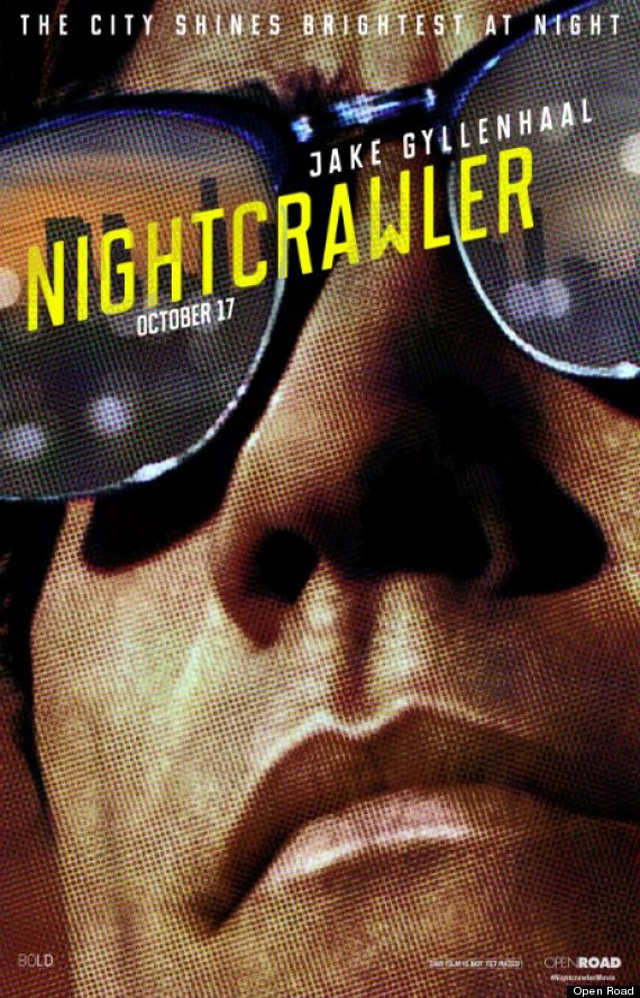
Nightcrawler

Genre: Drama

Director: Dan Gilroy

Writer: Dan Gilroy

Cast: Jake Gyllenhaal, Rene Russo, Riz Ahmed, Bill Paxton

Running Length: 117 minutes

Synopsis: Nightcrawler is a thriller set in the nocturnal underbelly of contemporary Los Angeles. Jake Gyllenhaal stars as Lou Bloom, a driven young man desperate for work who discovers the high-speed world of L.A. crime journalism. Finding a group of freelance camera crews who film crashes, fires, murder and other mayhem, Lou muscles into the cut-throat, dangerous realm of nightcrawling – where each police siren wail equals a possible windfall and victims are converted into dollars and cents. Aided by Rene Russo as Nina, a veteran of the blood-sport that is local TV news, Lou blurs the line between observer and participant to become the star of his own story.

Review: Jake Gyllenhaal has had an excellent body of work so far, with wide-ranging roles that manage to impress time and again (Enemy, Brokeback Mountain, Jarhead, Prisoners, and many more). However, his performance in Nightcrawler is undoubtedly his best yet, and that says a lot about how good it is – highly deserving of a great run at the awards season next year, and on its own is reason enough to give Nightcrawler a go. While Nightcrawler is not without some flaws, it has a mesmerising central performance around a smart, always engaging film, making it impossible to look away for the entire 2-hour running time. This is the poster child for movies that don’t accord audiences any good moments for a pee break.

The most immediate comparison that one can make to Gyllenhaal’s performance is that of Robert De Niro’s in Taxi Driver – Lou Bloom is as much of an anti-hero as Travis Bickle was, although Bloom definitely has less of a moral compass than Bickle. And it’s an equally transformative, unforgettable performance – Gyllenhaal totally disappears into the role, fully embodifying Bloom not just in his physicality (he lost over 20 pounds of weight for the role) but in every aspect. It’s clear that in Nightcrawler, Bloom is the antagonist, and his soulless eyes, forced smile and ruthless, sociopathic focus on the end game is unyieldingly creepy yet fascinating to observe. This is easily one of the best performances of the year, on par with the mind searing turn by Rosamund Pike in Gone Girl.

While Gyllenhaal carries the film on his performance alone, the supporting cast is also quite capable – Rene Russo (Dan Gilroy’s wife, by the way) is the only female presence in the film and leaves a strong impression as the network executive that’s almost willing to do anything for ratings. Bill Paxton plays a small but important role in the film, and despite limited screen time gives a memorable performance as well. Riz Ahmed’s Rick acts as the human foil for Lou, but at times does feel more like a convenient plot device rather than a convincingly written character.

Dan Gilroy pulls double duty as director (his debut) and screenwriter, and manages to excel at both. With such solid performers on board, he wisely chooses a straightforward, unflashy directorial style, but is aided by Robert Elswit hitting it out of the park with excellent cinematography – nighttime Los Angeles has not looked so spectacular since the equally lush take in 2011’s Drive. The scripting is impeccable, and although I question the veracity of how network news footage is acquired (and the sensationalism of news is a very tired, old trope), Gilroy is masterful in ramping up the suspense all the way to the explosive, macabre, yet strangely satisfying denouement.

Rating: * * * ½ (out of four stars)

Standard

The Hunger Games: Mockingjay – Part 1

Genre: Sci-Fi, Action

Director: Francis Lawrence

Writers: Peter Craig and Danny Strong, based on the novel by Suzanne Collins

Cast: Jennifer Lawrence, Josh Hutcherson, Sam Claflin, Woody Harrelson, Donald Sutherland, Liam Hemsworth, Julianne Moore, Philip Seymour Hoffman, Jeffrey Wright, Elizabeth Banks, Natalie Dormer

Running Length: 123 minutes

Synopsis: The Hunger Games: Mockingjay – Part 1 opens with Katniss Everdeen (Jennifer Lawrence) in District 13 after she literally shatters the Hunger Games forever. Under the leadership of President Coin (Julianne Moore) and the advice of her trusted friends, Katniss spreads her wings as she fights to save Peeta (Josh Hutcherson) and a nation moved by her courage.

Review: Despite its best intentions, Mockingjay Part 1 is easily the weakest installment in the Hunger Games franchise thus far. Lionsgate had made the financially-lucrative (but creatively bankrupt) decision to cleave the final installment in two, but unfortunately Mockingjay Part 1 does not work well as a standalone movie, and ends in such an abrupt manner that it can potentially turn casual audiences off from making a return visit for Mockingjay Part 2. The final novel in the Hunger Games trilogy was the grandest in scale, but does not lend itself well to a (probable) 4-plus hour transition to the big screen. Mockingjay Part 1 is ponderously paced, meanders and feels drawn out, and is only sporadically interesting in its two hour plus running time. While the elements that made the first two movies good are still present, they are weighed down by too much unnecessary baggage.

Although “The Hunger Games” is still part of the title of Mockingjay, it is important to note that while there’s war and strife, there’s no Hunger Games being conducted in the movie. While this is not surprising for anyone who has read the novels (like myself), expectations of some audience members will surely be confounded. Mockingjay is a far more static movie, with a very minimal number of action setpieces. Much of it is set underground, in District 13, and with Katniss essentially neutered from most of the action (of any kind), it’s almost like the franchise is banking on the halo effect of her past two cinematic outings to coast by. Even though Jennifer Lawrence is a great actress, she’s really only effective in a handful of scenes in Mockingjay Part 1, a stark difference from the previous two films where she held the audience’s attention from beginning to end. The film does boast a very strong supporting cast of veteran actors, especially the late Philip Seymour Hoffman, but none of them are really given enough time to shine, despite the film’s length.

It doesn’t help that Peeta is separated from Katniss for essentially the whole movie – while Liam Hemsworth’s Gale is around Katniss, the love triangle is essentially DOA since there’s no chemistry whatsoever between Hemsworth and Lawrence, which has already been confirmed in the last two movies, but brought into starker contrast this time round. Fortunately, the romance is a smaller and less consequential component of the film compared to other YA offerings, so it doesn’t completely undermine the movie despite the clunkiness.

Since it’s essentially half a movie, it is difficult to judge if Mockingjay is a befitting swansong for the franchise until Part 2 is released (a full year later, in November 2015). It cannot be denied, however, that nothing much really happens in Mockingjay Part 1, since it’s merely a placeholder for the true conclusion of the film in Part 2, where surely there’s less inaction and an actual denouement. This is the film’s most glaring fault and drowns out almost every positive aspect. While it’s still a perfectly serviceable YA film (albeit a fair bit darker and brooding than most films in the same genre), Catching Fire had set up higher expectations which unfortunately are not met with this half of the finale.

Rating: * * ½ (out of four stars)

Standard