Captain America: Civil War

Genre: Action

Director: Anthony Russo, Joe Russo

Screenplay: Christopher Markus, Stephen McFeely

Cast: Chris Evans, Robert Downey Jr., Scarlett Johansson, Sebastian Stan, Anthony Mackie, Don Cheadle, Jeremy Renner, Chadwick Boseman, Paul Bettany, Elizabeth Olsen, Paul Rudd, Emily VanCamp, Tom Holland, Frank Grillo, William Hurt, Daniel Bruhl

Running Length: 146 minutes

Synopsis:  Captain America: Civil War finds Steve Rogers (Chris Evans) leading the newly formed team of Avengers in their continued efforts to safeguard humanity. But after another incident involving the Avengers results in collateral damage, political pressure mounts to install a system of accountability, headed by a governing body to oversee and direct the team. The new status quo fractures the Avengers, resulting in two camps – one led by Steve Rogers and his desire for the Avengers to remain free to defend humanity without government interference, and the other following Tony Stark’s (Robert Downey Jr.) surprising decision to support government oversight and accountability.

Review:  It’s not surprising, given their track record, that Marvel has managed to hit yet another Marvel Cinematic Universe movie out of the park. This may sound repetitive, but Captain America: Civil War is possibly the best movie from the MCU so far – not only does it present an absorbing, complex and intellectual storyline, it is chock-full of impressive action set-pieces and even finds time to flesh out both old and new Marvel characters. This is the superhero movie that Batman v Superman wanted to be but failed terribly trying.

Although this is presented as the third Captain America movie, the number of superheroes involved in the story is as plentiful as a “proper” Avengers film. Apart from the rather obvious omissions of Thor and the Hulk, Civil War features almost all the Avengers, and introduces audiences to Black Panther and Spider-man (who makes a pretty triumphant, scene-stealing return to Disney after his stint in Sony Pictures). Impressively, scribes Christopher Markus and Stephen McFeely (who also wrote first two Captain America movies) managed to flesh many of these superheroes out to be more than the sum of their superpowers, despite an already narratively dense film.

Refreshingly, Civil War is not all grim and dour like in Batman v Superman, and yet the film grapples with heavy subject matter with far greater aplomb than the clunky incoherence that populated BvS. Directors Anthony and Joe Russo have applied their experience in TV comedies to the Marvel films they have directed, and the same is evident here – there are many moments of levity to be found amidst the seriousness, though never distractingly so. There is also some really great action sequences to be found here, including an excellent scene at the airport where the two opposing factions of the Avengers finally clash, and their superpowers being pitted against each other in very interesting and unexpected ways.

Civil War is the first salvo in Phase 3 of the Marvel Cinematic Universe, and one of the very few criticisms that can be leveled at the movie is that it feels slightly incomplete as a standalone movie, and ends in a really abrupt manner. This is to be expected given the way the MCU is being structured now, with each movie being a cog in the wheel of a larger movement, but it is particularly apparent in Civil War that many plot lines are being laid in the film and aren’t fully realized by the time the credits roll, since the audience isn’t expected to watch this movie in isolation. While the uneven nature of Batman v Superman has called to question the viability of DC’s cinematic universe and roster of upcoming films, Civil War has merely reaffirmed that Marvel is at the top of the cinematic game, and even if the proceedings feel a little predictable at times, the film is a highly enjoyable opener to the next five years’ worth of the MCU.

Rating: * * * ½ (out of four stars)

P.S. Like all Marvel movies, don’t miss the two post-credit sequences, although they aren’t particularly essential viewing.
Standard

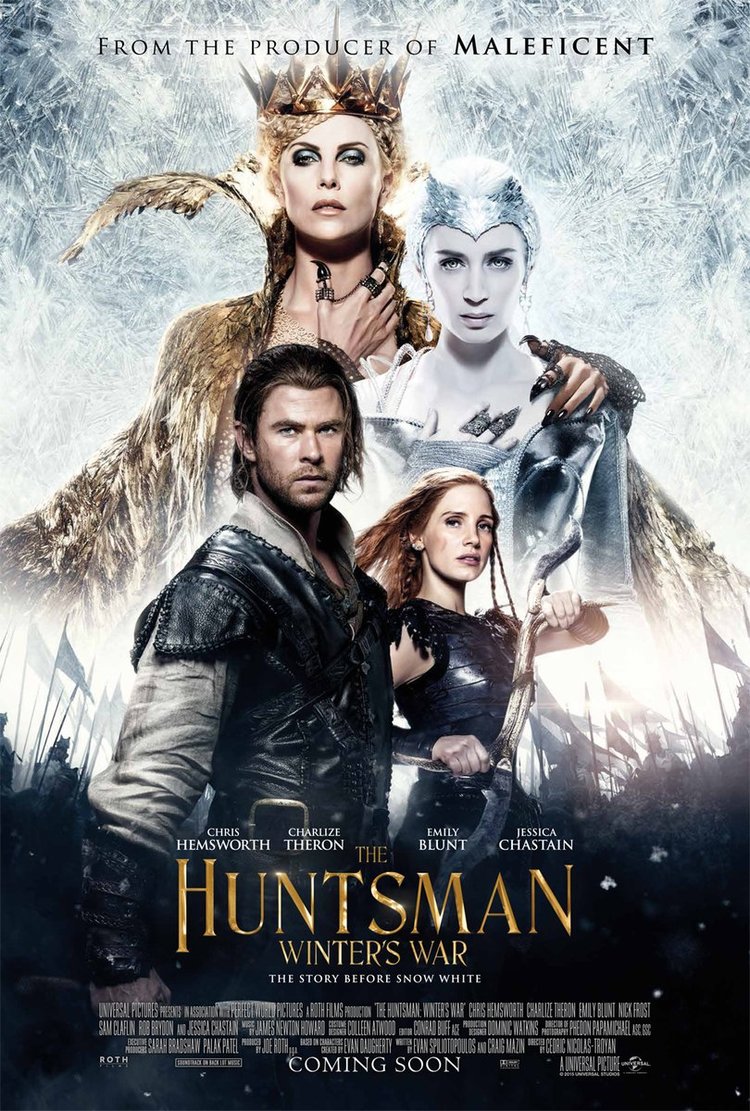
The Huntsman: Winter’s War

Genre: Fantasy

Director: Cedric Nicolas-Troyan

Screenplay: Craig Mazin, Evan Spiliotopolous

Cast: Charlize Theron, Emily Blunt, Chris Hemsworth, Jessica Chastain, Nick Frost, Rob Brydon

Running Length: 123 minutes

Synopsis:  Freya the Ice Queen (Emily Blunt) brings her sister Ravenna (Charlize Theron) back to life, and the powerful evil siblings plan to conquer the Enchanted Forest. Only the Huntsman (Chris Hemsworth) and his secret lover Sara (Jessica Chastain) can stop them in this sequel continuing the twist on the Snow White fable.

Review: While Snow White and the Huntsman was a somewhat interesting twist on the classic tale of Snow White, it didn’t really need a sequel or a prequel – but with near $400 million in global box office takings, it was perhaps inevitable that The Huntsman: Winter’s War was green-lit. Unfortunately, it seems almost all the life had been sucked out of the franchise with this second film, and even though the door remains open for yet another sequel, it would certainly take a huge leap of faith for most audience members to revisit this world for a third time.

Strangely, the decision was made to excise Snow White’s presence out from Winter’s War, leading to some rather convoluted storytelling where the film starts several decades prior to the time frame of Snow White and the Huntsman, then awkwardly lurches forward to “seven years later” after what had transpired in the first film. The writers seem to assume that everyone has seen (and remembers) the first film’s plot, however unlikely that might be, and there will be moments in Winter’s War that will not make a lot of sense if one is unacquainted with the previous film.

That Chris Hemsworth is a pretty face (and body) without too much thespian talent has been quite established in his body of work, but in Winter’s War he is particularly unspectacular, taking a back seat in dramatic duties to all the leading women (even the annoying dwarves seem to do better), and absolutely lacking in any romantic chemistry with Jessica Chastain. Chastain herself fares a little better, given a Tauriel-esque character with slightly more depth than Hemsworth’s. Charlize Theron hams it up and thus steals the spotlight from anyone sharing scenes with her, but the film’s true saving grace is Emily Blunt, who chooses not to overact but instead turns Freya into a believably vulnerable and emotionally fragile character, even as she inches ever closer to Ravenna’s darkness. If not for Blunt’s participation, Winter’s War would probably have been much less watchable.

Nicolas Cedric-Troyan is helming his first feature film here, stepping up from visual effects director in Snow White and the Huntsman, and his mastery in visual effects is indeed very clear. The entire film is saturated in visual effects, and some of them are indeed extremely impressive, none more so than the final showdown between the Huntsmen and the two Queens. The costume design by Colleen Atwood is also top notch, especially the various gowns worn by Blunt and Theron. However, the visual beauty of Winter’s War isn’t quite enough to overcome its flaws in character development and storytelling, and there’s certainly nothing on show here that will legitimize a third film in this already stretched-thin franchise.

Rating: * * (out of four stars)

Standard

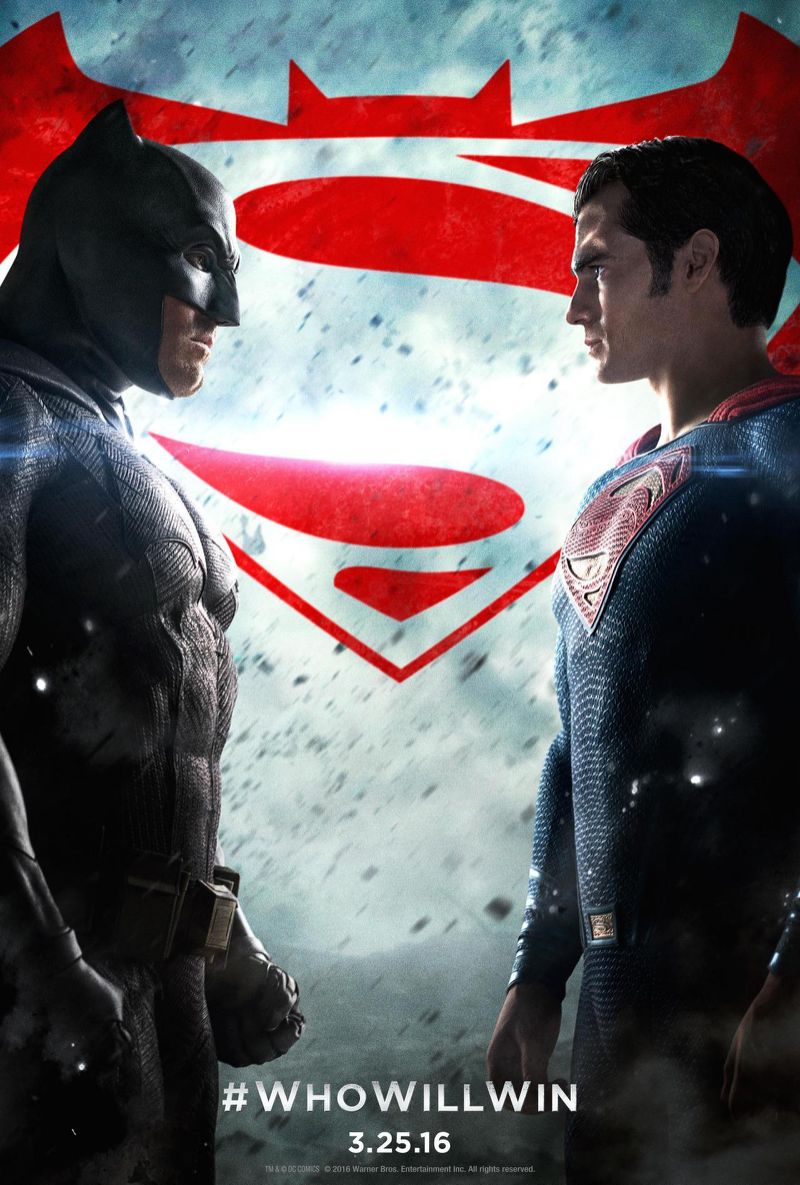
Batman v Superman: Dawn of Justice

Genre: Action

Director: Zach Snyder

Screenplay:  Chris Terrio, David S. Goyer

Cast: Ben Affleck, Henry Cavill, Amy Adams, Jesse Eisenberg, Diane Lane, Laurence Fishburne, Jeremy Irons, Holly Hunter, Gal Gadot, Scoot McNairy, Michael Shannon

Running Length:  152 minutes

Synopsis: Fearing the actions of a god-like Super Hero left unchecked, Gotham City’s own formidable, forceful vigilante takes on Metropolis’s most revered, modern-day saviour, while the world wrestles with what sort of hero it really needs. And with Batman (Ben Affleck) and Superman (Henry Cavill) at war with one another, a new threat quickly arises, putting mankind in greater danger than it’s ever known before.

Review:  It was inevitable, after the incredible box office successes of the Marvel Comic Universe, that competing comics giant DC would want a piece of the pie too. And thus the DC Extended Universe was born, with the first salvo fired being Batman v Superman: Dawn of Justice (shorthanded to BvS for the rest of the review), and a slew of movies announced all the way to 2020. However, based on BvS alone, one wonders if the DCEU is already off on a wrong foot from the get-go. While the film does have its merits and some high points, BvS is also mired with issues, ranging from terrible writing, an overlong (way, WAY overlong) running time, and a complete lack of joy in the proceedings.

Given that the film title states that it’s Batman v Superman, one would not expect that it takes almost 90 minutes for the premise to be setup, and that the setup is such a weak and unconvincing one. The conflict between the two superheroes is just not believable, and even though it presents an interesting angle (essentially, who watches the watchmen, a theme also explored by Snyder’s Watchmen adaptation in 2009), the twists and turns needed to get there just does not work on any level. This is not aided by the lack of anything for the audience to get emotionally invested in – while the film tries to be serious and weighty, there’s very little narrative and backstory for the audience to latch on to, which gives BvS very little dramatic heft. And do not get me started on how the “animosity” is resolved eventually, which is so contrived it truly beggars belief.

While the same self-seriousness worked well in Christopher Nolan’s Dark Knight trilogy, it already proved to be a bit of a miss in Man of Steel as it was quite a departure from Superman’s established canon, both in film and in print. This is further exacerbated in BvS – while no one is expecting a comedy, Snyder and his scribes do not seem to understand that being serious doesn’t mean sapping the joy out of a superhero movie, especially one that contains both Superman and Wonder Woman. BvS doubles down on the dourness of Man of Steel, and is indeed one of the most (if not the most) downer of a superhero movie I’ve watched in years.

Despite the initial outcry, Ben Affleck is actually a reasonable replacement for Batman, both in his physicality and in his performance. However, Henry Cavill remains a very wooden Superman, only looking the part when he shows up in the iconic spandex suit and cape. Jesse Eisenberg is terribly miscast, and his supposed psychotic Lex Luthor comes across more like an annoying teenager with a ridiculously long list of nervous tics and twitches. It is truly hard to believe that two intelligent beings like Batman and Superman falling for his rather simplistic schemes of manipulation. The women all fare better, but are all relegated to nothing more than window dressing in the film. Gal Gadot in particular shows great promise as Wonder Woman, and there is hope that her standalone movie next year would fare better than BvS.

Zach Snyder is a director that excels in crafting visuals, and it is not surprising that some portions of BvS are indeed very good looking. However, there is definitely an over-reliance on CG, especially in the (anti)climactic showdown between the heroic trio and Doomsday. Speaking of Doomsday, he is a complete bust as there’s absolutely no background to the villain, existing solely as a prop to advance the plot, and one that looks very unevenly animated, despite what must be a massive CGI budget. Coupled with way too many quick cuts in the last action-packed hour, and a relentlessly booming and overbearing score by Hans Zimmer and Junkie XL, and it’s just quite an exhausting ordeal of a movie to sit through. BvS functions more like a (very long) teaser trailer to the upcoming DCEU movies, but in their eagerness to launch the franchise, it does seem that Snyder and team have forgotten to make BvS itself a movie that would stand on its own strengths.

Rating: * * (out of four stars)

Standard

Zoolander 2

Genre: Comedy

Director: Ben Stiller

Screenplay: Justin Theroux, Ben Stiller, John Hamburg, Nicholas Stoller, based on the characters created by Drake Sather, Ben Stiller

Cast: Ben Stiller, Owen Wilson, Will Ferrell, Penelope Cruz, Kristen Wiig, Fred Armisen, Kyle Mooney, Milla Jovovich, Christine Taylor, Justin Theroux, Nathan Lee Graham, Cyrus Arnold, Billy Zane, Jon Daly

Running Length:  102 minutes

Synopsis: Derek (Ben Stiller) and Hansel (Owen Wilson) are lured into modeling again, in Rome, where they find themselves the target of a sinister conspiracy.

Review:  Full disclosure: I am a fan of the original Zoolander, and have watched the 2001 film multiple times outside of the cinema (the first Zoolander has the dubious honour of being banned in Singapore, due to its featuring the “Malaysian Prime Minister”). Over the years, the film had built up quite a cult following, and when Zoolander 2 was announced, I (and many other Zoolander fans) was rather stoked. Unfortunately, the sequel is a half-baked, overstuffed movie that proves pretty joyless to watch, despite the copious number of celebrity cameos and a handful of somewhat funny sequences.

One of the biggest issues of Zoolander 2 is the number of things going on at any one time. Not only does the espionage plot make a somewhat unwelcome return, there’s also the Zoolander father-and-son reunion, and then there’s the unresolved grudge between Derek and Hansel, the return of arch-nemesis Mugatu (Will Ferrell) and a whole bunch of other inconsequential plot threads, none of which feel satisfactorily resolved by the end of the movie.

It seems that Ben Stiller and his posse of screenwriters can’t bear to divorce the sequel from the original film, and almost constantly makes references to the 15 year-old movie, which is unnecessary and limits the appeal of the movie even further. Much as Zoolander has a cult following, this unabashed nudging and winking serve nothing more than make the proceedings feel ever more like drudgery, especially after the novelty of seeing these characters back on the big screen fades after the first reel.

It doesn’t help that Zoolander 2 is a little too self-aware for its own good. If everyone is in on the joke – and in this film that’s certainly the case, given the frankly ridiculous number of cameos of both celebrities and fashion industry mavens, even more so than the first film – then the joke ceases to be funny. While it may be a somewhat interesting diversion to spot the cameos (including Benedict Cumberbatch in an appearance that will haunt him for many, many years to come), much of it feels shoehorned into the scattershot scenes, and in the end it just feels like a chain of middling SNL skits stringed into a movie. Zoolander 2 is a sporadically funny film and thus not without merit, but it certainly is questionable if that is sufficient to justify paying the price of entry to watch it on the big screen.

Rating: * ½ (out of four stars)

Standard

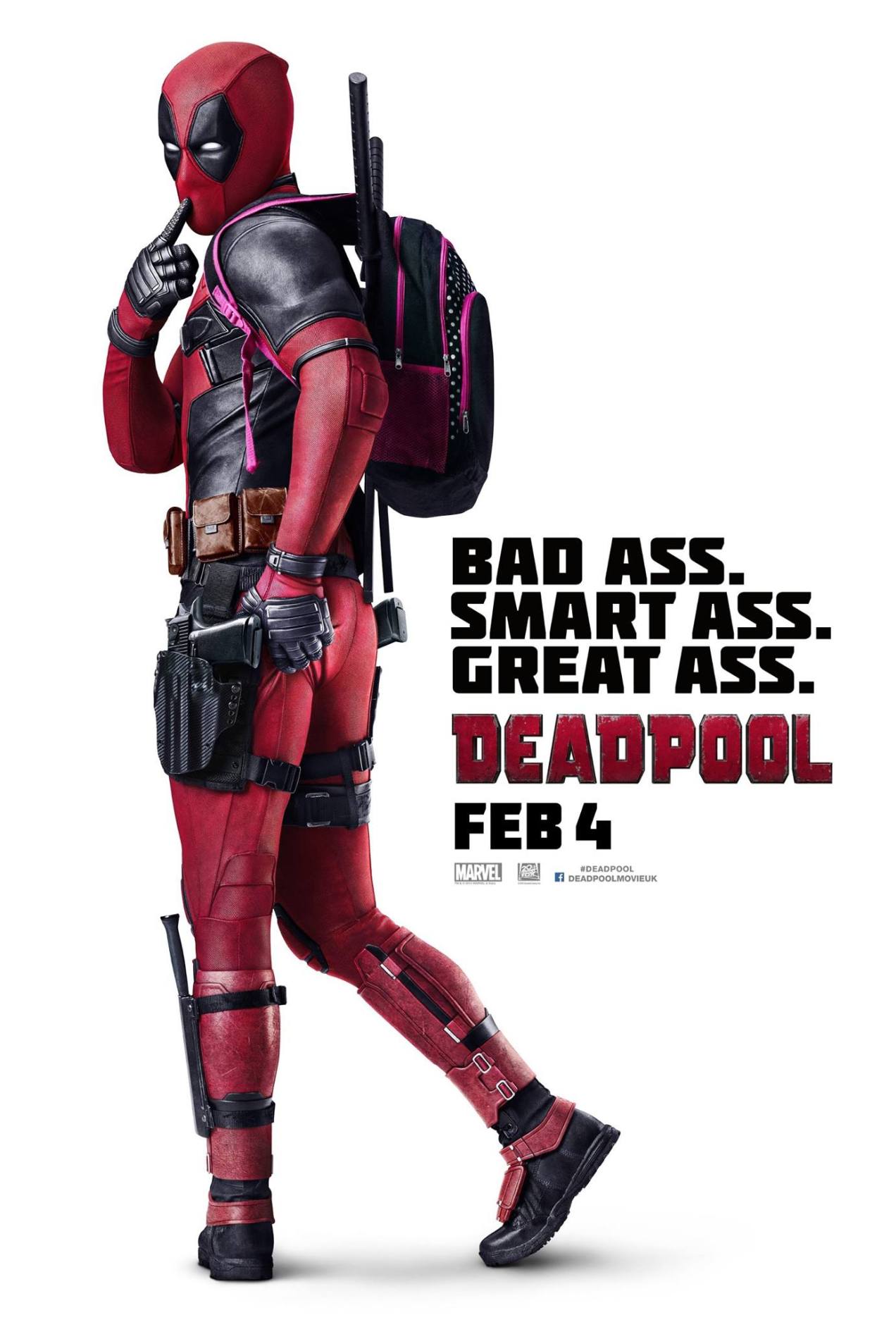
Deadpool

Genre: Action, Comedy

Director: Tim Miller

Screenplay: Rhett Reese, Paul Wernick

Cast: Ryan Reynolds, Morena Baccarin, Ed Skrein, T.J. Miller, Gina Carano, Leslie Uggams, Brianna Hildebrand, Karan Soni, Jed Rees, Stefan Kapicic, Randal Reeder, Isaac C. Singleton Jr.

Running Length:  107 minutes

Synopsis: Based upon Marvel Comics’ most unconventional anti-hero, Deadpool tells the origin story of former Special Forces operative turned mercenary Wade Wilson (Ryan Reynolds), who after being subjected to a rogue experiment that leaves him with accelerated healing powers, adopts the alter ego Deadpool. Armed with his new abilities and a dark, twisted sense of humor, Deadpool hunts down the man who nearly destroyed his life.

Review:  There’s no denying that the superhero movie genre is now one of the most popular, and in 2016 alone there are a whopping 7 superhero movies being released from both the Marvel and DC camps, with many more planned in the few years ahead. There’s also no denying that everyone is suffering from a little bit of superhero fatigue, which helps explain why Deadpool is such an appealing movie for many cinemagoers. After all, Deadpool is pretty much an anti-superhero, and together with one of the best movie marketing campaigns in recent years, have left many (including myself) anticipating the film with bated breath. Of course, it also helps that the film is being released in February instead of during the summer blockbuster season, with a much sparser release schedule.

Inspired marketing campaign aside, the actual Deadpool movie is indeed quite a refreshing change of pace, even though beneath that irreverent façade lies a pretty standard superhero origins movie. I’ve never witnessed any superhero (or movie, including spoofs) take so many potshots at the superhero movie genre, and in this aspect Deadpool is a tremendous success. Ryan Reynolds is totally in his element as the wisecracking, manic Deadpool, and his comic timing and delivery is close to flawless. Nothing is spared, and everything is fearlessly skewered – Ryan’s own failure in Green Lantern, the X-Men, even 20th Century Fox, and much, much more.

Deadpool also breaks the fourth wall repeatedly, turning to the audience and addressing them directly multiple times, and in one scene, even managing to break the fourth wall a second time while breaking the fourth wall (it truly needs to be seen to be believed). It’s smart to the point of being smart-alecky, and while a lot of it works, there are times where the self-aware, ironic shtick becomes a little tiresome.

The film is also not suited for everyone, as it is far raunchier and violent than usual superhero films, more than deserving of its R (locally, M18) rating.  However, if you have a stomach for the violence and are a fan of off-kilter humour, Deadpool will be a very rewarding cinematic experience that is refreshingly different from any other superhero movie before it.

Rating: *** (out of four stars)

Standard

Joy

Joy


Genre: Drama

Director: David O. Russell

Screenplay: David O. Russell, based on a story by Annie Mumolo and David O. Russell

Cast: Jennifer Lawrence, Bradley Cooper, Robert De Niro, Elizabeth Rohm, Edgar Ramirez, Virginia Madsen, Isabella Rossellini, Diane Ladd, Dascha Polanco

Running Length:  124 minutes

Synopsis: Joy is the wild story of a family across four generations centered on Joy Mangano (Jennifer Lawrence), the girl who becomes the woman who founds a business dynasty and becomes a matriarch in her own right. Betrayal, treachery, the loss of innocence and the scars of love, pave the road in this intense emotional and human comedy about becoming a true boss of family and enterprise facing a world of unforgiving commerce.

Review: If not for the interesting (true but heavily fictionalized) story of Joy Mangano and a riveting central performance by Jennifer Lawrence as the rags-to-riches businesswoman, Joy would have been a much more joyless affair to watch. This is David O. Russell’s first movie centred entirely on a female character, but Erin Brockovich this is not. It’s almost as though O. Russell is unable to make up his mind about how to go about making this “biopic” and the wild tonal and narrative shifts actually detract quite a bit from the cinematic experience.

The ensemble sequences and sprawling narrative in Joy don’t work as well as in O. Russell’s previous films, and his tendency of putting everyone in an enclosed space, shouting at one another really grates after a while. There are also odd surrealist moments that are absolutely unnecessary, jarring viewers out of the moment and probably scratching their heads in puzzlement. Even though many of O. Russell’s alumni make a return in the film, the sparks simply fail to fly in many of the interactions, because the characters are basically reduced to plot-forwarding caricatures this time round.

There is a glorious 30 minutes in Joy in which everything actually comes together, and that is the sequence which traces her first interaction with TV studio exec Neil Walker (Bradley Cooper) to when she makes her first live pitch on QVC. Lawrence’s transformation from unsure inventor to QVC pitchwoman is indeed magical, and her performance really sells it very well. Jennifer Lawrence has established herself as one of the best young actresses around, and her credible and sympathetic turn as Joy Mangano is yet another feather in her cap, though it’s not her best performance thus far.

Unfortunately, after the high of the QVC sequence, the film never finds a sure footing again, with the denouement feeling uncharacteristically rushed (case in point – a haircut is the sole visual shorthand O. Russell employs to signify the change and growth of Joy in a pivotal scene) and somehow inconsequential. While still a sporadically entertaining film, Joy doesn’t measure up to the previous efforts of O. Russell and feels like a rare misstep for the director.

Rating: ** ½ (out of four stars)

Standard

The Forest

Genre: Horror

Director: Jason Zada

Screenplay: Sarah Cornwell, Nick Antosca, Ben Ketai

Cast: Natalie Dormer, Taylor Kinney, Yukiyoshi Ozawa, Eoin Macken

Running Length: 94 minutes

Synopsis: The story is set in the Aokigahara Forest, a real-life place in Japan where people go to end their lives. Against this backdrop, a young American woman comes in search of her twin sister, who has mysteriously disappeared. Despite everyone’s warnings not to “stray from the path”, Saraa (Natalie Dormer) dares to enter the forest to discover the truth about her sister’s fate.

Review: For horror aficionados, The Forest does not bring anything new to the table – it is a run of the mill horror film that, whilst showing some promise and serving up some decent “boo” moments in the first hour, completely unravels in its final reel. While no one expects new ground to be broken in a genre as well-covered as the haunted house (in this case a haunted forest, which isn’t exactly new either), at the very least the film should deliver a coherent plot and a proper denouement. Both are unfortunately missing in The Forest (pun not intended).

While it really may not be the best idea in the world to follow your missing twin sister into a “suicide forest” in Japan (which is a  genuine location, by the way), it’s a somewhat interesting premise to base a horror movie on. Unfortunately, the plot of The Forest is severely muddled, and the film concludes with multiple plot threads still hanging in mid-air, which diminishes the horror element simply because audiences are left puzzling over these plot points than focusing on the horror. For example, it is never clear if there is indeed a presence in the forest that is actively seeking out new victims, or if it is simply an outward manifestation of one’s internal demons.

Natalie Dormer tries her best to put forth a convincing performance, but we’ve definitely seen better work from her elsewhere. Since almost the entire film is focused on Sara, it is almost irrelevant that she is playing two characters in the film (conveniently – and some would say lazily – demarcated by different hair colours). While she does a great job looking scared, there’s very little depth of character to be seen.  Taylor Kinney is ostensibly the romantic interest in the film but comes across as a dimensionless character existing solely to advance the plot at key points in the film.

There’s a sense that too much of The Forest has been left on the cutting room floor – there are moments in which an almost good horror film seems to be peeking out from behind the obfuscated plotting, but the speed at which the film hurtles towards its confusing, unsatisfying conclusion seems to suggest that given a different edit, The Forest would have had more of a fighting chance to leave a positive impression.

Rating: * ½  (out of four stars)

Standard

Star Wars: Episode VII – The Force Awakens

Genre: Sci-Fi, Drama

Director: J.J. Abrams

Screenplay: Lawrence Kasdan & J.J. Abrams and Michael Arndt, based on characters created by George Lucas

Cast: Harrison Ford, Mark Hamill, Carrie Fisher, Daisy Ridley, Oscar Isaac, John Boyega, Adam Driver, Peter Mayhew, Domhnall Gleeson, Anthony Daniels, Andy Serkis, Lupita Nyong’o             

Running Length: 136 minutes

Synopsis: Thirty years after defeating the Galactic Empire, Han Solo (Harrison Ford) and his allies face a new threat from the evil Kylo Ren (Adam Driver) and his army of Stormtroopers.

Review: The wait is finally over – a ten-year hiatus has followed Episode III: Revenge of the Sith, but Star Wars makes a somewhat triumphant return to the big screen, this time under the stewardship of its new owner (Disney) and directed not by George Lucas, but by J. J. Abrams. While it is a solid, very entertaining space opera, and a good start to the new Star Wars trilogy (and its spin off movies), The Force Awakens feels somewhat encumbered by the baggage of being the “true” sequel of essentially the most revered movie franchise of all time, and the exceptionally high expectations that follow such a status. Abrams has done a very good job giving fans what they expect, but nothing much more than that.

Abrams has chosen to develop four new characters to succeed the thrones of Han Solo, Luke Skywalker and Darth Vader, and the casting choices are quite astute. Daisy Ridley and John Boyega are great as the heroes-to-be for the new trilogy, and Ridley is in particular a revelation. This relatively unknown British actress brings a graceful intensity and quiet strength to her role as Rey, and her performance reminds one of a younger Kiera Knightley. Boyega isn’t as commanding as Finn, but works well as a companion to Rey (somehow I am reminded of Jennifer Lawrence and Joss Hutcherson’s pairing in the Hunger Games franchise). Oscar Isaac is given significantly less to do in the show, but shows promise as the swashbuckling pilot Poe. Adam Driver is also quite memorable as the Kylo Ren, menacing and petulant at the same time, though as the main villain of The Force Awakens he comes up a little short.

It is somewhat surprising, however, that the new droid BB-8 has managed to upstage everyone else in the film. Abrams pays a lot of attention to this new spherical orange and white droid, and although he has no real dialogue, BB-8 manages to express a surprising variation of feelings and emotions, even when he is in the periphery of a scene. That he is also responsible for some of the biggest laughs in the film is also just the cherry on top. BB-8’s “performance” comes close to (or even possibly surpasses) what was achieved by WALL-E’s Eve and WALL-E, which is the gold standard.

Apart from drama, a good space opera should also serve up a fair share of action sequences. In this aspect The Force Awakens is a mixed bag – the first aerial dogfight (involving the Millenium Falcon) is a treat, but the remaining action sequences (yes, even the lightsaber battles) come across as being somewhat perfunctory. There’s an old-school feel to many of these scenes, which does not necessarily work in the film’s favour.

While it’s not a necessity to watch the preceding six films in the franchise, The Force Awakens assumes (not unreasonably, given how ingrained Star Wars is in our pop culture) knowledge of the Star Wars universe, and doles out heaps of fan service to its fans. For a Star Wars fan like myself, it’s impossible not to feel a stir of emotions when the Millennium Falcon makes its first appearance, or when anyone from the original trilogy shows up – Han Solo! Chewbacca! Princess Leia! Artoo! Admiral Ackbar! – but I could almost sense that Abrams and team had an omnipresent checklist and was striving to check off every item by the time the end credits rolled. This slavishness to the original trilogy sometimes makes The Force Awakens feel like a reboot of the franchise instead of a sequel.

This is the most critical flaw of The Force Awakens, and despite its top-secret plot and requests to keep reviews and commentary spoiler-free, there really are very few surprises to be had along the way. This lack of originality and freshness is something that many fans (including myself) would be willing to overlook, just to have the satisfaction of watching a new Star Wars movie on the big screen, but The Force Awakens is not a film that holds up very well to repeat viewings without the rose-tinted glasses of fandom and nostalgia. However, as the necessary fan-servicing is now mostly out of the way, I hope that Episodes VIII and IX will be given the freedom to explore new stories instead of retreading the old and familiar.

Rating: * * * (out of four stars)

Standard

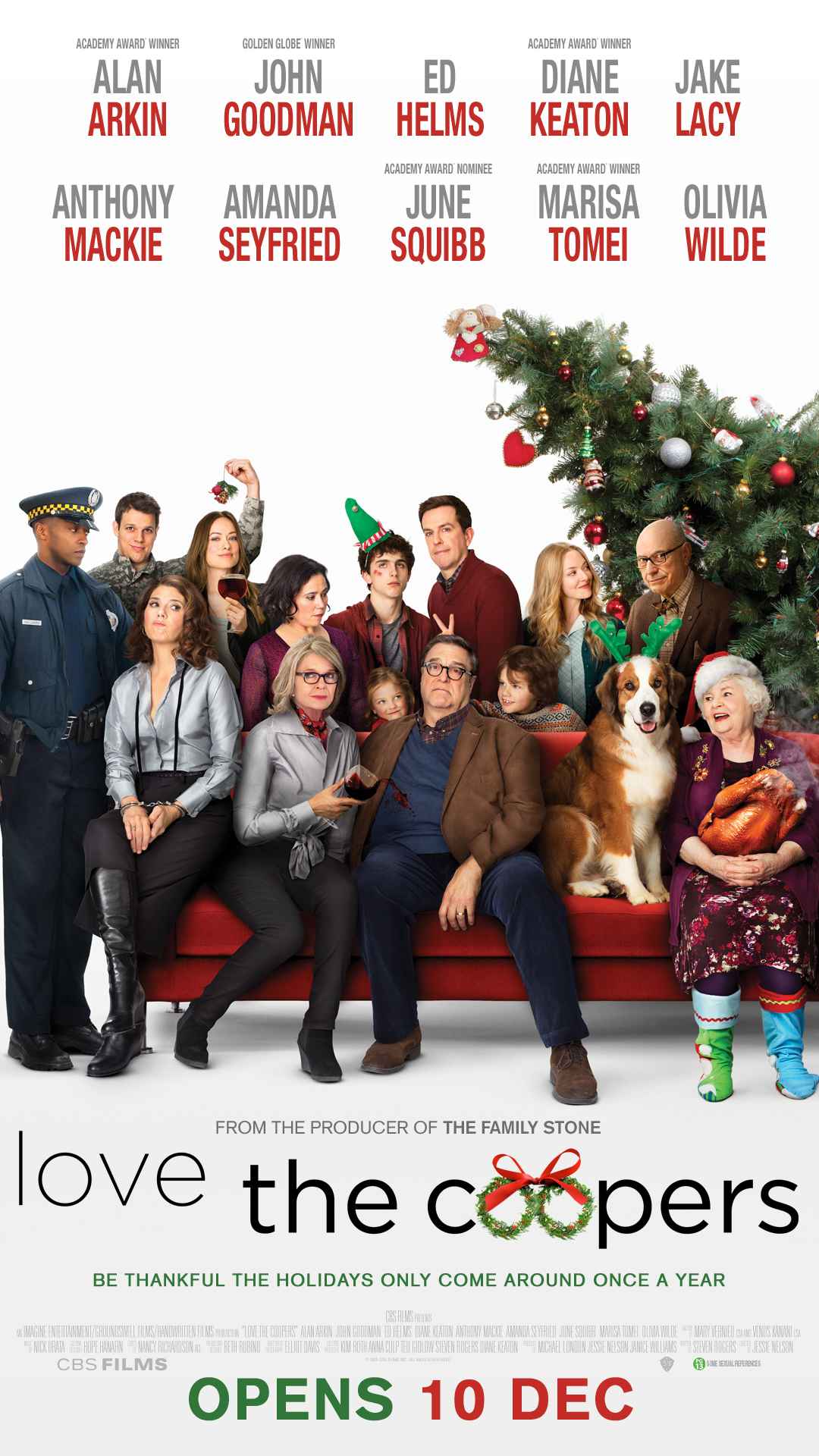
Love the Coopers

Genre: Comedy, Drama

Director: Jessie Nelson

Screenplay: Steven Rogers

Cast: Alan Arkin, John Goodman, Ed Helms, Diane Keaton, Anthony Mackie, Amanda Seyfried, June Squibb, Marisa Tomei, Olivia Wilde, Alex Borstein, Jake Lacy, Steve Martin (voice)

Running Length: 107 minutes

Synopsis: Love the Coopers follows the Cooper clan as four generations of extended family come together for their annual Christmas Eve celebration. As the evening unfolds, a series of unexpected visitors and unlikely events turn the night upside down, leading them all toward a surprising rediscovery of family bonds and the spirit of the holiday.

Review: It seems almost like there is one such movie every year – a family reunion dramedy during the festive season – but Love the Coopers is a wholly unremarkable addition to this sub-genre that works only on the most superficial level. And despite the title of the movie, there is very little reason to love the Coopers (or the movie).

One of the biggest problems with Love the Coopers is that the screenplay simply isn’t up to par. The characters are shallowly fleshed out, and most of them remain two-dimensional despite being played by a group of rather talented actors. Most of them are not given much to do, as there are obviously too many characters with too many plot lines that cannot be satisfactorily resolved in the film’s under-two-hour running time. It doesn’t help that some of these subplots are rather confusing (none more so than the interactions between Arkin’s Bucky and Seyfried’s Ruby, which seemed to suggest one thing but ended up being something else altogether).

There are also problems with the believability of some of the characters themselves – Anthony Mackie’s police officer Williams inexplicably opens up to Marisa Tomei’s Emma in a car ride, but I found myself hard-pressed to believe that a man that is apparently super-repressed would reveal his sexual orientation and troubled childhood to a near-complete stranger. Many of the inter-character conflicts either feel like a non-event or come across as being completely artificial, which further detracts from the cinematic experience.

That the whole film culminates in a hospital scene that shamelessly tries to tug at the heartstrings is perhaps to be expected, but given such a low emotional investment in the characters, the denouement rings as hollow as the rest of the film. Love the Coopers is watchable solely because of the collective charisma of the ensemble cast (even the voice of the family dog, who plays narrator, is voiced by Steve Martin), and even then barely passes muster.

Rating: * ½ (out of four stars)


Standard

The Good Dinosaur

Genre: Animation

Director: Peter Sohn

Screenplay: Meg LeFauve

Voice Cast: Jeffrey Wright, Frances McDormand, Maleah Padilla, Ryan Teeple, Jack McGraw, Marcus Scribner, Raymond Ochoa, Jack Bright, Peter Sohn, Steve Zahn, Mandy Freund, Steven Clay Hunter, A.J. Buckley, Anna Paquin, Sam Elliott, Dave Boat, Carrie Paff, Calum Mackenzie Grant, John Ratzenberger

Running Length: 101 minutes

Synopsis: The Good Dinosaur asks the question: What if the asteroid that forever changed life on Earth missed the planet completely and giant dinosaurs never became extinct? Pixar Animation Studios takes you on an epic journey into the world of dinosaurs where an Apatosaurus named Arlo (voice of Raymond Ochoa) makes an unlikely human friend called Spot. While traveling through a harsh and mysterious landscape, Arlo learns the power of confronting his fears and discovers what he is truly capable of.

Review: The Good Dinosaur revolves around one central “what if?” – what if the asteroid that wiped out the dinosaurs never hit Earth, and dinosaurs managed to survive for millions of years more? Although an interesting proposition, the story on show in The Good Dinosaur is extremely simplistic, and even in the hands of Pixar, the film very nearly feels like it’s a little too sparse in the plot department. Fortunately, it is Pixar after all, and the studio still manages to turn the film into a somewhat absorbing hour and a half, filled with cute critters, interesting vignettes and some of the best environmental animation I have ever seen in an animated film.

Although the setting is a bit off-kilter, the story of The Good Dinosaur develops in a very classic Disney style. After a rather predictable tragedy befalls Arlo’s family, Arlo gets (again, predictably) separated from his family and has to fend for himself – until he meets Spot. Yes, the reptile has a human pet, and this is just the beginning of a plethora of rather odd situations that film thrusts its viewers into. An extended sequence sees Arlo interacting with a family of T-Rex “cowboys”, and in one of the strangest sequences ever in a Pixar film, Arlo and Spot consume some hallucinogenic fruit and end up getting high on them. There’s a very good reason why the Good Dinosaur is rated PG, and parents of very young viewers may find this film to be somewhat unsuitable for their consumption.

Look past this general weirdness, and there are some gems to be found in the film. It’s filled with cute critters (and a number of rather disturbing ones) and there are sequences which are very fun to watch while not adding much to the main plotline. And to Pixar’s credit, they managed to include one extremely well executed sentimental scene where Arlo and Spot communicate their family history to each other with minimal dialogue. And whilst Arlo isn’t the most memorable central character in a Pixar film, the environmental animation certainly is. It’s incredible what Pixar managed to achieve here, with photorealistic environments that seem so lifelike I had to question if what I was seeing onscreen was culled from a nature documentary, and not digitally rendered 1s and 0s.

Despite all the visual splendor and a generally enjoyable viewing experience, it is undeniable that The Good Dinosaur firmly seats itself in the second-tier section of Pixar’s studio output. To have to follow an excellent film like Inside Out isn’t an easy thing to begin with, and the unyielding quirkiness of the storyline does the film no favours either.

Rating: * * * (out of four stars)

Standard