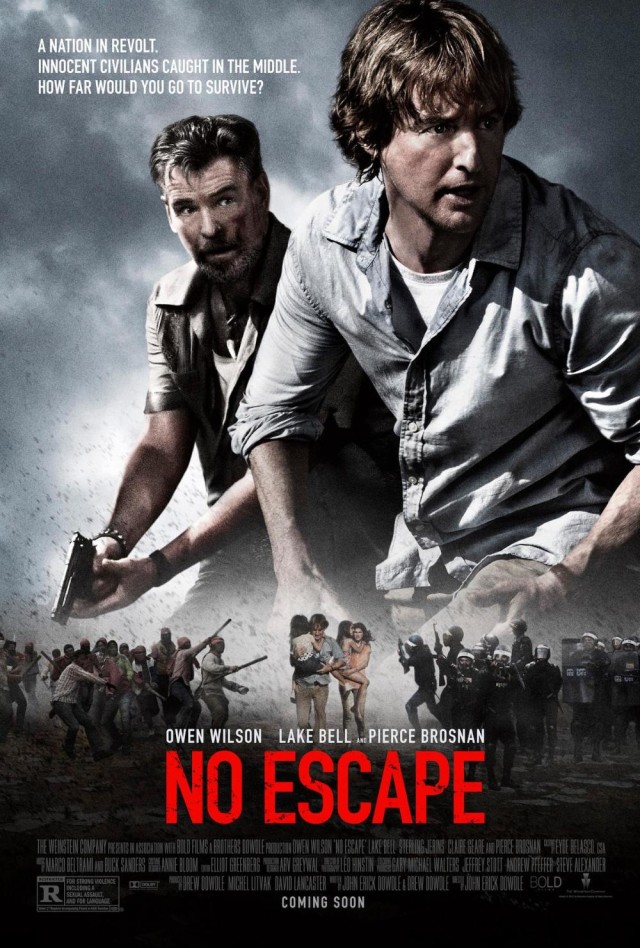
No Escape

Genre: Action, Drama

Director: John Erick Dowdle

Screenplay: John Erick Dowdle, Drew Dowdle

Cast: Owen Wilson, Lake Bell, Pierce Brosnan, Sterling Jerins, Claire Geare

Running Length: 106 minutes

Synopsis: No Escape centres on an American businessman (Owen Wilson) as he and his family settle into their new home in Southeast Asia. Suddenly finding themselves in the middle of a violent political uprising, they must frantically look for a safe escape as rebels mercilessly attack the city.

Review: One of my pet movie peeves is when any director chooses to use the shakycam effect to convey a “visceral” sense of action – apart from the found footage genre, there’s really no need to put viewers through a discomfiting viewing experience. No Escape is the latest in a long, long line of movies that abuses the shakycam effect, and it really managed to mar the cinematic experience of an already rather mediocre film. There’s also the issue that the entire film drips of a rather unkind xenophobia, undoubtedly amplified by the fact that Asian viewers like myself don’t seem be one of the target demographics that the Dowdle brothers are aiming for.

Set in an resolutely unnamed Southeast Asian country (and the subject of a real-life controversy, as Khmer lettering was used upside down on the police shields in the film, leading to outrage and a ban in Cambodia), No Escape does deliver some thrills along the way, but requires the audience to not think about the plot at all, as it is riddled with holes and necessitates the cast members to behave in the most reckless way possible, putting themselves into peril so as to advance the plot. Both the rebels (namely one murderous mob, with the leader sporting a prominent facial scar, because that’s probably the only way the directors felt “the Asians” could be identified) and the resistance (namely Pierce Brosnan and his local sidekick) seem to show up with alarming precision and frequency. It’s amazing how a nationwide coup could be reduced to such a simplistic face-off.

Although the country is unnamed, there are some really ridiculous conventions that John Erick Dowdle stoops to, reducing the locals to nothing more than seemingly irrational, bloodthirsty murderers and rapists. There’s even a scene where the protagonists are scuttling through a den of vice, which includes young prostitutes and (I kid you not) what appears to be an opium den. It’s seriously mind boggling how Dowdle’s perception of Southeast Asia seems stuck at the turn of the 20th Century, instead of being more rooted in current-day sensibilities and realities. As a Southeast Asian viewer, I am honestly quite insulted by such a portrayal.

Put aside all the social commentary and the filming techniques, and we are indeed left with a half-decent movie, with a good number of taut set-pieces, especially in the first few reels of the film. Both Owen Wilson and Lake Bell put in relatively strong performances despite playing against type, though Pierce Brosnan seems to be in this one solely for the paycheck (to be fair, his screen time is fairly limited). No Escape does become increasingly unraveled along the way, culminating in a really ridiculous, anti-climactic denouement that fails to make much sense. However, in all likelihood, the audience would have ceased to care about the movie by then, and are simply looking to escape the cinema once the credits roll.

Rating: * ½ (out of four stars)
Standard

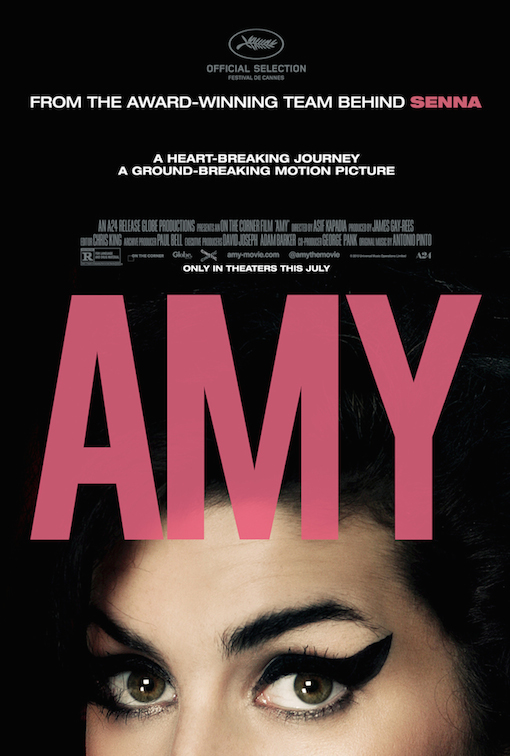
Amy

Genre: Documentary

Director: Asif Kapadia

Running Length: 128 minutes

Synopsis: Amy tells the incredible story of six-time Grammy-winner Amy Winehouse – in her own words. Featuring extensive unseen archive footage and previously unheard tracks, this strikingly modern, moving and vital film shines a light on the world we live in, in a way that very few can.

Review: Just like Asif Kapadia’s previous documentary Senna, you don’t need to be a fan of Amy Winehouse to appreciate the documentary Amy. It is a quietly devastating meditation on her stratospheric rise to fame and how she rapidly came undone, succumbing at the age of 27 to the cumulative effect of drugs, alcohol and bulimia. It’s not a story that’s unique to Amy (other “27 Club” members include Janis Joplin, Jimi Hendrix, Kurt Cobain, and Jim Morrison), but the fact that she belongs to a generation that has diligently self-documented their lives, and in an era where celebrities’ lives are under constant scrutiny, gives rise to a richness of material that Asif uses to great effect.

Asif continues to employ the technique that he used in Senna, where instead of talking head interviews and re-enactments, most of the interviews that he conducts are audio-only, and serve as voiceovers to a wealth of images and videos (many taken by Amy Winehouse or those close to her), performance footage and news footage. It is often raw, pixelated video that is queasily jerky (think Blair Witch Project or Cloverfield shakycam – those who are prone to motion sickness may be better advised to watch this on the small screen), but because the material is so personal, gives a deep, nuanced glimpse into the most intimate moments of Amy Winehouse’s short life.

It’s also interesting to see how much access Asif managed to obtain for this documentary – not only was he able to get notes and videos created by Amy Winehouse herself (and for fans, some previously unseen performance footage as well), he was also able to interview almost all the key people in Amy’s life, including her childhood friends Juliette Ashby and Lauren Gilbert, her first manager and friend Nick Shymansky, and more importantly, her ex-husband Blake Fielder-Civil and her father Mitch Winehouse. Although Asif generally presents the material (expertly edited by without comment, it’s clear to see that Blake and Mitch were the two most destructive influences in Amy’s life. Mitch has particularly been vocal about how the documentary had twisted his relationship with Amy, but the dispassionate way the material is presented makes it hard to reach any other conclusion.

The last one-third of Amy is especially difficult to watch, as the audience literally witnesses Amy waste away, as well as get a glimpse of what a media and paparazzi feeding frenzy resembles. Yet it’s also tempered with one of the most poignant scenes in the film, of a star-struck Amy recording a duet with one of her idols, Tony Bennett, just a few months prior to her death. Despite a shaky start, she eventually manages to record an excellent rendition of “Body and Soul” that reminds the audience yet once again that she was an incandescent talent whose light burned out way too early. Particularly memorable is a line from Bennett himself that “life will teach you how to live it, if you live long enough”. Unfortunately, Amy Winehouse had no such luxury.

Rating: * * * ½ (out of four stars)

Standard

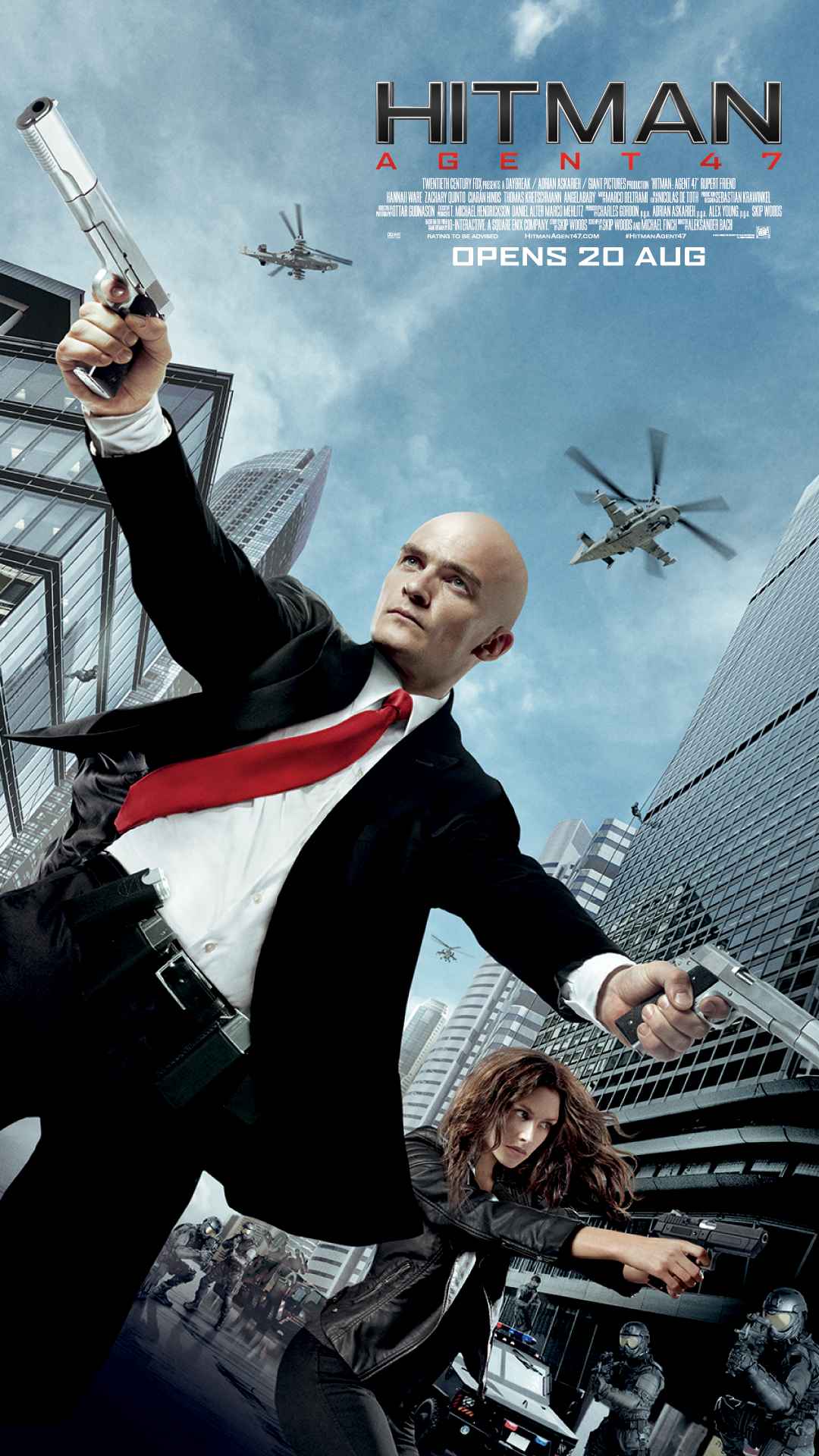
Hitman: Agent 47

Genre: Action

Director: Aleksander Bach

Screenplay: Skip Woods, Michael Finch

Cast: Rupert Friend, Hannah Ware, Zachary Quinto, Ciaran Hinds, Thomas Kretschmann, Angelababy

Running Length: 96 minutes

Synopsis: Hitman: Agent 47 centers on an elite assassin who was genetically engineered from conception to be the perfect killing machine, and is known only by the last two digits on the barcode tattooed on the back of his neck. He is the culmination of decades of research – and forty-six earlier Agent clones – endowing him with unprecedented strength, speed, stamina and intelligence. His latest target is a mega-corporation that plans to unlock the secret of Agent 47’s past to create an army of killers whose powers surpass even his own. Teaming up with a young woman who may hold the secret to overcoming their powerful and clandestine enemies, 47 confronts stunning revelations about his own origins and squares off in an epic battle with his deadliest foe.

Review: Video game to movie adaptations have generally not gone well, and for the Hitman videogame, there was even a poorly-received precedent set in 2007. Flash forward almost a decade later, and it’s time for yet another movie franchise to be rebooted. Agent 47 is likely to elicit a higher interest level locally, simply because parts of the movie were shot on location in Singapore, and let’s face it – there is always a little bit of a cheap thrill when you see familiar landmarks on the big screen, especially in an international blockbuster.

This is not a film that will please fans of the Hitman videogames, simply because it chooses to forgo the stealth element that was an essential component to the videogames. More often than not Agent 47 feels more like a younger, supercharged John McClane, coming out with guns blazing and blowing brains out along the way, and earning the film its NC-16 rating. As an action film, it is a rather generic one, though with a number of pretty decent action set-pieces that serve to move the film along nicely. The CG, unfortunately, is quite unimpressive, though Bach seems to try to mitigate this by employing a copious amount of quick cuts during most of the action scenes.

Apart from the lack of a coherent plot, one of the most glaring faults of Hitman: Agent 47 is how blatant the product placements are. It is clear that Audi must have spent a pretty penny for all the exposure in the film, but even the Singapore portions of the film resemble a promotional video rather than being vital to the film. Was there a need to show Hannah Ware swimming in the (an admittedly gorgeous) infinity pool of a five-star hotel, or to arrange a meeting at (again, admittedly gorgeous) Gardens by the Bay if it was intended to be a clandestine one? More disappointingly, for a film that must have been substantially bankrolled by Singapore, there seems to be only one discernable local actress involved in the film, and even then only as an extra in a very short sequence.

While Rupert Friend makes for a rather effective Agent 47 (this was a role that apparently was intended for Paul Walker before his death), the rest of the cast is bland and forgettable, and Zachary Quinto and Ciaran Hinds in particular feel criminally underused. Although the end credits sequence sets the stage for a potential sequel, it’s hard to imagine this film garnering enough interest or box office for the studios to consider a follow-up.

Rating: * * (out of four stars)

Standard

Pixels

Genre: Comedy

Director: Christopher Columbus

Screenplay: Tim Herlihy, Timothy Dowling

Cast: Adam Sandler, Kevin James, Michelle Monaghan, Peter Dinklage, Josh Gad, Brian Cox, Sean Bean

Running Length: 105 minutes

Synopsis: As kids in the 1980s, Sam Brenner (Adam Sandler), Will Cooper (Kevin James), Ludlow Lamonsoff (Josh Gad), and Eddie “The Fire Blaster” Plant (Peter Dinklage) saved the world thousands of times – at 25 cents a game in the video arcades. Now, they’re going to have to do it for real. In Pixels, when intergalactic aliens discover video feeds of classic arcade games and misinterpret them as a declaration of war, they attack the Earth, using the video games as the models for their assaults – and now-U.S. President Cooper must call on his old-school arcade friends to save the world from being destroyed by PAC-MAN, Donkey Kong, Galaga, Centipede, and Space Invaders. Joining them is Lt. Col. Violet Van Patten (Michelle Monaghan), a specialist supplying the arcaders with unique weapons to fight the aliens.

Review: The only reason that Pixels gets a passing grade from me is because of the nostalgia it taps into – after all, the 80s video games that the film so relentlessly references formed part of my childhood. Thus, in spite of the paper-thin, messy plot and the lack of any quality acting, I must admit that there were parts of Pixels that I enjoyed. However, the same probably can’t be said of the majority of the moviegoers that would attempt to watch this film.

The premise that aliens chose to attack Earth because of arcade game footage found in an interstellar time capsule is a thin one, and the seams constantly show in Pixels. Stretching out a two-minute short film (that the story is based on) into an almost two-hour movie is ill-advised in this case, and the absolute paucity of plot means the show wears out its welcome very quickly. There’s absolutely no effort to give any background to the attacking aliens, which makes much of the proceedings rather meaningless, carrying no dramatic weight at all. The aliens may be threatening the total annihilation of Earth, but it never feels like anything is at stake.

While Adam Sandler has honed his portrayal of the sullen man-child to perfection over a good number of films, the rest of the casting leaves much to be desired. Josh Gad is unendingly grating and annoying, while Peter Dinklage doesn’t make much of an impression apart from the weird accent he chose to adopt for his role. Michelle Monaghan is given the totally thankless role of playing Sandler’s love interest, and the absolute lack of chemistry between the duo makes the romantic sequences truly cringe-worthy to sit through.

Fortunately, the visual effects are decent enough, especially during the live-action videogame battles. For viewers that grew up in the 80s, it will be fun to look out for videogame icons like Donkey Kong, Mario, Q*Bert, Frogger, Paperboy and more. However, Wreck-It Ralph has already done a much better job back in 2012 integrating these into a movie, and boasts a far stronger plot, despite being an animated film. There’s really only that much nostalgic good-will that one can tap into, and even for myself I was scraping the bottom of the barrel barely halfway through the movie.

Rating: * * (out of four stars)

Standard

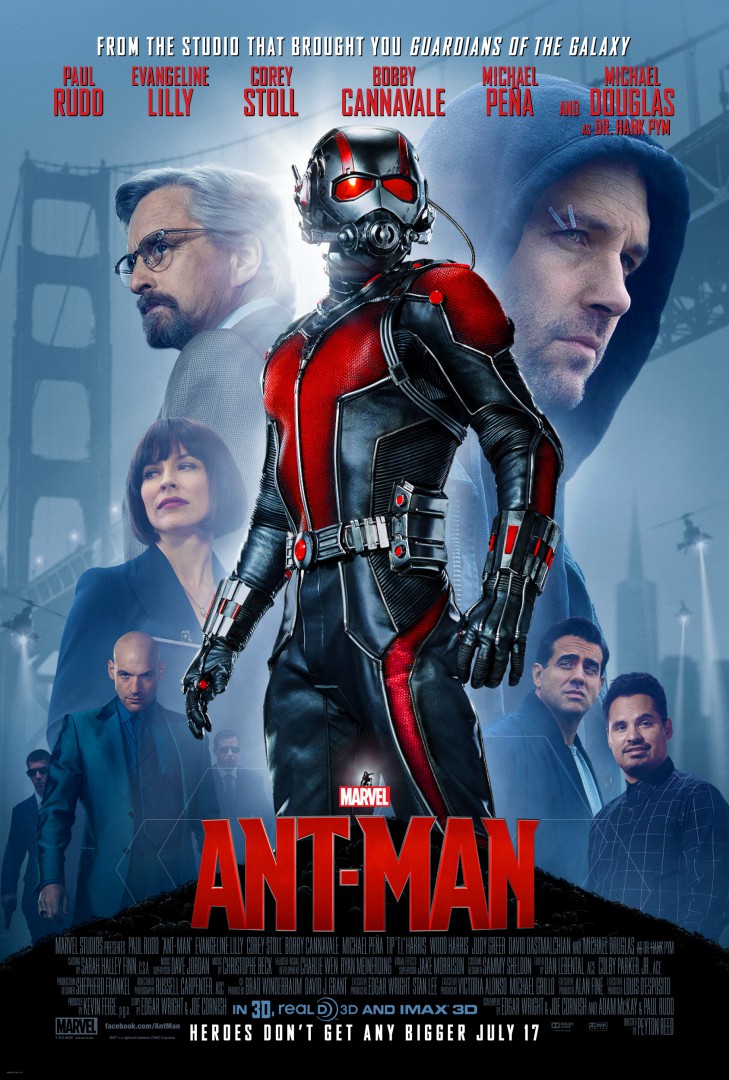
Ant-Man

Genre: Action

Director: Peyton Reed

Screenplay: Edgar Wright, Joe Cornish, Adam McKay, Paul Rudd

Cast: Paul Rudd, Evangeline Lilly, Corey Stoll, Bobby Cannavale, Michael Pena, Tip “T.I.” Harris, Wood Harris, Judy Greer, David Dastmalchian, Michael Douglas, Abby Ryder Fortson, Martin Donovan

Running Length:  117 minutes

Synopsis: Armed with a super-suit with the astonishing ability to shrink in scale but increase in strength, con-man Scott Lang (Paul Rudd) must embrace his inner hero and help his mentor, Dr. Hank Pym (Michael Douglas), plan and pull off a heist that will save the world.

Review: It may seem strange that Marvel has chosen Ant-Man as the film to close out Phase 2 of the Marvel Cinematic Universe, since he is definitely one of the smaller (in every sense of that word) heroes in the Marvel canon. However, if Guardians of the Galaxy is any indication, just because the character isn’t well-known doesn’t mean it won’t be a well-received film. And in this case, although Ant-Man doesn’t quite reach the heights of Guardians, it is very entertaining and as an origins film, sets the stage for yet another franchise opportunity for Marvel (although Ant-Man will already return in next year’s Captain America: Civil War).

There is this sense throughout the film that this is not considered a marquee Marvel property, and it shows in the anything-goes spirit that embodies the bulk of the movie. Even the trials and tribulations faced by the cast feel more personal than usual – there’s only the merest hint of a global crisis, and more often than not it is familial conflicts that propel the plot forward.

The amount of sight gags and humorous asides are second only to Guardians of the Galaxy, and it will be near impossible to not feel entertained by the film. Paul Rudd is an extremely amicable central protagonist, and his immense likeability, much like Chris Pratt’s Starlord, is one of the biggest reasons why Ant-Man works. Of the supporting cast, Evangeline Lilly once again takes on a strong female role as Hank Pym’s daughter Hope (though she isn’t given enough to do), but no one is as memorable as Michael Pena, and two excellent montages in which other characters “lip-sync” to his motor-mouth narration feel particularly inspired.

While audiences of any Marvel superhero movie would naturally expect a good number of action sequences, these scenes in Ant-Man aren’t particularly memorable, with a fair number of scenes that seem to exist simply to up the action to drama ratio. What does manage to impress is how effectively Reed manages to convey the differences in point of view between the human-sized and ant-sized Ant-Man – the sequence where Scott first uses the suit, where he literally falls through a number of “universes” is both fun and unique. There is, again, a lot of humour employed in these scenes, none more clearly so than during a climactic showdown on a Thomas the Train Engine toy track. Oddly, there does seem to be a higher-than-normal amount of product placement in Ant-Man, and though some of it is quite obvious, it never becomes excessive or too glaring.

Expectations may have been low for Ant-Man, the film has more than exceeded them, and quite easily ranks as one of the best films in Phase 2 of the MCU. It is also one of the most kid-friendly Marvel movies to date, an endearing smaller-scale film that is sure to be a crowd-pleaser and generate positive word of mouth.

P.S. Remember to stay throughout the end credits to catch two coda sequences, one mid-credits and one at the very end.

Rating: * * * ½ (out of four stars)

Standard

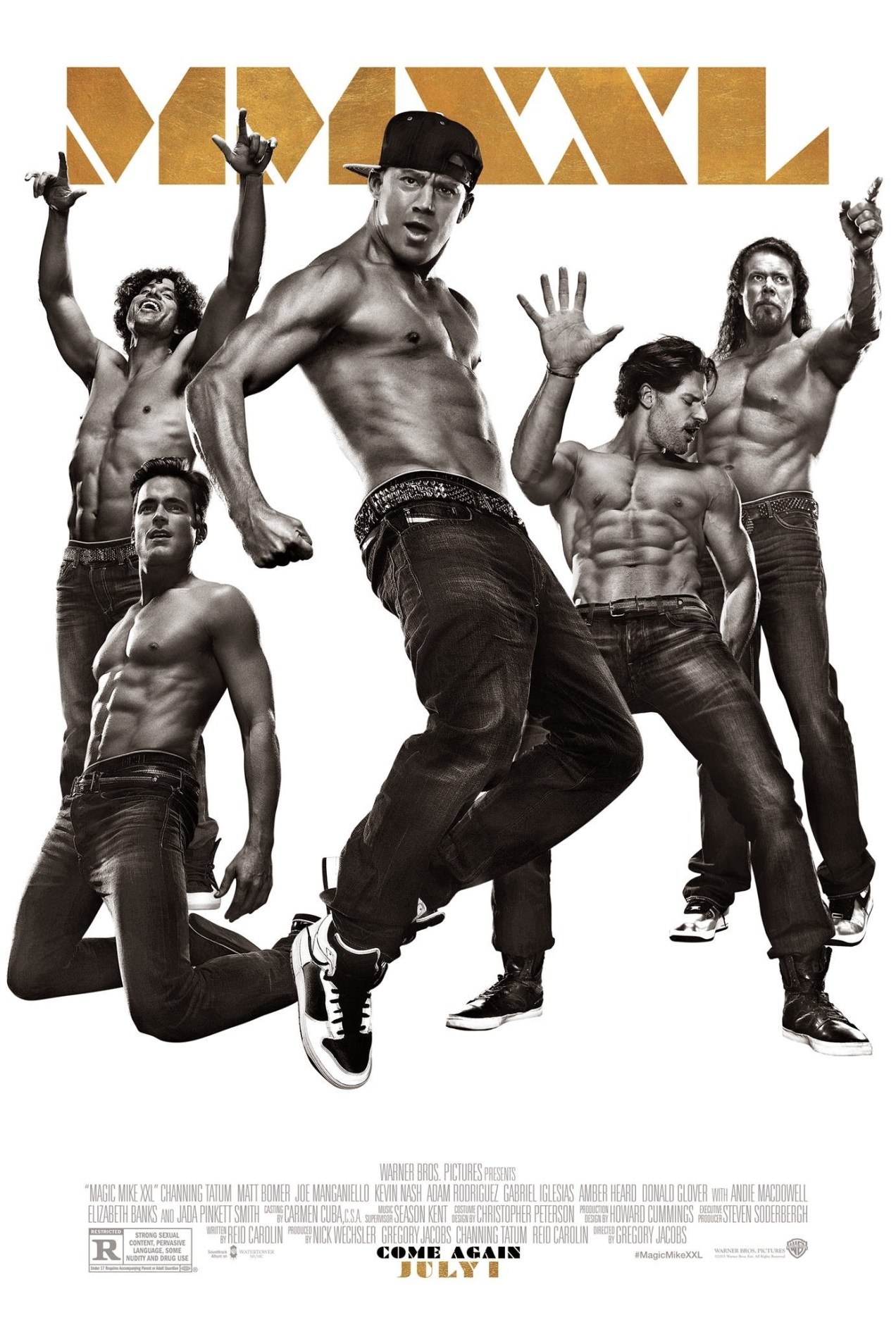
Magic Mike XXL

Genre: Drama

Director: Gregory Jacobs

Screenplay: Channing Tatum, Reid Carolyn

Cast: Channing Tatum, Matt Bomer, Joe Manganiello, Kevin Nash, Adam Rodriguez, Gabriel Iglesias, Amber Heard, Jada Pinkett Smith

Running Length:  115 minutes

Synopsis: Picking up the story three years after Mike (Channing Tatum) bowed out of the stripper life at the top of his game, Magic Mike XXL finds the remaining Kings of Tampa likewise ready to throw in the towel. But they want to do it their way: burning down the house in one last blow-out performance in Myrtle Beach, and with legendary headliner Magic Mike sharing the spotlight with them. On the road to their final show, with whistle stops in Jacksonville and Savannah to renew old acquaintances and make new friends, Mike and the guys learn some new moves and shake off the past in surprising ways.

Review: While Magic Mike was one of the bigger surprises in 2012 – although it’s about male strippers, in the end it was the power of storytelling that held the movie together, and not the strip acts – Magic Mike XXL is much less of a surprise. It’s essentially a road trip movie involving a bunch of old friends, except that they are “male entertainers” who get their kits off quite a number of times along the way. One thing that’s for sure – if you enjoyed the acts in the first Magic Mike, this aspect has been truly upsized (the movie title is not a lie) and more than earns the film its M18 rating, which probably isn’t a bad thing for the intended audiences.

There’s no real reason for this sequel to exist, and it clearly shows in the paper-thin plot that the film hangs onto. No matter, since the majority of audiences would have other things on their mind anyway. Yet, there’s a certain charm to the laid-back, almost impromptu style of storytelling that Magic Mike XXL has chosen to employ, which is in contrast to how Soderbergh chose to present the original Magic Mike. The film is also genuinely funny – there are little moments along the way that ensures a belly laugh or two, none more so than the hilarious gas station sequence where Richie (Joe Manganiello) tries to make the attendant smile.

What’s more interesting is that Magic Mike XXL is obtusely a girl-power movie: although the main cast is dripping with testosterone, the positions of power in the film are almost exclusively female – Jada Pinkett Smith as the steely yet sultry strip club owner cum (ahem) emcee, Andie McDowell’s cameo as an aging but rich Southern belle, Elizabeth Banks as the owner of the male stripper “convention”, and even all the women that are busy throwing money at the strippers. This is a movie made for the ladies (sorry guys – both straight and gay, although more the former than the latter), make no mistake about that.

And of course there’s the strip acts – lensed and edited impeccably by Soderbergh himself (under his Peter Andrews pseudonym) and choreographed flawlessly, the scenes in Domina and the finale really showcase what would imaginably be the top tier of male strip acts in the real world. Rarely has a movie been able to convey the steaminess of such acts without coming across as being sleazy, and while there are times where the movie toes the line, it will successfully leave many audiences feeling hot and bothered. And how can anyone actively hate on a film that can evoke such a visceral response?

Rating: * * * (out of four stars)

Standard

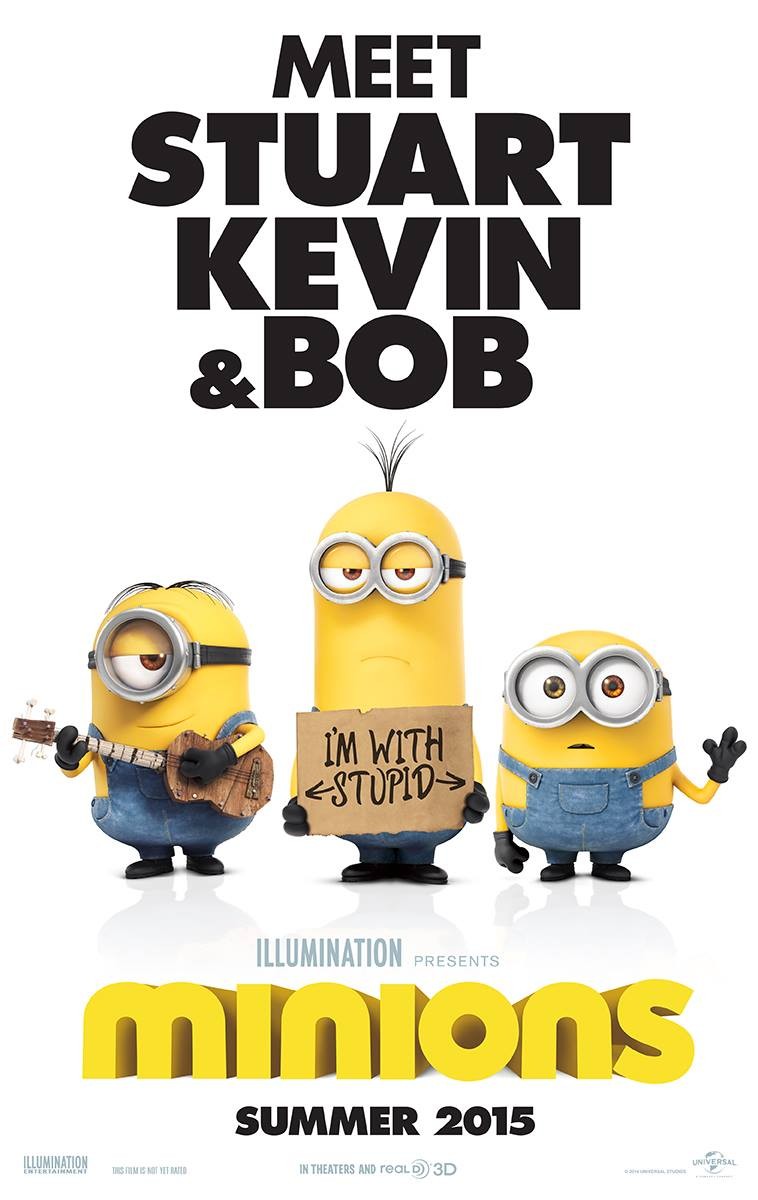
Minions

Genre: Animation

DirectorS: Pierre Coffin, Kyle Balda

Screenplay: Brian Lynch

Voice Cast: Sandra Bullock, Jon Hamm, Pierre Coffin, Michael Keaton, Alison Janney, Steve Coogan, Geoffrey Rush

Running Length: 91 minutes

Synopsis: Minions Stuart, Kevin and Bob (Pierre Coffin) are recruited by Scarlet Overkill (Sandra Bullock), a super-villain who, alongside her inventor husband Herb (Jon Hamm), hatches a plot to take over the world.

Review: With the widespread (and totally understandable) popularity of the Minions, it was only a matter of time before they broke away from the Despicable Me franchise and became a standalone film. And make no mistake, this movie is catered specifically for Minions fans, which means it will do well enough at the box office, but is unlikely to win over any moviegoer who isn’t already enamoured with the yellow creatures.

The best part of the movie is the first half hour, in which we see the Minions serving various “bad guys” from prehistoric times until they go into a self-imposed exile after a disastrous stint with Napoleon. Although most of the sight gags have already been featured in the film’s trailer, but the inventiveness of the various skits still proves humorous despite having been revealed beforehand.

However, the rambling plot starts to unravel once the film moves into the 60s, where the trio of Minions Stuart, Kevin and Bob (all voiced by director Pierre Coffin) behave almost like the Three Stooges, trying their best to please their new master Scarlet Overkill (Sandra Bullock in a very uninspiring, blasé vocal performance). Though it can be quite entertaining to watch their antics, the entire last hour of the film feels like a string of loosely connected skits rather than a coherent whole, and the eventual denouement feels almost like writer Brian Lynch was high on hallucinatory drugs.

Unlike Despicable Me and its sequel which had a bit of heart, this prequel completely lacks any brains or heart, and is enjoyable solely on a very superficial level. The film is bright and colourful and will certainly appeal to the key audience group of under-10s, and the 60s setting does inject a good number of musical numbers that would add some appeal to adult viewers. While it isn’t a bad movie in any way, there’s nothing really good about it either, and is instantly forgettable once the credits roll (do keep your 3D glasses on during the entire credits sequence to make it really worth the additional 3D price of entry).

Rating: * * ½ (out of four stars)

Standard

Jurassic World

Genre: Action/Sci-Fi

Director: Colin Trevorrow

Screenplay: Rick Jaffa, Amanda Silver, Derek Connolly, Colin Trevorrow, based on the novels by Michael Crichton

Cast: Chris Pratt, Bryce Dallas Howard, Vincent D’Onofrio, Nick Robinson, Ty Simpkins, B.D. Wong, Irrfan Khan, Omar Sy

Running Length: 123 minutes

Synopsis: Located off the coast of Costa Rica, the Jurassic World luxury resort provides a habitat for an array of genetically engineered dinosaurs, including the vicious and intelligent Indominus Rex. When the massive creature escapes, it sets off a chain reaction that causes the other dinosaurs to run amok. Now, it’s up to a former military man and animal expert (Chris Pratt) to use his special skills to save two young boys and the rest of the guests from an all-out, prehistoric assault.

Review: It has been a long time since the Jurassic Park franchise has seen the big screen, with the last (rather dismal) movie, Jurassic Park III released in 2001. Stuck in development hell for over a decade, Jurassic World represents a somewhat triumphant return for the franchise, though it would be hard to imagine there being enough interest for a fifth installment. Jurassic World boasts excellent visuals, and strong performances from leads Chris Pratt and Bryce Dallas Howard, but is a little let down near the end when the CG takes over the movie, like so many films these days are wont to do.

The 22-year old Jurassic Park was one of the first movies to make use of the then cutting-edge computer generated imagery, and the awe and wonder of seeing dinosaurs come to “life” can never be replicated in present times. The CGI in Jurassic World is miles ahead of the original film, but that’s honestly a given these days when technology has advanced so far. But, probably akin to the jaded amusement park attendees that populate Jurassic World, it doesn’t stir the soul like that Brachiosaurus reveal in the first film. Perhaps that’s the power of nostalgia speaking, but Jurassic World also falls to the uniquely present-day trap of letting the CGI do the acting – without going into spoilers, the finale sequence feels entirely (and probably is) artificial, and hence it was difficult to vest myself in the outcome in any way.

Although it works as a standalone film, Jurassic World assumes prior knowledge of the Jurassic Park films, never really delving into the backstory of the theme park. There are also a multitude of references to the first movie, which will particularly resonate with fans of Jurassic Park (aren’t we all, though). Michael Giacchino, who takes over the scoring of the movie from John Williams, does not shy away from the well-known musical cues from Jurassic Park either, although his score can feel a bit too bombastic at times. While it would be good to see Jurassic Park on as large a screen as possible to take in the majesty of the imagery, 3D is once again absolutely pointless and should be avoided.

Chris Pratt has really stepped up his Hollywood leading man game, and in Jurassic Park he channels his performance in Guardians of the Galaxy – funny and macho at the same time, he’s instantly likeable as Owen. Bryce Dallas Howard has the slightly more uphill task, since she needs to play both the “modern” action heroine and the “traditional” damsel in distress, and the duality does not work very well at times. She does share great onscreen chemistry with Pratt, which makes much of their interaction pleasant to watch. However, the Jurassic Park franchise has never been about the human actors, and relies more on its dinosaur counterparts. In this aspect the movie is not as successful. Although the Indominus Rex is positioned as a bad-ass dinosaur that’s even more dangerous than a T-Rex, she doesn’t really feel all that menacing onscreen. The velociraptors also make a return, but once again they come across as rather tame and certainly not as intelligent as the old raptors seemed to be.

No movie in the franchise will ever compare to the original, but it’s easy to place Jurassic World as the second-best film thus far. I am firmly of the opinion, however, that this should mark the end of the franchise – there’s no room in the franchise for any additional plot development, and any sequel after this one will be flogging a dead horse. I won’t put it past the studio executives to greenlight more films, especially if Jurassic World does well, but if this is indeed the swan song, it will conclude the franchise on a relatively high note.

Rating: * * * (out of four stars)

Standard

Good Kill

Genre: Drama

Director: Andrew Niccol

Screenplay: Andrew Niccol

Cast: Ethan Hawke, Bruce Greenwood, Zoe Kravitz, January Jones

Running Length: 102 minutes

Synopsis: In the shadowy world of drone warfare, combat unfolds like a video game – only with real lives at stake. After six tours of duty, Air Force pilot Tom Egan (Ethan Hawke) yearns to get back into the cockpit of a real plane, but he now fights the Taliban from an air-conditioned box in the Las Vegas desert. When he and his crew start taking orders directly from the CIA, and the stakes are raised, Egan’s nerves – and his relationship with his wife (January Jones) – begin to unravel. Revealing the psychological toll drone pilots endure as they are forced to witness the aftermath of their fight against insurgents, Andrew Niccol directs this riveting insider’s view of 21st-century warfare, in which operatives target enemies from half a world away.

Review: What happens when war can be conducted remotely, when obliterating human lives is reduced to an operator using a joystick thousands of miles away, and reviewing the carnage on a monitor? Does this reduce the emotional toll of war for the aggressor, and does it result in a more clinical, detached view of the casualties and collateral damage of waging a war? This is the grim scenario and tough questions that Good Kill puts forth, and is indeed one of the most relevant war movies that has been released in years. However, Andrew Niccol has directed and written the movie with a rather heavy hand, which actually lessens the impact that the movie has on audiences.

Ethan Hawke puts forth a solid, credible performance as Thomas Egan, and manages to convey a complex gamut of emotions without that many lines of dialogue. Unfortunately, the same cannot be said of his supporting cast – almost everyone is used either as a plot device or an expositional tool, and remains essentially dimensionless as characters.

Given the nature of the interactions in Good Kill, there is very little action to be had, but Niccol manages to ramp up the tension even given these confines. Although the action is viewed vicariously through a TV monitor and usually without any sound, it remains riveting and visceral, with such a high level of perceived realism that I found myself holding my breath each time the trigger is pulled. This is by far the most successful aspect of the film, and one that would likely stay with the viewer long after the credits roll.

Although it’s undeniable that Niccol has picked a very timely and relevant topic in Good Kill, his incessant soapboxing and moralizing comes across as a bit too much. It also doesn’t help that the various subplots (particularly the unnecessary romantic tension between Egan and new airman Suarez (Zoe Kravitz)).  Even the disembodied voice from Langley barking out executive commands via conference call falls prey to this, having to explain the administration’s rationale for issuing morally ambiguous kill orders at every turn. It’s a particularly clunky way of putting one’s point across, important as it may be.

Rating: * * * (out of four stars)

Standard

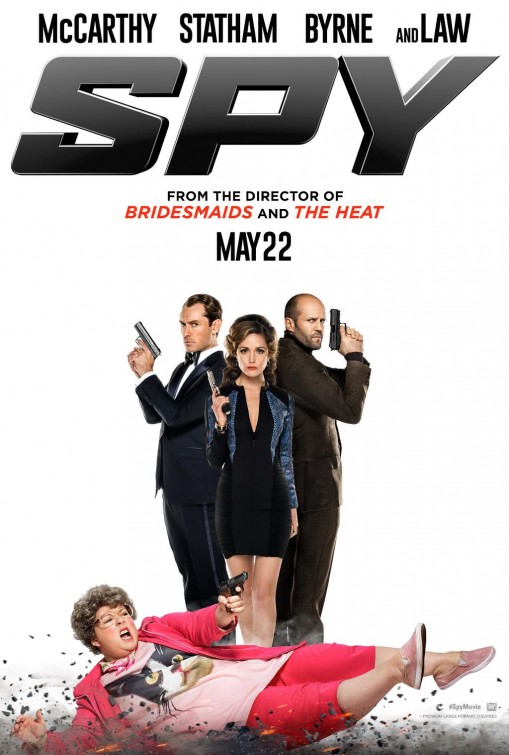
Spy

Genre: Action/Comedy

Director: Paul Feig

Screenplay: Paul Feig

Cast: Melissa McCarthy, Jason Statham, Rose Byrne, Miranda Hart, Bobby Cannavale, Allison Janney, Peter Serafinowicz, Morena Baccarin, Jude Law

Running Length: 120 minutes

Synopsis: Susan Cooper (Melissa McCarthy), a shy deskbound CIA analyst, goes on a mission to help a field agent in trouble. Employing not-so-outrageous identities and not-so-fancy spy gadgets, she attempts to infiltrate the shadowy world of an alluring but dangerous weapons dealer. She leaves a trail of mayhem crisscrossing Europe, utilizing deception and false bravado to try and outwit her quarry and locate a stolen nuke.

Review: No one has managed to make Melissa McCarthy shine like Paul Feig has (and that includes McCarthy’s husband, who directed her in the mediocre Tammy), and in Spy they have left everything else (so far) in the McCarthy canon in the dust. Spy is undeniably the best Feig-Mccarthy pairing in the three films they have worked together on (the breakout hit Bridesmaids and the equally successful The Heat), and despite it being positioned firstly as a comedy, Spy is also a totally legit espionage action film, and I foresee it scoring great success at the box office despite a pretty packed Summer roster.

The most impressive thing about Spy is how it manages to meld the comedy and action genres together so well, without diminishing either aspect. This is in large part due to the how deftly Melissa McCarthy balances between the two – her comic timing is impeccable here, but she also manages to pull off the action and physical comedy sequences with equal aplomb (though there are some scenes where a body double was quite clearly used). Not many actors can lay claim to such an achievement, and it firmly establishes McCarthy as the reigning queen of comedy with a few tricks up her sleeve.

Paul Feig’s script does the same – it’s filled with excellent zingers and visual gags, so rich in material that one can easily watch the film a second time round and find even more to belly laugh at, and yet the spy story is equally engaging, with twists and turns that would surprise even the most jaded moviegoers. All the things that make a good spy movie are present here: exotic locations, over-the-top action sequences, a doomsday device and yes, even the classic Bond-style opening sequence makes an appearance.

Both McCarthy and the script are also bolstered greatly by a uniformly excellent supporting cast, almost all playing against type (and obviously having a great time doing it). The most notable are Rose Byrne, who is fantastic as the cruel but vapid villainess with a ridiculous accent and even more ridiculous coiffure, and Jason Statham, gleefully sending up his usual tough guy routine as a British spy who is all bark and no bite. Spy is possibly the most fun that will be had this Summer season, and is an easy recommendation to make to virtually any moviegoer.

Rating: * * * ½ (out of four stars)

Standard