Rurouni Kenshin: Kyoto Inferno

Genre: Action, Drama

Director: Keishi Ohtomo

Writers: Kiyomi Fujii, Keishi Ohtomo, based on the original comic “Rurouni Kenshin” by Nobuhiro Watsuki

Cast: Takeru Satoh, Tatsuya Fujiwara, Emi Takei, Yusuke Iseya, Munetaka Aoki, Yu Aoi, Ryunosuke Kamiki, Tao Tsuchiya, Min Tanaka

Running Length: 139 minutes

Synopsis: Kenshin Himura (Takeru Satoh) is a legendary swordsman in the wars accompanying the turbulent fall of Japan’s Shogunate in the 19th century. Once feared as ‘Battosai the Killer’, he has adopted a peaceful life since the arrival of the ‘new age’ in Japanese history. But Makoto Shishio (Tatsuya Fujiwara), the ‘Shadow Killer’ who succeeded to Kenshin’s position in the service of the new government, has since then been active in the Kyoto underworld. Because he knew too much of the dark side of the new government, he was stabbed and his body set on fire. He survived, however and, wrapped in bandages, has raised an army of disaffected former samurai with the aim of overthrowing the new regime. Agreeing to a request by Toshimichi Okubo, the Home Minister, Kenshin leaves his friends in Tokyo and sets out for Kyoto. He and Shishio are a match in skill and in wits, but their aims are opposite. Kenshin seeks to preserve the nation without breaking his vow that he will kill no more.

Review: With Hollywood blockbusters crowding the cinemas, it’s little wonder that the jidaigeki (period drama) genre of Japanese cinema has become a shadow of its former self, and apart from the Rurouni Kenshin series itself, decent chanbara films have been few and far between. Kyoto Inferno is the follow up to the first Rurouni Kenshin film (in 2012), and perhaps more importantly, is part one of a two-part epic feature (Rurouni Kenshin: The Legend Ends opens in Singapore about a month later on 9 October). And much like other films that are cleaved into two, it’s perhaps a bit unfair to pass judgment on what essentially is half a movie and not on the entire body of work.

Yet, it’s also a necessity that each film should be able to stand on its own, and in a way Kyoto Inferno does succeed to a certain extent. Although the film is very slow going, Kyoto Inferno manages to establish the characters and their motives (it can get a little confusing, but prior knowledge of the Rurouni Kenshin series or the previous movie is not required), as well as set the stage for what would likely be a much more kinetic second film. This unevenness is one of the bigger problems of the film, because it is likely that there will be audiences that go into Kyoto Inferno expecting swordfights galore and not a weighty drama, even if it’s good drama for most of the film. Fortunately, the pace does pick up sporadically in a number of well choreographed action sequences. The action in Kyoto Inferno seems largely to be traditional stunt work, and CG has been kept to a minimum, a refreshing change from typical Hollywood fare these days.

Although no one is going to carry home award trophies for their acting in Kyoto Inferno, at least each actor bears a good resemblance to their manga/anime counterparts. Tatsuya Fujiwara does manage to impress as his turn as Shishio is appropriately menacing despite acting entirely behind a mask of bandages. Much emphasis is placed on the romance between Kenshin and Kaoru, this to me is the weakest link in the film, as the two actors share very little onscreen chemistry and the dalliance simply does not convince.

It seems to be a trend for filmmakers to split finales nowadays, and although in this case the wait is a fair bit shorter than usual, it is still a bugbear to me. Did this installment Rurouni Kenshin need to be played out over two full-length movies? The answer once again is no – there’s so much narrative excess in Kyoto Inferno that much of it could have been edited out in the first place with very little loss to the structure of the film. It remains to be seen if The Legend Ends would justify the two part treatment, but perhaps the better route would have been to release a single film cinematically then a director’s cut later on.

Rating: * * * (out of four stars)

Standard

The Hundred-Foot Journey

Genre: Drama

Director: Lasse Hallstrom

Writer: Steven Knight, based on the novel by Richard C. Morais

Cast: Helen Mirren, Om Puri, Manish Dayal, Charlotte Le Bon, Amit Shah, Farzana Dua Elahe, Dilton Mitra, Aria Pandya, Michel Blanc

Running Length: 122 minutes

Synopsis: Hassan Kadam (Manish Dayal) is a culinary ingénue with the gastronomic equivalent of perfect pitch. Displaced from their native India, the Kadam family, led by Papa (Om Puri), settles in the quaint village of Saint-Antonin-Noble-Val in the south of France. Filled with charm, it is both picturesque and elegant – the ideal place to settle down and open an Indian restaurant, the Maison Mumbai. That is, until the chilly chef proprietress of Le Saule Pleureur, a Michelin starred, classical French restaurant, Madame Mallory (Helen Mirren), gets wind of it. Her icy protests against the new Indian restaurant a hundred feet from her own, escalate to all out war between the two establishments – until Hassan’s passion for French haute cuisine and for Madame Mallory’s enchanting sous chef, Marguerite (Charlotte Le Bon), combine with his mysteriously delicious talent to weave magic between their two cultures and imbue Saint-Antonin with the flavors of life that even Madam Mallory cannot ignore.

Review: Not every movie needs to be groundbreaking to be entertaining, and this is totally embodied in The Hundred-Foot Journey, a derivative, by-the-numbers culture clash movie that somehow manages to be light and enjoyable despite being entirely predictable from start to end. Much of this is due to the eminent Helen Mirren, who manages to elevate the film to a higher level with her performance, despite a really exaggerated Gallic accent.

Although this is a movie about food, Lasse Hallstrom has actually kept “food porn” sequences to a minimum – of course there are still scenes of cooking, but he seems more intent on showing the various interactions amongst the leads. That’s not a bad thing, and other than Helen Mirren, who is flawless in every scene, the rest of the ensemble cast are all also capable performers, which means that these interactions are never uninteresting. Hallstrom and his director of photography Linus Sandgren also manage to capture the beauty of the little French village, resulting in many sun-bathed, postcard perfect shots of Saint-Antonin. This is also augmented by an excellent (though somewhat clichéd) score by A.R. Rahman, almost on par with his work on Slumdog Millionaire.

The Hundred-Foot Journey offers no surprises from beginning to end, and the culinary journey of Hassan goes exactly as one would expect. The film does feel a little spent by its third and final act, however, and although the intention was surely to tug at the heartstrings of the audience, this third act is the weakest link and least emotionally resonant in my opinion. Its inclusion also draws the film out to just a hair over two hours, which is arguably a little too long for its own good. Fortunately, there is enough goodwill built up from the preceding segments that it does not diminish the movie by too much, and this cinematic equivalent of comfort food will surely be a crowd pleaser for almost anyone willing to give it a try. If The Hundred-Foot Journey were a restaurant, it probably won’t earn any Michelin stars, but will still get a solid recommendation via word of mouth.

Rating: * * ½ (out of four stars)

Standard

The White Haired Witch of the Lunar Kingdom

Genre: Action, Romance, Drama

Director: Jacob Cheung

Writers: Kang Qiao, Wang Bing, Guo Jinle, Shi Heran, Zhu Yale

Cast: Fan Bingbing, Huang Xiaoming, Vincent Chao, Wang Xuebing

Running Length: 103 minutes

Synopsis: At the end of the Ming Dynasty, corruption is rife, a traitor is in power and the Jin army is threatening war. In the Northwest, famine is rife. Jade Raksha (Fan Bing Bing), a female pugilist thought of as evil throughout the empire, helps the victims of the famine by arresting and killing corrupt officials.

Meanwhile, the future successor of the Wudang Sect, Zhuo Yihang (Huang Xiaoming) is dispatched to Beijing to pay tribute to the emperor. He encounters Jade Raksha and sees that she is not the evil person she is rumored to be. Despite their differences, they begin to fall in love.

Review: Cinemagoers who are familiar with the source novel by Liang Yusheng will know that Ronny Yu’s iconic Bride with White Hair in 1993 did not do the novel any justice, and really the final product did not feel like a “proper” adaptation, more a wuxia film inspired by the novel. In this new 2014 incarnation, Jacob Cheung and his team of writers have managed to include a lot more of the novel and historical context into the film, but it is still a rather uneven effort.

The White Haired Witch of the Lunar Kingdom (what a mouthful!) runs a lean 103 minutes, but boy is it overstuffed, especially when it comes to the plot – incorporating political intrigue, a Romeo and Juliet-esque romance, a wuxia movie, and a half-baked “undercover cop” plot element in such a short amount of time is an unwise endeavour, since it just means everything is given short shrift.

The biggest problem to arise from this is that the central romance between Jade Raksha and Zhuo Yi Hang simply does not come across as being convincing, despite commendable thespian efforts from both Huang Xiaoming and Fan Bing Bing. Due to this lack of emotional heft, it is quite difficult to feel vested in either character, regardless of how hard the director tries. And tries he does, complete with an at-times overbearing score and a cheesy song segment that seems to have been transplanted intact from the early 90s wuxia films.

The film does have its merits, however, with impressive production design – the costumes (by the Oscar-winning Timmy Yip) in particular are quite well done, and the action choreography by Stephen Tung delivers, though annoyingly there are very few scenes in which the action is allowed to play out. While it may be a bit too emo and busy for its own good, The White Haired Witch of the Lunar Kingdom remains one of the better Chinese films I’ve seen this year to date, which says quite a bit about the state of the Chinese film industry these days.

Rating: * * ½ (out of four stars)

Standard

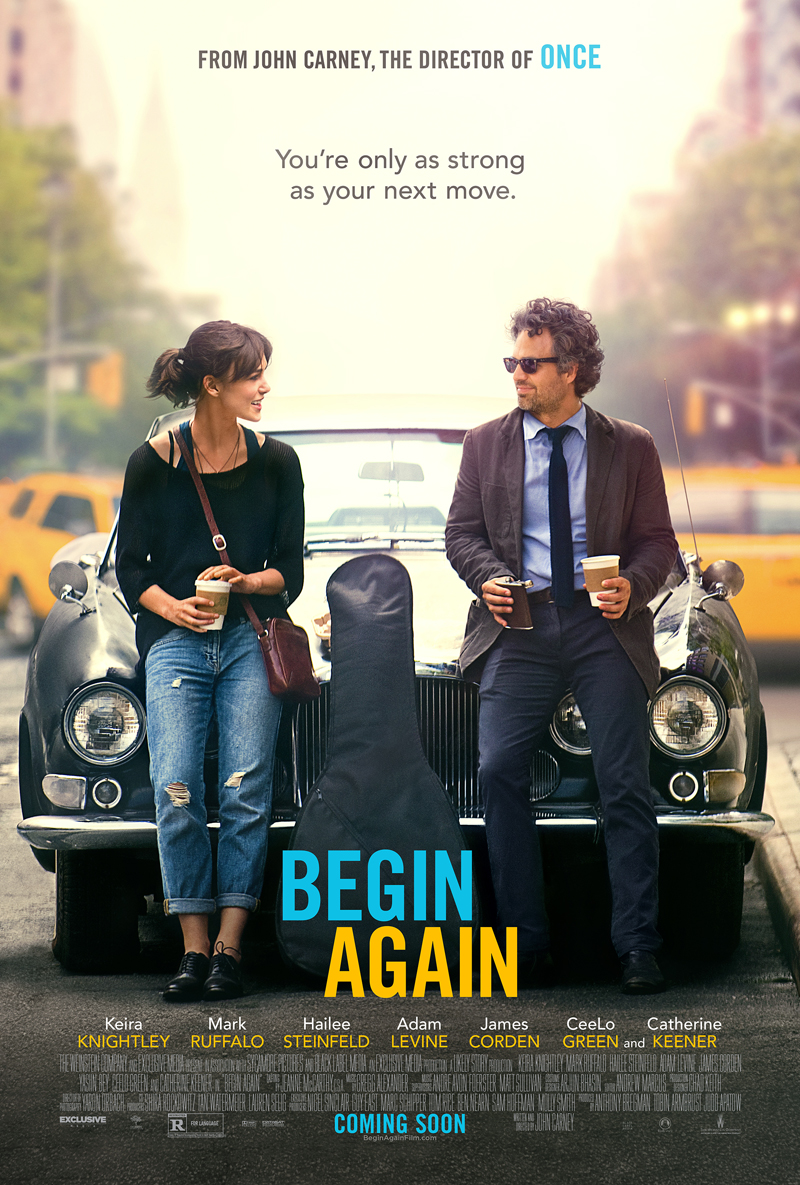
Begin Again

Genre: Drama

Director: John Carney

Writer: John Carney

Cast: Mark Ruffalo, Keira Knightley, Adam Levine, Hailee Steinfeld, James Corden, Catherine Keener, Ceelo Green

Running Length: 104 minutes

Synopsis: Gretta (Keira Knightley) and her long-time boyfriend Dave (Adam Levine) are college sweethearts and songwriting partners who decamp for New York when he lands a deal with a major label. But the trappings of his new-found fame soon tempt Dave to stray, and a reeling, lovelorn Gretta is left on her own. Her world takes a turn for the better when Dan (Mark Ruffalo), a disgraced record-label exec, stumbles upon her performing on an East Village stage and is immediately captivated by her raw talent. From this chance encounter emerges an enchanting portrait of a mutually transformative collaboration, set to the soundtrack of a summer in New York City.

Review: As the old saying goes, lightning doesn’t strike twice – John Carney’s breakout indie hit, Once, was an excellent motion picture that won the hearts of many audiences and critics back in 2007, and also spawned a multi-Tony Award winning musical – and true to this, Carney’s Begin Again doesn’t manage to reach the heights that Once did. It’s essentially a variation on the same theme that Once covered, except with bigger stars and higher production values, but when evaluated on its own merits, Begin Again is still a charming enough movie, featuring some really great songs and generally authentic performances from the main cast.

It can get a little too cheesy for its own good (an example would be the music-sharing sequence), but Begin Again comes across as being a bit more genuine than the typical Hollywood romantic comedy. Mark Ruffalo and Keira Knightley share a good onscreen chemistry, and the “will they or won’t they” romantic tension between the two doesn’t come across as feeling too forced. However, the film suffers when the focus shifts away from this pairing – Adam Levine and Catherine Keener’s characters simply aren’t as fleshed out, and these extraneous plot threads become distracting and make the film feel a little more unfocused. The biggest offender would be the inclusion of Ceelo Green playing Ceelo Green – not only is his flashback sequence edited rather confusingly, there seems to be no good reason for his presence except perhaps to increase the celebrity count of the film.

Much like Once, the songs in Begin Again play a very important role, perhaps more so than some of the actors. And in this aspect, the film has managed to deliver in spades. Gregg Alexander (of the New Radicals and the one hit wonder “You Get What You Give”) co-wrote the songs, and many of these songs are catchy, heartfelt and (surprise surprise) decently performed by Keira Knightley. Adam Levine of course does a bang up job as well, and his rendition of Lost Stars is exemplary. The music manages to imbue even some of the more mediocre moments of Begin Again with a magical touch, and in a season filled with mega-budget action blockbusters, one could not really ask for more from a small-ish film like this one.

Rating: * * * (out of four stars)
Standard

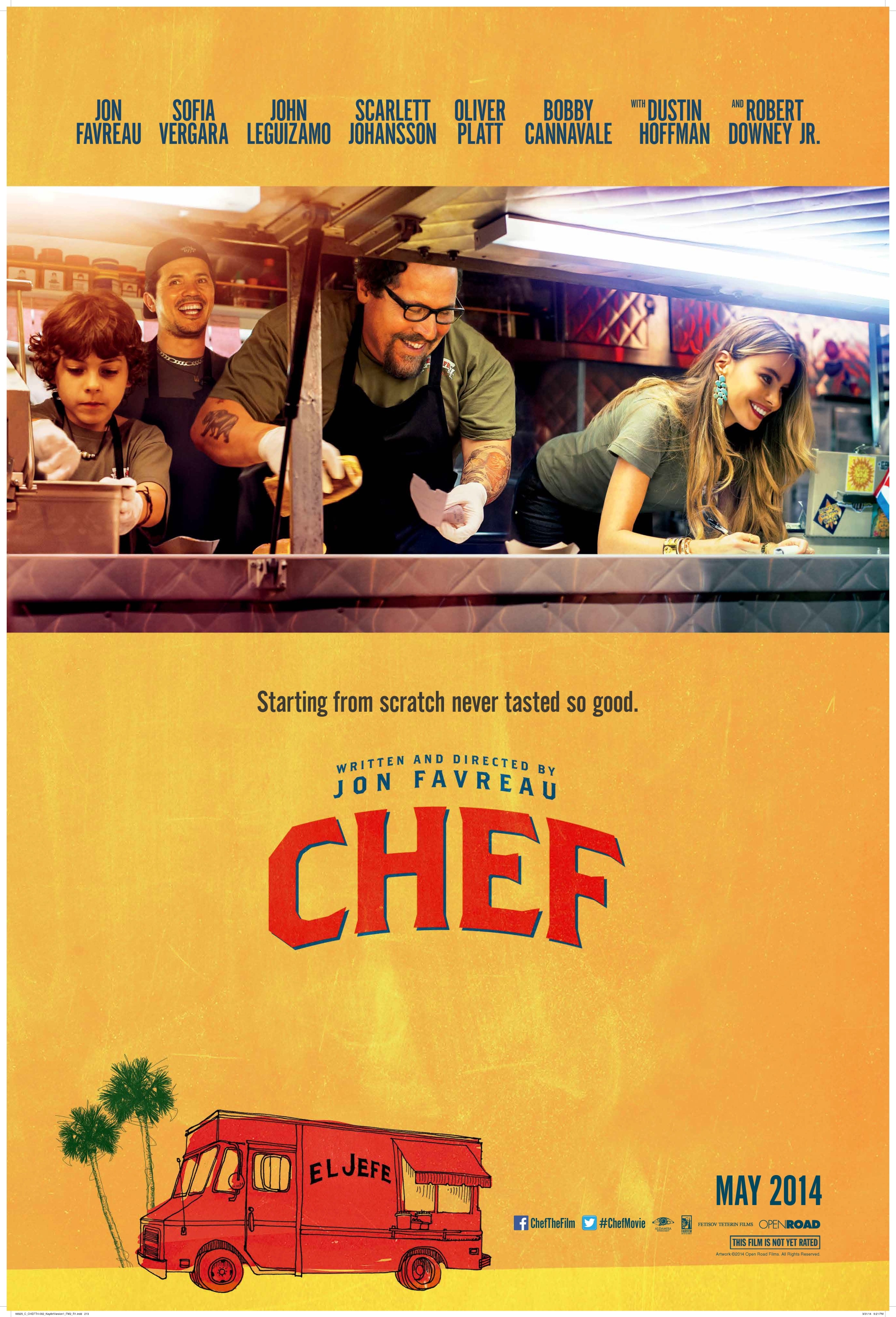
Chef

chef-poster

Genre: Drama

Director: Jon Favreau

Writer: Jon Favreau

Cast: Jon Favreau, Sofia Vergara, John Leguizamo, Scarlett Johansson, Dustin Hoffman, Oliver Platt, Bobby Cannavale, Amy Sedaris, Emjay Anthony, Robert Downey Jr.

Running Length: 115 minutes

Synopsis: A chef who loses his restaurant job starts up a food truck in an effort to reclaim his creative promise, while piecing back together his estranged family.

Review: Most current moviegoers will know Jon Favreau for the three action blockbusters he directed in the last decade – two successful Iron Man episodes (the first and second) and the not-so-great Cowboys and Aliens. Chef represents a return to his indie movie roots, and despite the big names in the cast, is a refreshing, small-budget movie with good intent and an excellent soundtrack. It also features a good amount of “food porn”, so viewers beware – any attempts to watch this movie on an empty stomach will be rather detrimental to health.

The premise of the film is a simple one, and the denouement is a given, but Favreau is happy to take his time getting there – like a true road trip, the enjoyment of this movie lies in the journey and not the destination. Favreau himself is excellent in the lead role of Chef Casper, but it’s the great chemistry that he shares with two other cast members – John Leguizamo’s Martin and the young Emjay Anthony as his son Percy, that truly makes the film special. There’s an easy, seemingly genuine camaraderie between the trio, and this makes their road trip across America a very enjoyable one.

Not only does Chef feature a fair amount of hunger-inducing food and cooking sequences (the grilled cheese sandwich scene is destined to become the de facto instructional video for making grilled cheese sandwiches), but there are also great scenes that showcase the sights and sounds of the various cities that the food truck passes by, augmented by an eclectic and energetic soundtrack. There’s interestingly a whole occasionally amusing subplot devoted to the usage of social media, but it unfortunately come across more like a paid advertisement for Twitter because it feels a little too staged.

Sure, there are elements that don’t work too well – the family drama in particular pretty much fails to take off.  It requires viewers to be vested in characters that just aren’t all too fleshed out (Sofia Vergara in particular seems to have simply transplanted her role in Modern Family), and Favreau goes off the deep end a fair bit with the schmaltz. And whilst it’s clear that Favreau has great access to big-name stars, the cramming of a good number of celebrity cameos doesn’t really do much for the film either. While Chef may not work as a degustation menu, it certainly satisfies as an amuse-bouche, and while it’s clearly a vanity project for Favreau (perhaps more accurately termed an anti-vanity project in this case), it does far better than the usual crop of films in this niche genre.

Rating: * * * ½ (out of four stars)

Standard

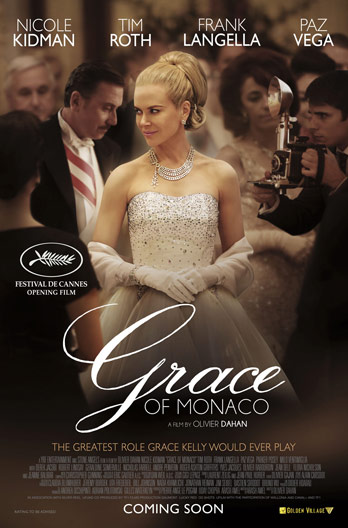
Grace of Monaco

Image

Genre: Drama

Director: Oliver Dahan

Writer: Arash Amel

Cast: Nicole Kidman, Tim Roth, Frank Langella, Paz Vega, Parker Posey, Milo Ventimiglia, Derek Jacobi, Robert Lindsay   

Running Length: 103 mins

Synopsis: The story of former Hollywood star Grace Kelly’s (Nicole Kidman) crisis of marriage and identity, during a political dispute between Monaco’s Prince Rainier III (Tim Roth) and France’s Charles De Gaulle (Andre Penvern), and a looming French invasion of Monaco in the early 1960s.

Review: If Nicole Kidman was looking to end her poor run at the box office, Grace of Monaco is not going to be the one to do it. Critically ravaged at Cannes, the film – though not as bad as what early reviewers have indicated – is still a terrible misstep in more ways than one. Perhaps the title card that opens the movie already says it all – instead of the typical “based on a true story”, it is instead “a fictional account inspired by real events”, which suggests that much of what transpires on screen belongs strictly in the imagination of Dahan and probably Arash Amel. (I’m quite sure that Grace Kelly’s role in the blockade was far smaller than what was intimated here) I will not be alone in feeling that the film does not do justice to Grace Kelly or any of the other real life characters.

Although Nicole Kidman had obviously put a lot of effort into the role, her portrayal of Grace Kelly remains unconvincing, though one must give kudos to Kidman putting up with the ridiculous extreme close ups that Dahan subjects her to. While it’s understandable that close ups allow the audience to observe the smaller nuances in expression, when the actress’s face is pressed right up to the lens, allowing one unfettered access to even her nostril hairs, I would believe that backing the camera up is the wiser thing to do. There’s absolutely no chance that this performance would generate any Oscar buzz, although it had seemed promising before the film was released.

There’s also a sense that no one really knew what direction to take this movie, which echoes the equally misguided Diana from last year, starring Nicole Kidman’s good friend Naomi Watts. The film is alarmingly superficial in its treatment, and the audience neither gets an in-depth look at Grace Kelly nor at the 1962 blockade, which means it essentially is a daytime soap opera with a bigger budget. That parts of it isn’t even real just makes things worse – were the real life developments not interesting enough that it required pointless re-imagination?  

There are nice things to look at in the film, as it boasts exotic locales, attention to period detail, and a lavish set design. Fans of Nicole Kidman will surely be placated by the numerous costume changes she goes through, as well as the beautiful jewelry she dons throughout. However, it’s extremely difficult to muster up a genuine recommendation for the film based simply on these positives, and one cannot help but feel that Grace Kelly and Nicole Kidman both deserved something better than this.

Rating: * ½ (out of four stars)

Standard

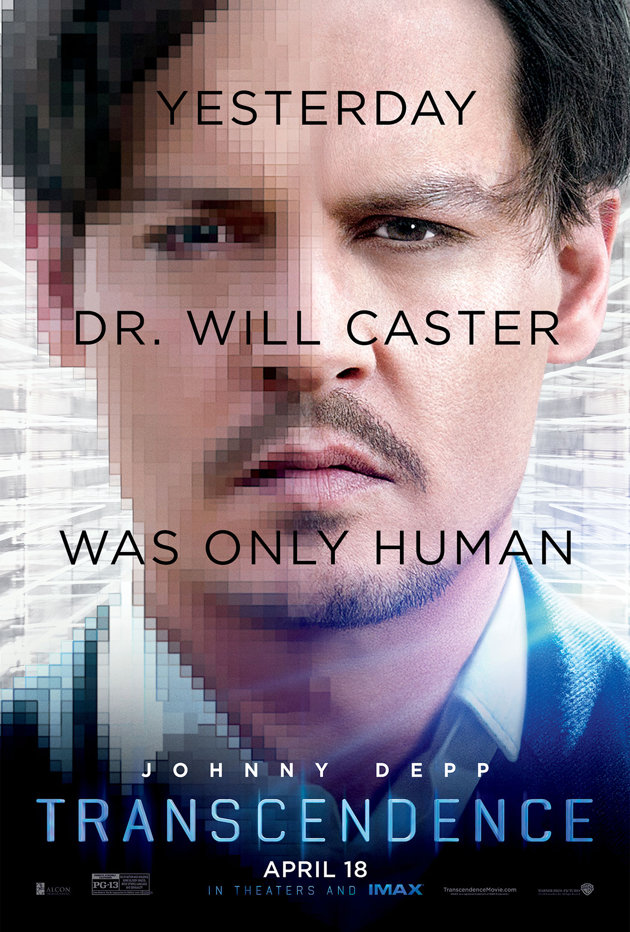
Transcendence

Image

Genre: Sci-Fi, Drama

Director: Wally Pfister

Writer: Jack Paglen

Cast: Johnny Depp, Rebecca Hall, Paul Bettany, Morgan Freeman, Cillian Murphy

Running Length: 119 mins

Synopsis: Dr. Will Caster (Johnny Depp) is the foremost researcher in the field of Artificial Intelligence, working to create a sentient machine that combines the collective intelligence of everything ever known with the full range of human emotions. His highly controversial experiments have made him famous, but they have also made him the prime target of anti-technology extremists who will do whatever it takes to stop him. However, in their attempt to destroy Will, they inadvertently become the catalyst for him to succeed—to be a participant in his own transcendence. For his wife Evelyn (Rebecca Hall) and best friend Max Waters (Paul Bettany), both fellow researchers, the question is not if they can… but if they should. Their worst fears are realized as Will’s thirst for knowledge evolves into a seemingly omnipresent quest for power, to what end is unknown. The only thing that is becoming terrifyingly clear is there may be no way to stop him.

Review: Transcendence is Wally Pfister’s first directorial outing after a good number of collaborations with Christopher Nolan as his DP, and it’s clear to see that Nolan has made more than an impression on Pfister’s directorial style – it’s almost as though Pfister had morphed into a Mini-Me version of Nolan, except without as much directorial flair. Pfister had set out to make a weighty, cerebral sci-fi movie in the mould of Inception, but the end result is more heavy-handed than weighty, more befuddling than thought-provoking. While it starts off intriguing and tries its best to captivate the audience, the movie sags under its own overplotting, eventually imploding in a most spectacular fashion into a hole-ridden, completely unbelievable denouement, after going nowhere with its plot for more than an hour.  

There are certainly things to like about Transcendence – the film is handsomely shot (on 35mm film no less), and both Rebecca Hall and Paul Bettany do a good job of being the focal points for much of the movie. Paul Bettany in particular turns in a particularly heartfelt performance, and becomes the emotional centre of Transcendence, and though it is definitely not intentional, Bettany becomes the person to root for in the film, eclipsing Rebecca Hall despite her continual presence. The technobabble is at least interesting for the first few reels, and the film does try its best to make a point about the over-reliance on computers and technology that plagues all of us these days.

However, for every positive aspect, negative aspects abound. The leading name on the poster may have been Johnny Depp, but he disappears for most of the movie, and given that he is playing an AI version of himself, it perhaps can be forgiven that his performance is flat and uninspired. The same goes for the rest of the supporting cast apart from Hall and Bettany, who are given nothing much to do except be devices for exposition. Even the usually great Morgan Freeman fails to impress, and that’s when you know something has gone awry.

Transcendence also makes the fatal flaw of trying to be smarter than the audience, but then actually not following through on the attempt. It’s immediately apparent – the movie is told from a flashback perspective of Max Waters, which essentially gives the ending away in the first five minutes. Usually this would mean that the movie has another reveal up its sleeves, but that’s not really the case in Transcendence, which leads one to question why the narrative structure was picked.

And in the second half of the movie, where nanotechnology plays a huge role, the script time and again requires audiences to fully suspend their disbelief and to accept the proceedings at face value. The technology is absurd, and the logic is nonexistent – this may be acceptable in a typical Summer action blockbuster, but not in a movie that’s trying so hard to be an intellectual one. It’s ineffective and rather insulting to the audience to be quite honest, especially given how the plot eventually writes itself into a very tight corner, and then plods to a long-expected but illogical conclusion that the audience has already (literally) seen coming from the start. And true to the shared DNA with Christopher Nolan, Pfister chooses to end off the movie with one final shot that is open to interpretation, much like Inception – the only difference being that I was absolutely not vested to even attempt any interpretation. Transcended, this has not.

Rating: * * ½ (out of four stars)

Standard

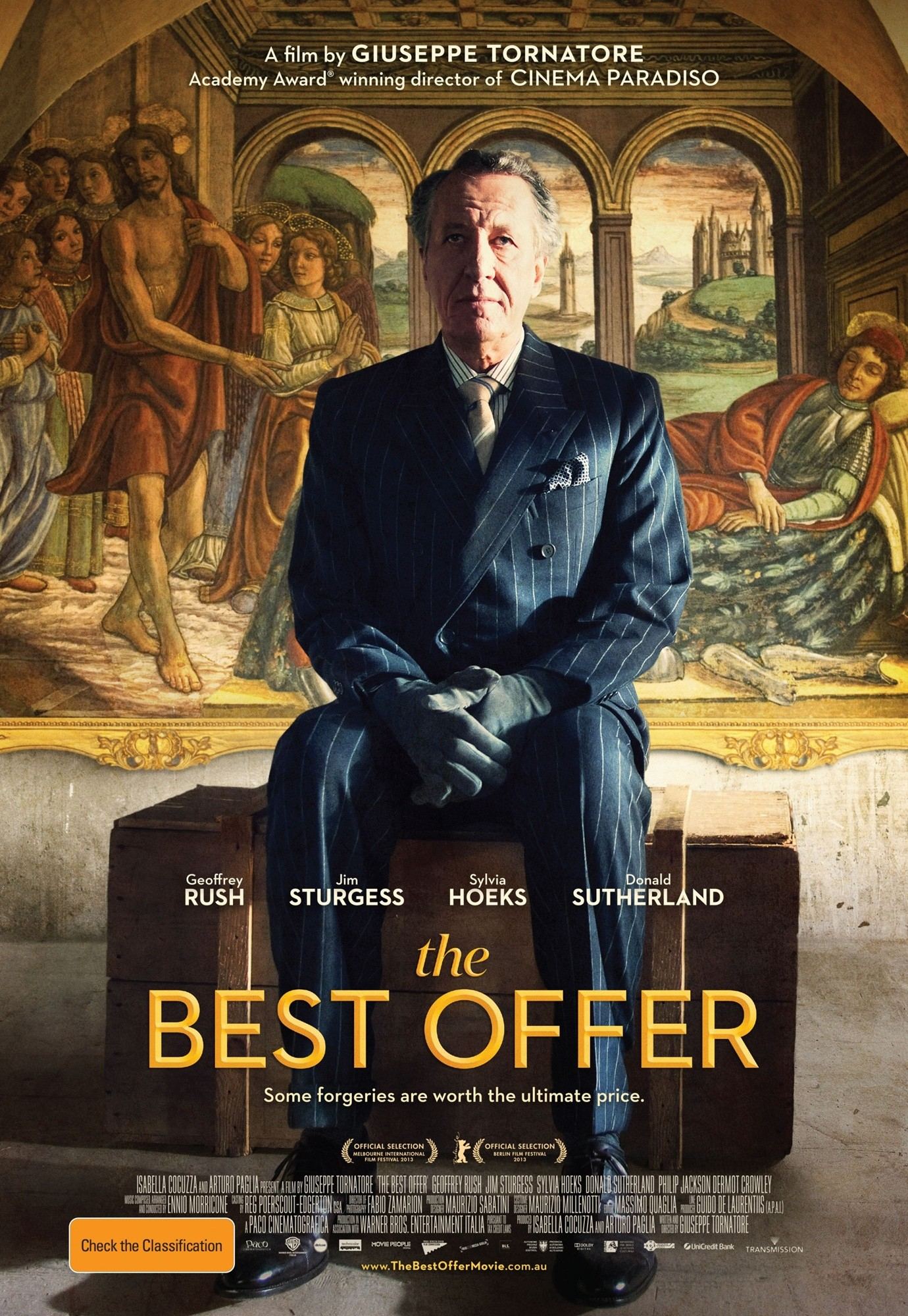
The Best Offer

Image

Genre: Drama

Director: Giuseppe Tornatore

Writer: Giuseppe Tornatore

Cast: Geoffrey Rush, Sylvia Hoeks, Donald Sutherland, Jim Sturges

Running Length: 131 minutes

Synopsis: The Best Offer is the tale of the solitary, cultured Virgil Oldman (Geoffrey Rush), no longer young, whose reluctance to engage with others is matched only by the dogged obsessiveness with which he practices his profession of art expert and auctioneer. Asked to handle the valuation and sale of a mysterious woman, Claire Ibbeston’s (Sylvia Hoeks) priceless heirlooms, Virgil finds himself enveloped by a passion that will transform his grey existence forever.

Review: The Best Offer is an uneven offering from Giuseppe Tornatore, whose body of work can be best described with the same word – uneven – since the early career success of Cinema Paradiso. Directed and written by Tornatore, The Best Offer is an excellent showcase of Geoffrey Rush’s thespian skills, and is accompanied by great visuals and a lush score (by Ennio Morricone). However, the rest of the cast don’t fare as well as Rush, and the plot is an extremely convoluted one that eventually does itself in with a flurry of hamstrung, too-obvious twists and turns.

Geoffrey Rush once again proves to be a brilliant actor, especially since he has to portray two aspects of Virgil – the cold, calculative social misfit before he meets Claire, and the more human and vulnerable old man that he becomes after falling for the largely unseen Claire. His performance does veer into the over-dramatic at times, almost a caricature of a crotchety old eccentric, but overall it’s still a very assured and charismatic performance. Sylvia Hoeks unfortunately disappoints as Claire, and worked better as a disembodied voice in the first half of the movie, than the petulant and quite unlikeable (though still beautiful) woman in the second half. One cannot imagine her being attractive even to a social hermit like Virgil, no matter how much the script tries to force this union.

Tornatore also seemed to be unable to practice self-editing, the most evident being a completely baffling subplot with a mechanical automaton that has zero need to be present in the film, except to function as a tool for exposition. The end result is a movie that runs over 2 hours and yet doesn’t justify the running time at all. Over-exposition is the order of the day, and since the finale is so glaringly obvious, the film feels as though it takes forever to reach a foregone conclusion. And yet, so many plot lines are left unexplained that it’s almost frustrating, and the film simply assumes that no one would question the logic (or lack thereof) of the whole venture.

The Best Offer is an offer that’s marginally good, at its best – although highly technically proficient, checking all the requisite boxes for what makes a handsome movie, the film falters and stumbles along, despite an intriguing start. It is rescued solely by Rush’s presence, but the most of the goodwill runs out along the way, and the entire film virtually falls apart in its final, rather disappointing reel.

Rating: * *(out of four stars)

Standard

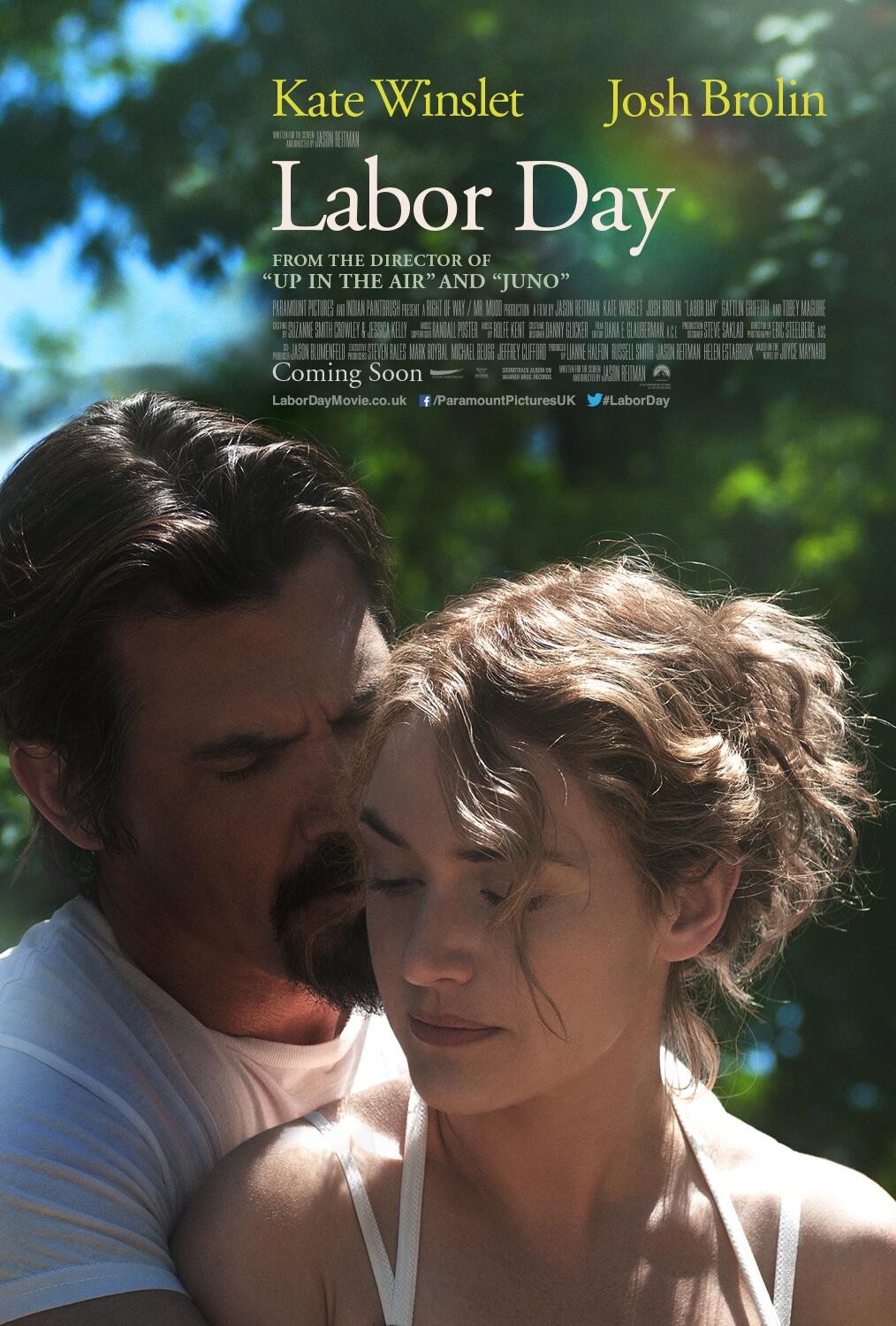
Labor Day

Image

Genre: Drama

Director: Jason Reitman

Writer: Jason Reitman, based on the novel by Joyce Maynard

Cast: Kate Winslet, Josh Brolin, Gattlin Griffith, Clark Gregg

Running Length: 111 minutes

Synopsis: Labor  Day  centers  on  13-­year-­old  Henry  Wheeler (Gattlin Griffith),  who  struggles  to  be  the  man of  his  house  and  care  for  his   reclusive mother Adele (Kate Winslet) while confronting all the pangs of adolescence. On a back-to-school shopping trip, Henry and his mother encounter Frank Chambers (Josh Brolin), a man both intimidating and clearly in need of help, who convinces them to take him into their home and later is revealed to be an escaped convict. The events of this long Labor Day weekend will shape them for the rest of their lives.

Review: Sentimental to a fault, it’s hard to associate the director of Thank You For Smoking, Up In the Air and Juno to be behind the helm of Labor Day, a movie that would be perfectly at home in the canon of Nicholas Sparks movies, despite it not being a novel written by Sparks. Yet, Jason Reitman not only directed the film, but was also responsible for the screenplay, and it is such a stark departure from his previous work that it’s nearly impossible to reconcile.

Looking past that, it’s easy to see that Labor Day must have had some Oscar aspirations. The film is beautifully shot, and Kate Winslet once again hits it out of the ballpark with her portrayal of Adele. It’s a demanding role that requires the thespian to portray a broad spectrum of emotional states, and yet it has to be done with restraint, appropriate for a love-starved woman who has hidden away from the world. It’s a terrific, engaging performance. Josh Brolin puts forth one of his most charismatic turns ever, and it’s easy to see how anyone would fall for his Frank, who apart from being a convict, is about as perfect a mate as one could hope for.

Despite the great performances by Winslet and Brolin, Labor Day is really too schmaltzy for its own good, resulting in a film that becomes increasingly hard to take seriously. This is particularly apparent in the final reel, where there’s such a massive confluence of unfortunate events that the film firmly detaches itself from reality (and this potentially is more the fault of Joyce Maynard than Reitman, but having never read the novel I cannot say for sure). The film also suffers from mild schizophrenia, none more apparent than the pie-making scene, which seems to draw inspiration from the (in)famous pottery sequence in Ghost, and suddenly switches modes into a cooking program. It is almost as though Reitman couldn’t decide whether to make this a thriller, a romance, a drama or a Food Network special, and so he simply threw everything into the mix (pun not intended).

Labor Day ends up being a film that would work for a very narrow audience – if you loved the Nicholas Sparks movies, there’s a good chance that you will find Labor Day to be a gem amongst the testosterone-fueled pre-Summer flicks of late. One does hope that Reitman’s next project would bring his sharp, satirical eye back into focus, and not be another rather generic, near-mawkish film like this one.      

Rating: * * ½ (out of four stars)

Standard

Dallas Buyers Club

Image

Genre: Drama

Director: Jean-Marc Vallee

Writers: Craig Borten & Melisa Wallack

Cast: Matthew McConaughey, Jared Leto, Jennifer Garner

Running Length: 118 minutes

Synopsis: Matthew McConaughey stars in Dallas Buyers Club as real-life Texas cowboy Ron Woodroof, whose free-wheeling life was overturned in 1985 when he was diagnosed as HIV-positive and given 30 days to live. These were the early days of the AIDS epidemic, and the U.S. was divided over how to combat the virus. Ron, now shunned and ostracized by many of his old friends, and bereft of government-approved effective medicines, decided to take matters in his own hands, tracking down alternative treatments from all over the world by means both legal and illegal. Bypassing the establishment, the entrepreneurial Woodroof joined forces with an unlikely band of renegades and outcasts – who he once would have shunned – and established a hugely successful “buyers’ club.” Their shared struggle for dignity and acceptance is a uniquely American story of the transformative power of resilience.

Review: There really are only two reasons to watch Dallas Buyers Club – Matthew McConaughey and Jared Leto. Yes, the “based on a true story” account of Ron Woodroof is a somewhat interesting movie, but without the amazing performances from the two leads, the movie would probably have felt much more generic. It’s not a stretch to say that McConaughey in particular carries the movie on his shoulders throughout, and it’s no surprise that he’s the frontrunner for the awards race this year.

McConaughey’s last appearance on the big screen (for most cinemagoers) would have been Magic Mike in 2012, and in Dallas Buyers Club he is a literal shadow of the muscled male stripper portrayed previously. McConaughey lost more than 40 pounds to play Woodroof, but it isn’t simply the weight loss that impresses – this is bar none his best performance in his entire career, a nuanced, ferocious and at times truly moving portrayal of a man stricken with what was then seen as a terminal illness.

Then there’s Jared Leto, who has taken an extended break from the big screen for a number of years to focus on his singing career with 30 Seconds to Mars. Yet he seems to have not lost his previous thespian form, and in his portrayal of the emotionally vulnerable transgender Rayon, we have a wonderful foil to McConaughey’s Woodroof. The movie’s most enjoyable moments are the interactions between the two, and the gradual shift in the dynamics of their relationship convinces because of the excellent chemistry between the two. These are transcendent performances, projecting the film into a whole different league on their own.

Perhaps understanding that this is a performance-driven movie, Jean-Marc Vallee displays very little flair at the helm of the film, and it unfolds pretty much as a straight biopic. There are interesting elements to the plot, especially the protracted “battle” that Woodroof and the FDA engage in, but it does seem to somewhat underplay the paranoia and difficulties that surrounded HIV positive patients in that era. Woodroof’s overcoming immense odds to triumph (somewhat) holds a universal appeal, however, and although the subject matter may not be all that popular with cinemagoers, anyone who’s willing to pay the price of admission will likely find themselves with a rewarding cinematic experience.

Rating: * * * (out of four stars)
Standard